
 Jenny Zhang
Soundstage facilities are indispensable components for projects tailored to support the thriving film production industry and Entertainment in Hollywood District. They differ from general shooting space and ordinary film studios in terms of their unique aspects to provide full array of control for video making teams without too much concern about nuances like calibrating light features for the scene, recording live sound crisply and clearly, extravagant traveling costs to capture footages onsite, etc. In order to achieve the aforementioned functionalities, soundstages are typically massive warehouse like buildings no more than 2 stories with staggering floor to ceiling height. At its core, the design and execution of soundstage require architects not only consider the aesthetic attributes of the monolithic volumes, but put more emphases on articulating the utilitarian feasibility related to structural, acoustical and mechanical disciplines, etc. Architects working on soundstage project would normally have to deal with miscellaneous unconventional design parameters analytically and synthetically in the quest for ideal technical solutions.
Structural Design Specifics
Just like large scale warehouse infrastructure, the horizontal structural members of soundstages are usually characterized by their capacity of attaining exceedingly clear span without intermediate vertical supports, which maximize the flexibility and mobility usage of the space. Moreover, the mechanism to coordinate and support the overhead elements like catwalk levels and external rigging load also constitutes one of the major factors for engineers to determine their structural system. Given the special bases of design and load criteria, truss and pilaster frames are widely use in modern construction industry for soundstages. Longer span between pilasters positioned at the perimeter of soundstage usually calls for speculated engineering for truss design and meticulous calculation when sizing its members. Another spatial vintage of utilizing trusses in composing soundstage skeleton is the ability to provide enough free areas for hvac ductworks and other utilities to pass through the web between top and bottom chords. The rigid assembly of a truss consists of two-force straight members only, either in tension or in compression, so that point loads like external hoisting forces are considered to be applied at nodes occurred in conjunction with each joint within the same two-dimensional plane of the truss per se. Bracing elements would be introduced running in perpendicular direction from truss span and bridged in certain bays to drag the lateral load from the framing members to its designated shear wall components. Lighting grids are typically suspended underside of the bottom chords to provide expanded freedom for fixture attachments and illumination control in each customized set.

Diagram by Jingwen He, Soundstage of Echelon Studio at Television Center

Courtesy Jingwen He, Catwalks supported by the bottom chord of truss in soundstages of NBCUniversal
Acoustic Design Specifics
Soundstages offer tremendous acoustic benefits to filmmakers for recording live sound in good quality without garbling as they were conceived originally in response to the advent of sound in film production era. Acoustic analysis and soundproofing requirements inside the stage boxes are paramount factors for architects to opine on when detailing the assemblies for soundstage buildings. Based on acoustical report and fundamental inputs from acoustic consultants, architects might specify recommended thickness of insul-quit, a proprietary sound absorbing blanket catering for Hollywood’s standard as the appropriate acoustical finishes wrapping around all interior wall and ceiling surfaces. Besides installation of insul-quit, wall partitions are supposed to carry STC 55 or higher ratings for airborne noise control in soundstages. Minium partition for STC 55 assembly is likely to call out double studs with air gap and full cavity batt insulation faced with multiple layers of type X gypsum board. Alternatively, sound-absorptive material with an indicated minimum NRC value could be acceptable for horizontal assembly applying the entire ceiling surface as well.
On the other hand, vibration analysis report might be an included alternate scope for acoustic professionals to examine structural vibration generated by vehicular movement, if there are proposed parking garages adjacent to soundstage facilities. For instance, there are 4 soundstages sitting directly above P1 parking level at South Parcel of Echelon at 6311 Romaine, which renders potential concerns of structural-borne noise exceeding background noise criteria inside the stages and floor vibration interfering with production activities regarding perceivable camera shakes or visible motion of lights, etc. Additionally, air-borne noise isolation from the garage to the stages need to be addressed by separate cover of horizontal assembly in this case.
On top of the sound attenuation strategies mentioned above, equipment and featured products as well as related hardware specified in soundstages need to be meticulously engineered and reconciled to meet design NC levels and general noise reduction coefficient. Based on mitigation recommendation by acoustical engineer, architects will need to design the corresponding assembly to provide sufficient acoustic insulation for any noise source that might affect the audio production in the stages.
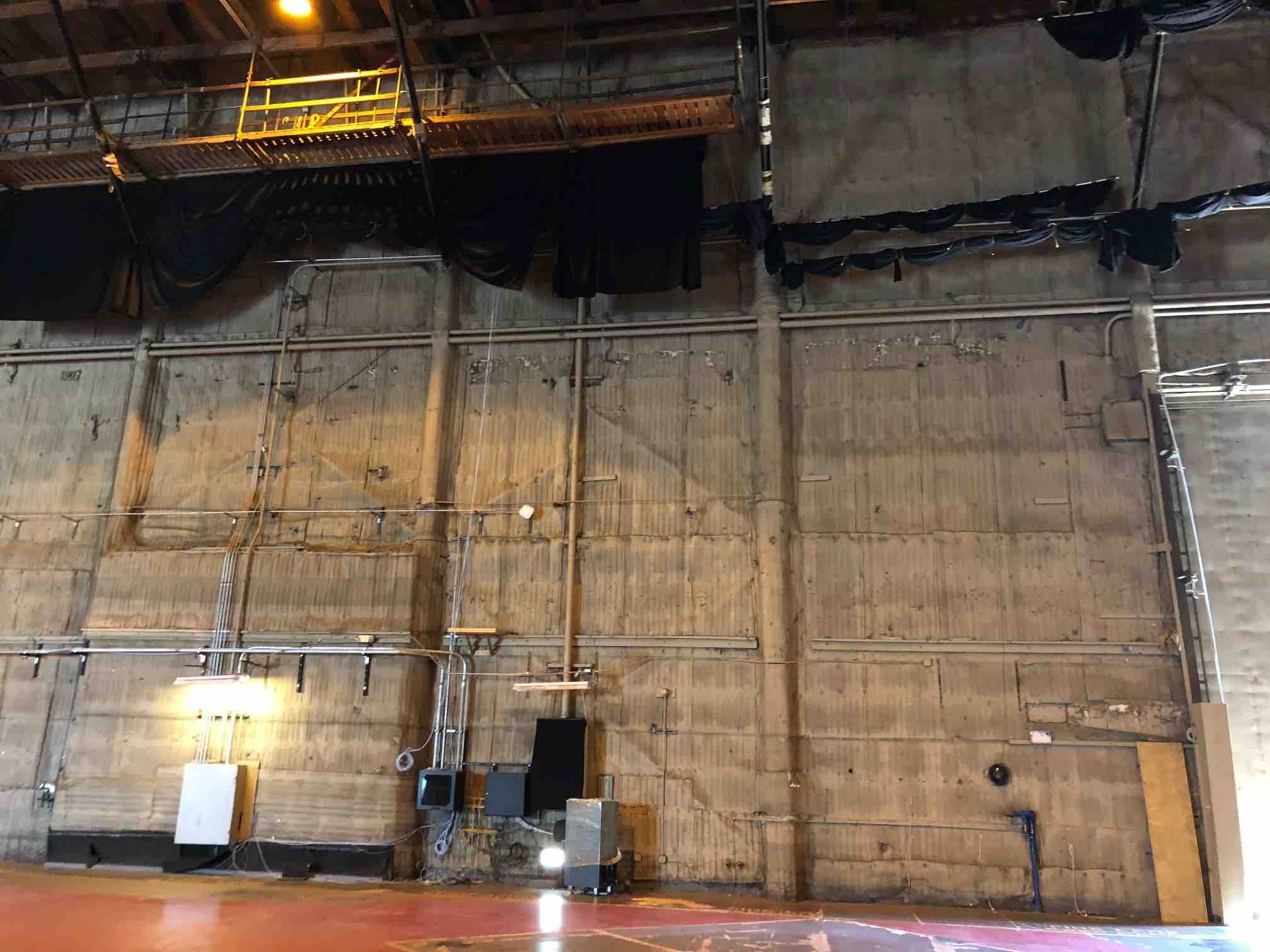
Courtesy Jingwen He, Insul-quit application at soundstages in NBCUniversal’s Campus
Mechanical Design Specifics
HVAC system for soundstage project is yet another major thread interrelated with acoustic performance and mechanical integration for thermal control. Architects and engineers generally will speculate different variables comprehensively in DD phase to come up with a feasible scheme for ductwork layout. Provided the NC rating to meet on BOD, air distribution within soundstages at Echelon Romaine Television Center shall be acoustically lined low velocity, which yields much larger duct sizes to provide equitable cfms for each stage. In light of the ultimate goal to maintain NC25 every nook and cranny in mechanical routes, the viable strategy is expected to look at air velocity in each segment of distribution ducts from relevant distance to supply/return outlets. Main ducts and primary branch lines away from grille openings are allowed to run higher at air speed while velocity in smaller ducts upstream of diffusers need to be held under certain limit to retain acceptable free air velocity at outlets. Architects also need to make sure that the engineer is right sizing their ducts and the distribution plan could work in concurrence with structural framing and overhead clearance above catwalk path.
Besides efforts to coordinate the mechanical layout inside the stages, there is suggested amount of travel distance for main ducts from packaged roof top unit before penetrating the roof and drop into the acoustic envelope. Introducing 90-degree elbows for duct routes on roof is preferred acoustically as well. Ductwork outside on the roof might be placed inside the wedge plenum which is acoustically isolated from the stage via vertical silencers, hence the air movement could be faster out from the unit and lower face velocities at their inlets is desirable. Mechanical equipment located above noise-sensitive spaces like soundstages, shall be installed on additional concrete pads atop roof assembly with no cavity and the detailing process should be overseen by architects alongside with engineers in responsible control. Mechanical noise mitigation strategies will be furthered reviewed when sound data analysis containing octave-band sound power levels is conducted by acoustic consultants.
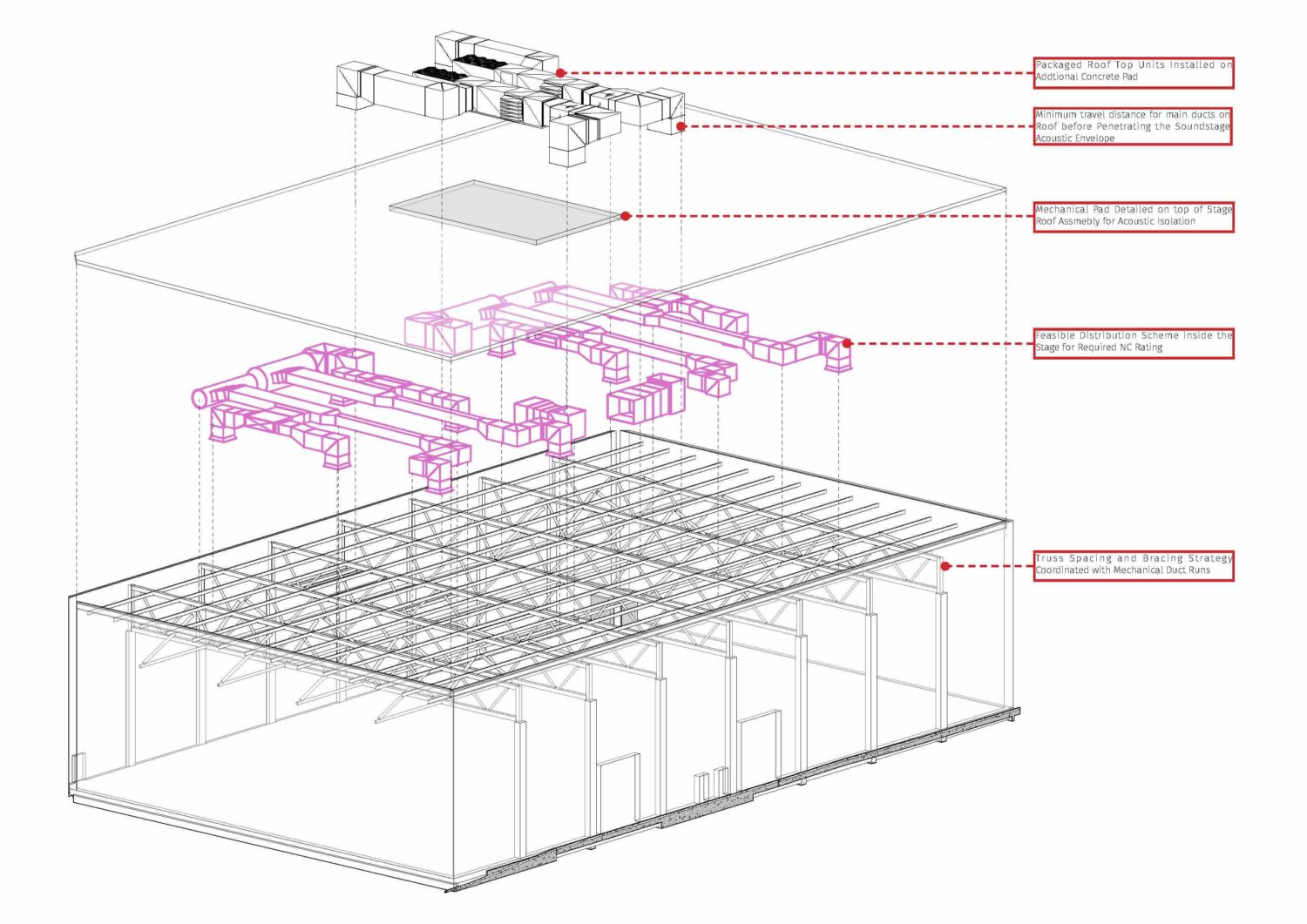
HVAC Diagram by Jingwen He, Soundstage of Echelon Studio at Television Center
Soundstage Opening Specialities
Big openings at soundstage facilities are typically scarce and they will need to accommodate mobility of heavy machinery and necessary props arrangement, so that the architectural appurtenances are slated to carry both acceptable acoustical rating and adequate clearance for maneuvering purposes.
- Truck Access Doors (Elephant Doors)
Soundstages need to provide sliding door assemblies for truck access, preferably cast in field normal weight concrete panels for no less than STC 54 sound protection. Fully equipped by motor operation with required warning sounds and automatic clearance stops and overrides, those hefty concrete elephant doors come with deep bottom trench and structural implications. Independent concrete door frames and header beams or integrating supports by structural members at studio are possible options to articulate the featured doors in place. In light of the need for large industrial doors with ever stringent acoustic requirements for major studios in Hollywood, architects often specify proprietary products by Titan Specialty doors or GPS Specialty Doors, the certified manufacturers in current market capable of providing custom acoustic doors with the unique sound seals allow for maximum construction tolerances within the building envelope.

Courtesy Titan Specialty Doors, Elephant doors by Titan, https://www.titanspecialtydoors.com/
- Operable Acoustic Partitions for Stage Demising walls
Ownership might choose to demise massive soundstage buildings to cater for different content creations. Different studio divider assemblies could be designed to validate flexible extent of clear opening sizes on them, while ensuring that the noise barrier did carry the expected sound rating.
Soundstage at Echelon TVC adopted dual operable acoustic partitions for stage demising assembly as the base of design, a specific model manufactured by Advanced Specialties Inc. or equal. A pair of bi-parting stacking pocket doors made of 4″ thick panels with 14ga steel faces is acoustically rated at STC 53, which technically maximized the versatility between substages when the dividers are fully opened. Demising walls are top supported by secondary framing perpendicular to trusses with continuous floor tracks above downturn beams at ground level. Alternates included bottom supported operable steel acoustic doors by Titan Specialty doors or GPS Specialty Doors, with maximum clear width at each partition conditioned by 40′-0″ high; or large elephant doors mounted on CMU demising walls in equitable acoustic performance.

Courtesy Advanced Specialties Inc, Operable bi-parting pocket doors, https://advancedequipment.com/products/panel-construction/
In a nutshell, architects working on soundstage project not only have to mull over applicable code provisions in space planning phase, specifically looking at chapter 48 of California Fire Code regarding motion picture and television production studio and sound stages for provisions at egress components as well as occupancy classification, but also orchestrate various factors and work closely with technical specialists to generate architectural solutions in well-coordinated and code-compliant ways.