
 Michele Stueven
On Kristallnacht during WWII in November of 1938, Jewish homes, hospitals, and schools were ransacked as Nazis demolished buildings with sledgehammers and rioters destroyed more than 1,400 synagogues and prayer rooms throughout Germany, Austria, and the Sudetenland. More than 7,000 Jewish businesses were damaged or destroyed.
A few short months later, the Silver Levy of 1939, also known as the Silberzwangsabgabe was instituted, a Nazi decree requiring German Jews to hand over their precious metal possessions, as part of a broader process of persecution, dispossession, and shame.
German Jews stood in lines for hours on the streets at pawn shops waiting to sell their items, which were all meticulously recorded by owner, description, dates, and amount of sale.
The pawnshops were transit stations. They bought the objects from the families under degrading circumstances, which was the whole point of the exercise. There were huge quantities of material that included everyday Judaica like kiddush wine cups, menorahs, Shabbat candlesticks, thimbles, Jewish spice boxes, and silverware. In Munich alone, it added up to almost 10 tons of pure quality silver. The Nazis referred to it as Jewish Silver and about 99.5% of it all was melted down. Two-thirds of the last owners did not survive the Nazi regime and were murdered in death camps.

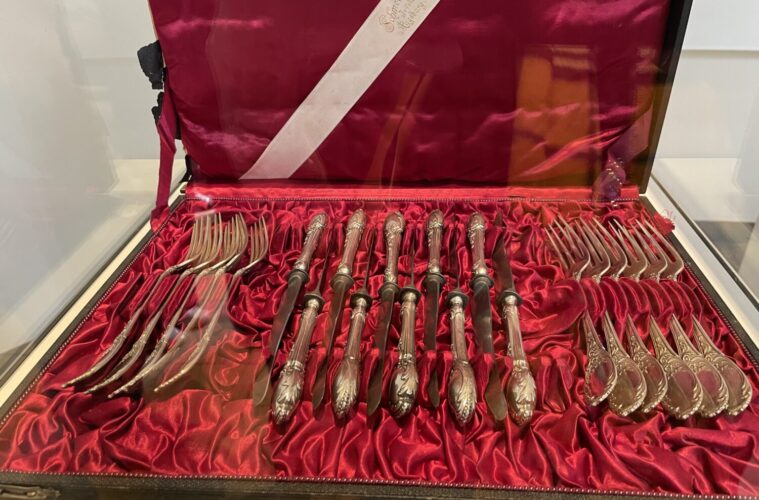
Unclaimed silver items at the Bavarian National Museum (Michele Stueven)
The Bavarian National Museum in Munich was given the opportunity under some problematic circumstances to buy 350 items in 1939 and 1940 that survived the Silver Levy. Until a few years ago, these items sat forgotten and neglected in a cupboard at the museum.
That is until they began haunting Dr. Matthias Weniger, the museum’s Head of Provenance Research when he arrived in 2019. They didn’t belong there; they belonged with their families.
He began researching the items and found an old inventory listing names and descriptions. He tracked down descendants of those families, many of whom had perished during the Shoah in Dachau, Theresienstadt, and Auschwitz, and has personally returned all but 20 of the items. His mission and restitution trip to Israel were documented in a moving film by Liv Thamsen called Dr. Weniger’s Auftrag.
With the support of the Bavarian State Ministry of Science and Art, the Bavarian National Museum has published its acquisition records from 1933 to 1950 online.
At the Forschungsverbund Provenienzforschung Bayern, the Bavarian network for provenance research facilitates the identification of Nazi-looted art in the museum’s holdings. It lists the circumstances of access to works of art that came to the museum between 1933 and 1950. According to the museum, “Not every acquisition during this period (purchase, donation/endowment, bequest, exchange, etc.) has an unlawful, violence- or persecution-related context. For data protection reasons, redactions had to be carried out in some places.”
Last week at a reunion one year in the making, Dr. Weniger brought together about 80 descendants from 20 families from across the world to Munich, for a week-long conference that included the installation of memorial plaques across the city of those relatives who died in the Shoah, walks through historic German Jewish neighborhoods, visits to synagogues, Jewish cemeteries, Dachau and a private tea at the historic Nymphenburg castle, given by H.R.H. Duke Franz of Bavaria, who himself spent 10 months in Dachau because of the royal family’s anti-Nazi outspokenness.

Jorge Feuchtwanger Morales, left, and Dr. Matthias Weniger (Courtesy Bavarian National Museum)
Jorge Feutchwanger Morales, who received a silver cup from Dr. Weniger three years ago made the trip from Spain.
“When I got this email from Munich written in Spanish about items I never knew existed, I thought it was a scam,” Morales told LA Weekly over a traditional Bavarian meal of white spring asparagus and boiled potatoes at the Leib und Seele restaurant in Munich during the reunion.
“It took me a while to go on the internet to determine if there was actually a Matthias Weniger that worked at the Bavarian National Museum and it was legitimate. It turns out it was a dish that had belonged to my great, great grandmother, Theresa Lippman who was the mother of Nina Feuchtwanger, my great-grandmother. I came to Munich to retrieve it and met Matthias in person, a kind and wonderful human being.”
One of Morales’s relatives is Lion Feuchtwanger, an 1884 Munich-born renegade novelist and playwright who flirted with communism. Lion’s grandfather (Elkan Feuchtwanger) and Morales’s grandfather’s grandfather (David Feuchtwanger) were brothers and owned a margarine factory together. Because of his spirited anti-Nazi writings, Lion was targeted by Adolf Hitler, fled Germany, and was granted asylum in Los Angeles in 1941. He and his wife Marta bought the 1927 Villa Aurora in the Pacific Palisades in 1943, which became the hub of bohemia for writers like Thomas Mann and other German Jewish exiles.

Lion Feuchtwanger (Courtesy USC Digital Library. Lion Feuchtwanger Papers Collection)
During the McCarthy era, Lion became the target of suspicion as a pro-Soviet intellectual. He died of stomach cancer in Los Angeles in 1958. His wife Marta continued to live in the villa and remained an important figure in the exile community, devoting the remainder of her life to her husband’s work. Before she died in 1987, she donated her husband’s papers, photos, and personal library to the Feuchtwanger Memorial Library housed within the Special Collections of the Doheny Memorial Library at the University of Southern California. The Villa Aurora was also donated to USC and is landmarked as a Los Angeles Cultural Monument. It will reopen to the public for programs and events again in the fall with virtual events to be held in in May.
In an ironic twist of fate, while the Nazis demolished Munich’s first synagogue built by the Feuchtwangers during the war, the Villa Aurora survived the Palisades wildfires with just some damage to Marta’s beloved gardens. The recent fire was eerily similar to the 1961 Bel-Air fire which Marta described in her oral history.

Marta Feuchtwanger at the Villa Aurora in the 1970’s (Courtesy USC Digital Library. Lion Feuchtwanger Papers Collection)
“I’ve learned so much on this trip and got to know so many people,” said Morales, whose Feuchtwanger family roots run deep in Munich. There’s a street named after the family. “I learned that people here who had items returned are distantly related to me. Another person at the reunion knew some of my relatives that we had no contact with. Most people who got something back from the museum came from prominent families and there were a lot of political marriages at that time, so it’s not surprising that people who came here for this restitution in one way or another are linked to each other.”
Together with USC Libraries and the USC School of Dramatic Arts, the Wende Museum in Culver City will be presenting a program titled Feuchtwanger Refreshed: THE FIRE LAST TIME, which presents the work of USC student playwrights exploring resilience in the face of destruction and community in the face of diaspora on Tuesday, April 29 at the Wende Museum, where much of the villa’s contents were evacuated to during the fires.
There are still some unclaimed silver items left in the Bavarian National Museum. Whether it’s a matter of bureaucracy or finances, they remain in a case waiting to be reunited with their families. Some families have not responded to the museum’s outreach.
“It can be an emotional issue,” says Dr. Weniger. “Some people feel it’s a long journey to make and a costly process just to retrieve a spoon.”

Bavarian National Museum in Munich (Michele Stueven)

Silver Levy descendants in Munich (Courtesy Bavarian National Museum)

After the Palisades fire (Courtesy Villa Aurora)