
 Nia Bowers
One year after the Eaton Fire turned the San Gabriel foothills into a landscape of ash and twisted rebar, a “K-shaped” recovery is defining the future of Altadena. On some blocks, the only thing growing are the weeds around blackened foundations where families are still waiting for insurance checks that no longer cover 2026 construction costs. On others, like the lot belonging to Grammy-nominated artist Aloe Blacc, a different story is being written in steel and glass.
Blacc has spent the last twelve months acting as a lighthouse for a community drowning in bureaucracy. While the vast majority of his neighbors remain caught in a soul-crushing limbo—with fewer than a dozen homes in the burn zone fully rebuilt by late 2025—Blacc’s new residence has risen in a staggering five months. He bypassed the traditional “stick-build” nightmare by opting for a precision-engineered modular home from LiveLarge Home.
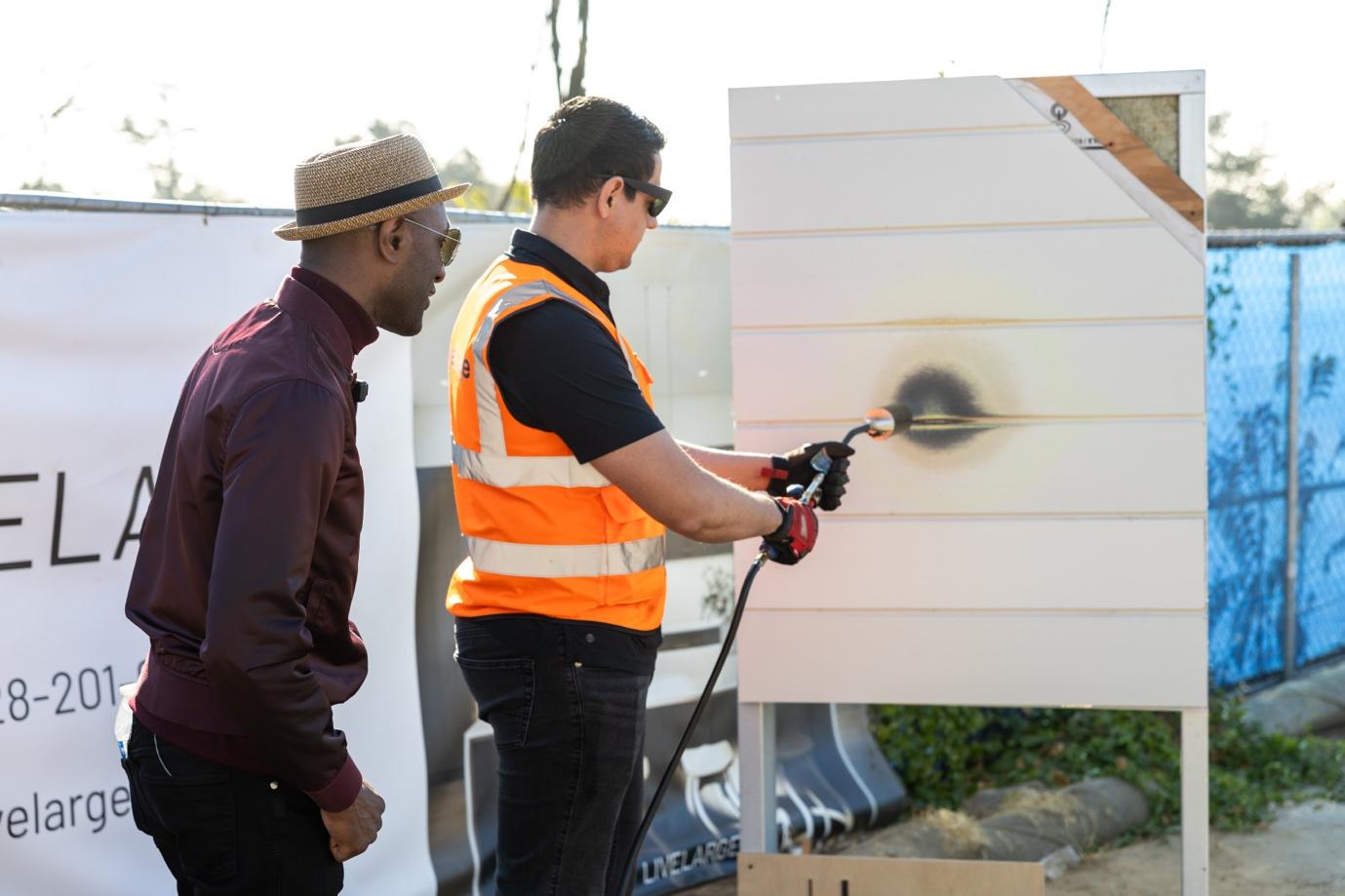
The modular house conducted real-world fire resistance testing, demonstrating external wall system performance under direct flame exposure conditions.
The speed is almost provocative in a neighborhood where a standard build can take years. Blacc’s home arrived in factory-built modules, engineered with light steel frames and specialized cladding designed to withstand one hour of direct flame exposure without ignition. For Blacc, the decision was about more than personal housing; it was a necessary experiment in neighborhood survival.
“Altadena is home for so many,” said Aloe Blacc. “Through my work helping fire survivors, and managing our property loss, one thing became clear: our community can’t survive if rebuilding takes years. Families need permanent, safe homes they can move into quickly, finding ways to rebuild faster without sacrificing quality, that’s how we keep Altadena whole.”
But Blacc’s success highlights a bitter reality of the one-year anniversary. A recent UCLA report reveals that 70% of Altadena homeowners have seen no progress on their lots, paralyzed by “underinsurance” gaps and a permit process that many residents feel is situated to push them out. While modular options offer a faster path, the entry point remains a steep climb for many in Altadena’s historic Black and Latino community, where the destruction was disproportionately high.
The real threat now is “climate gentrification”. Investors are currently scooping up nearly half of the available lots in Altadena, preying on residents exhausted by a “rebuilding apparatus” that many feel is designed to make them quit. As the Santa Ana winds begin their annual howl this week, swirling dust across empty lots, Blacc’s house stands as a silver-lined promise—but one that emphasizes the urgent need to make these tools of survival accessible to the entire community.