
 Michael Atkinson
 If anything, just being alive in America in 2026 should provide enough shock therapy to make you flinch and squint at the very title of the new documentary You Can See Everything. Yeah, that title and the boggled swooning accompanying the film from the Telluride and New York Film festivals. Everything? Can we? The fact is, at three compelling and exhausting hours, you’re not sure exactly what’s revealed, or if anything is — an ironic dance-floor juke that’s being jotted onto the film’s black column by many critics. But the quasi-documentary’s reigning perspective is a studied skepticism, so we can be forgiven, it seems to me, for being suspicious. In the beleaguered realm of nonfiction cinema, that’s some kind of existential issue.
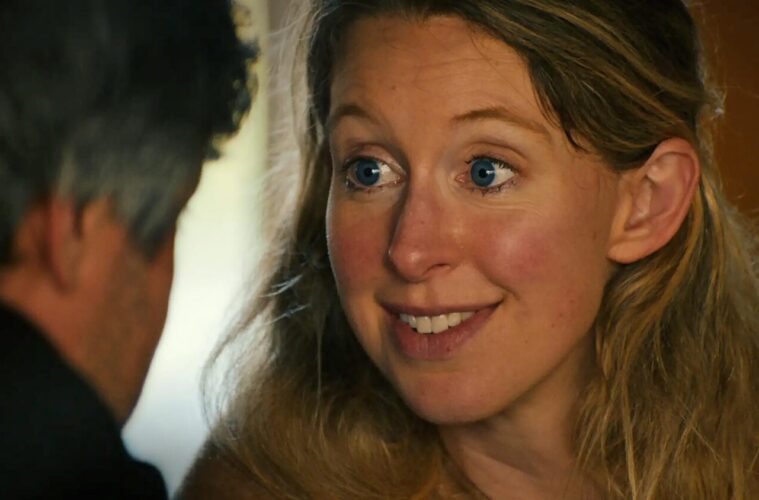
As you no doubt know, the film began shooting in 2023, 34 days before Elizabeth Holmes, the blue-eyed blonde scandal princess convicted of defrauding investors, was carted off to federal prison. Her blood-test invention, Theranos, didn’t work as she said it would; billions were lost and lives were put at risk, a matter the doc barely touches. Now Holmes has two little children with a matching blue-eyed partner, Billy Evans, who seems both solicitously devoted to Holmes and something of a hard-charging narcissist. The filmmakers in the rented Pacific-shore house are doc vet (and culprit behind the recent docudrama semi-debacle Primetime) Lance Oppenheim, who’s largely off-camera, and Nathan Fielder, comic and HBO reality-show satirist, whose watchful, deadpan on-camera presence, listening and questioning from the corner of every room, becomes the film’s primary subject. Or object. Or something.
You feel the film evolve in time, as Fielder (or “Fielder”) becomes increasingly stymied by Holmes and Evans — about exactly what level of truthiness or bullshit they’re operating on, and how brainy-yet-“not normal” Holmes is. With a penchant for shining her vast azure eyeballs toward Fielder without blinking, she’s insistent about being innocent, yet she can’t pin down exactly where things went wrong. When she tries to explain the Theranos technology to Fielder, she either fails or Fielder, in the editing room, makes it seem as though she had. Is she acting, or lying, or “weird”? (Evans is who, whispering to Fielder, says she’s “not normal” and “weird.”)
The pivotal gotcha scene, for Fielder, if not us, quite, is when he shows her the old Abbott and Costello routine “Who’s on First?,” which she claims not to “get.” Fielder’s toast-dry dead stare does a lot of work in the film’s slo-mo peeling of Holmes’s onion, and yet, as the clock ticks down, it’s impossible to say if there’s any takeaway to be had. Unless that’s it: The vaporous not-knowing that makes up our 21st-century landscape, a mapless minefield of quasi-celebrity, publicity, scandal, “reality” TV and social-media-ized news.
I’ll hold my own beer for now, thanks. An unavoidable context here is Fielder himself, who has done his share of muddying our waters. His schtick consists of a sort of disingenuous disingenuousness; he may be, up till now, just a harmless nothing’s-real pot-stirrer, in shows like Nathan for You (2013–2017) and The Rehearsal (debuting almost a year before the Holmes shoot began), but he might be the Devil. If you’ve seen even one episode of The Rehearsal, you know not to trust a single minute of the man’s footage to be what it initially purports to be. How could anyone, even someone as bizarrely guileless as Holmes, invite Fielder into their home to make an ostensibly honest documentary about their lives? She claims not to have known who he was, exactly, but really? Like almost everything in You Can See Everything, her naivete might just be a canard, a scrim, a joke masquerading as truth.
Once Holmes surrenders to the authorities — that much is real — Fielder and Oppenheim’s film faces an abyss, and a two-year jump. And, almost predictably, the participation of Amanda Seyfried, who played Holmes in the cheesy Hulu limited series The Dropout (2022). In fact, Holmes, Evans, and Fielder do sit down and watch the show at one point early on, and Holmes understandably collapses into sickened tears. It’s indicative of Fielder’s barometer that he then, in Holmes’s absence, uses Seyfried to play Holmes again, in reenactments from his film’s first half and in scripted scenes he didn’t get to film with the real woman. (Christopher Abbott, Seyfried’s co-star in last year’s The Testament of Ann Lee, plays Evans.) There’s no guarantee that every lick of it, including the parts that are supposedly real, isn’t scripted. (From the outset, we know there are two cameras working, but scenes are often cut between four or more POVs, which means the filmmakers reshot for coverage.) If this is when your thinking toggles toward the metafictional slippages of the Iranian masters Abbas Kiarostami and Mohsen Makhmalbaf, I’d say consider the relative measures of honesty and empathy. Insofar as you sympathize with Holmes at all, it’s not hard to feel sorry for the woman once she’s out of stir and sits down to see what Fielder and Oppenheim have ultimately done to her.
What we have here is a case of distended Duck Amuck-ness — like the old Chuck Jones cartoon, which entails Daffy Duck battling with the offscreen animator and losing, it’s a movie that fails to coalesce and is therein a collage of its own unmaking. The filmmakers manage to muster a rousing sense of epic mystery, with an anxiously thudding soundtrack and Fielder as the wary-glance sleuth on the trail of “the truth.” But in the end, the questions end up being only about whether Holmes did or did not know that Evans contracted for a share of the new film’s profits. There’s precious little at stake, not unlike in Fielder’s TV shows, which extract their chuckles by crashing very small crises into neurotically elaborate chicanery. Again, we’re looking into the void — a massive essay-experience on epistemological danglers. Tantalizing though it might be, I was relieved when it ended.