
 Will Jones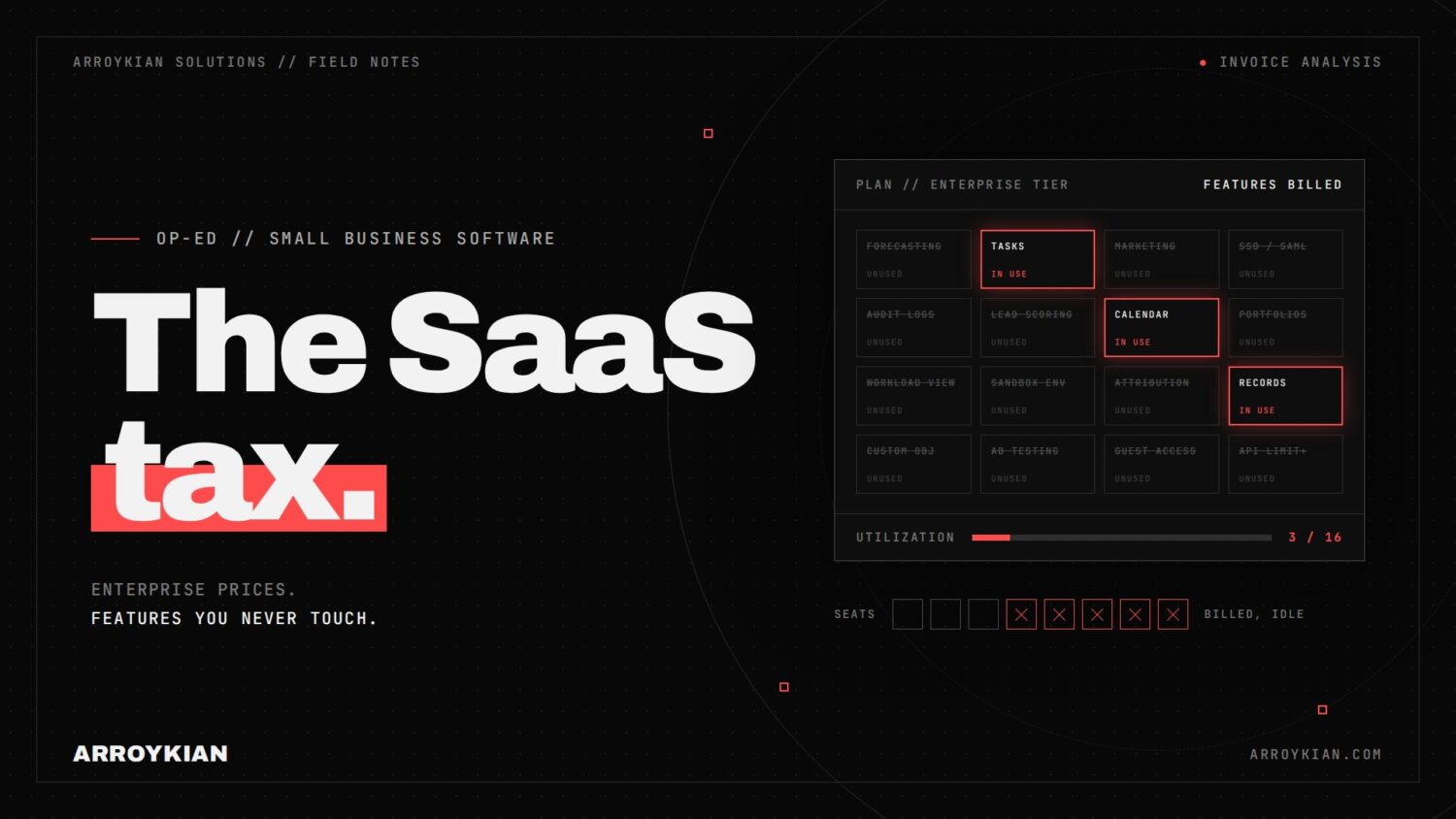
Photo: Arroykian Solutions
There is a line item hiding in almost every small business budget, and nobody put it there on purpose. Call it the SaaS tax: the monthly premium a ten-person team pays for software built for a thousand-person company.
It shows up as per-seat pricing that punishes hiring, as tiers that lock one needed feature behind a bundle of twenty unneeded ones, and as implementation projects that eat a quarter before the tool does anything useful. Platforms like HubSpot and Monday.com are strong products. They were also designed around the budgets and assumptions of much larger organizations, and small teams pay for that design whether they use it or not.
Arroykian Solutions, a software firm founded by former corporate employees who spent years inside that model, argues that the tax is optional.
“We sat on the other side of those contracts,” the company said in a statement. “We watched teams pay for seats nobody logged into, and features nobody asked for, because the one thing they actually needed only came in the expensive tier. At some point you stop calling that a pricing strategy and start calling it a toll.“
The three ways small teams overpay
The first is seat pricing. Every new hire raises the software bill, which means the tool gets more expensive precisely when the business is trying to grow. For lean operations, this quietly turns headcount decisions into software decisions.
The second is tier bundling. A business that needs a calendar tied to a job tracker often has to buy the plan that also includes marketing automation, forecasting dashboards, and integrations it will never configure.
The third is fit. Off-the-shelf platforms ship with fixed assumptions about how work should move. When a team’s process does not match, the team bends its process to the software, or pays consultants to bend the software, or gives up and runs the business on spreadsheets again.
No-code tools promised an exit from all three. In practice, many trade the enterprise price tag for a different ceiling: the moment a workflow falls outside the template, the builder stops building.
What the alternative looks like
Arroykian’s approach starts with the premise that small businesses should only pay for what they use, and should see it working before they commit.
The company’s platform is built as a matrix of interconnected extensions. A calendar module links to a task system, which links to comments, which links to records, and so on across the ecosystem. Instead of selling a fixed product, Arroykian assembles the modules a client actually needs into a standalone application.
That architecture is what makes the sales process unusual. Prospects describe their operation on a single call, and the team configures a working version of the software during that same conversation, populated with sample data so the client can click through their own workflow in real time. Deployment can follow the same day, depending on the client’s preferences.
“The demo is not a slideshow and it is not a mockup,” the company said. “It is the actual software, doing the actual job, before anyone signs anything. If it does not fit, you find out in the meeting, not three months into an implementation.“
The firm has shipped builds for a weekend food operation, a creator management agency, and a multi-property rental network, three businesses with nothing in common except that none of them fit a standard template. Its own executive planning system, built on the same infrastructure, went from concept to production in a day.
Built for how teams will work next
Arroykian’s builds are also designed with AI tools in mind. Each application can connect to any AI assistant through the Model Context Protocol, the emerging open standard that lets AI systems read and act on business data directly. In practice, a team can manage records, tasks, and schedules through the AI tools it already uses rather than clicking through another dashboard. The company is also exploring in-house assistants that could reconfigure a client’s system on the spot.
That matters for the SaaS tax argument. As AI assistants become the front door to business software, paying a premium for an elaborate interface makes less sense. What matters is whether the underlying system fits the business and can talk to the tools around it.
The case against the toll
The larger platforms are not going anywhere, and for enterprises with complex compliance needs and large IT departments, they often remain the right choice. Arroykian’s argument is narrower and harder to dismiss: a small business should not be subsidizing features built for someone else.
“Software should get cheaper to run as a business gets smarter about what it needs,” the company said. “Right now, for most small teams, it works the other way around. That is the part we are trying to break.“
Arroykian Solutions currently operates without outside funding and focuses on small and mid-size businesses in Southeast and Central Asia.