
 Nia Bowers
In May 2024, WalgadaKan Good, Ssalon, an exhibition on migration and queerness, opened at two venues at once: Project Space Los Angeles and Space Mirage, an art space in Seoul’s Euljiro neighborhood. It brought together thirteen artists, among them Star Montana, whose ongoing series documents her family in East Los Angeles. Ji Yoon “Guava” Rhee, then an assistant teaching professor at Penn State, proposed the exhibition and co-curated it with Space Mirage through project ieerie, the curatorial duo she runs with Kay Seohyung Lee. It was supported by Penn State and the Korea Arts Management Service, and its catalog opens with an essay by Rhee that moves between Korean and English mid-sentence.
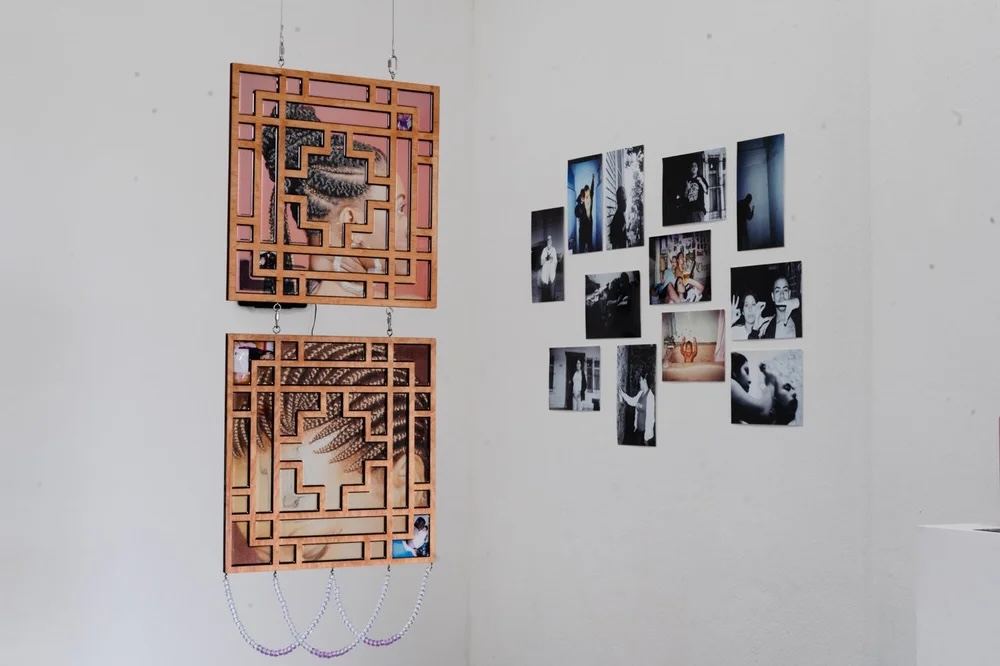
Installation view, WalgadaKan Good, Ssalon, Project Space Los Angeles, 2024.
Rhee was born in Daegu, South Korea, and has been based in Philadelphia since 2024, where she is a Lecturer at the University of Pennsylvania teaching 3D computer modeling and animation. She and Lee founded project ieerie, and in 2023 organized let me know you are alright at Penn’s Charles Addams Gallery with support from Sachs grant” 34 student artists from six Philadelphia institutions, a published catalog and, for many of the artists, a first exhibition. She is also a member of Grizzly Grizzly, the Philadelphia collective founded in 2009 whose members curate other artists’ work rather than showing their own. As an artist, her own work takes up queer desire and the Korean diaspora through reconstructed autobiography.
Her current exhibition, In Other Words, pairs Philadelphia artist Rachel Hsu with Eunhoo Jo, who co-organized WalgadaKan Good, Ssalon as a member of Space Mirage and designed its catalog under the name zozo. It runs at Grizzly Grizzly through November 1 as part of Collective Futures, a citywide festival of Philadelphia’s artist-run galleries.
Q: Your catalog essay for WalgadaKan Good, Ssalon switches between Korean and English mid-sentences. Why write it that way?
A: Because that’s how a lot of immigrants actually talk, and some things are just not translatable. For me it goes back to how I learned English. In the 2000s, a lot of Korean families sent their kids to English-speaking countries as young as they could. At nine, I was sent to live with distant relatives in Anaheim Hills and go to a private elementary school in Fullerton. In Korea I was the loud kid who got scolded for talking before thinking. In California I became the kid who thought so long before talking that I usually didn’t say anything in school. I learned English by reading the room all day. There’s a Korean word for that, nunchi.
My mother stayed for the first six months, and she made me practice ordering. At Starbucks she’d wait in the car while I went in. I asked for an iced caramel macchiato, and the guy at the counter couldn’t understand my pronunciation or my description of the drink. In the end I did get a drink – it was a lukewarm black coffee with cinnamon on top. After enough “Can you say that again?” I learned to feel humiliated without anyone having humiliated me. The drive-thru was the one place she had to do the ordering. I loved sitting in the back while she was the one struggling, waiting for her to hand my McNuggets and orange juice.
Q: You’re an artist, a curator, and you teach 3D modeling and animation at Penn. How do those fit together?
A: Honestly, teaching is intense during the semester, but it comes with a long summer break, and that gives me time for independent projects. The two aren’t really separate, though. I curate exhibitions for students as part of the job, like Rendering in Progress at Charles Addams Gallery in November 2025, so curating is part of the school year too. I see all three as part of one practice.
Q: How did a show end up in Los Angeles and Seoul at the same time?
A: I was drawn to L.A. first, because of Koreatown and the size of its immigrant population. Then I thought it would be interesting to connect that to the diaspora in Korea, people from other countries who live there. So the show opened in both cities. We worked with Space Mirage mostly over Zoom. After COVID everyone was used to that, so it wasn’t hard, except for the time difference. The opening performance, by David Jongsung Myung, who’s based in Germany, streamed on Instagram Live at 8 p.m. in Seoul, 1 p.m. in Berlin and 4 a.m. in L.A.
Q: In Other Words pairs Eunhoo Jo, who you organized a show with, and Rachel Hsu. How did that come about?
A: WalgadaKan was an independent project on a limited budget, and we figured a lot out as we went. Eunhoo was someone I could lean on the whole time. Later I went to her solo show, and the work was so good I knew I wanted to curate her someday. This show only has her fabric work, but she works in a lot of media, including sculptural installation and video.
Rachel was already well known in Philadelphia for her work on diaspora. Kay and I had done a studio visit with her through project ieerie, and we’d both wanted to show her work ever since. When I got to curate a show at Grizzly Grizzly, I wanted to show them together.
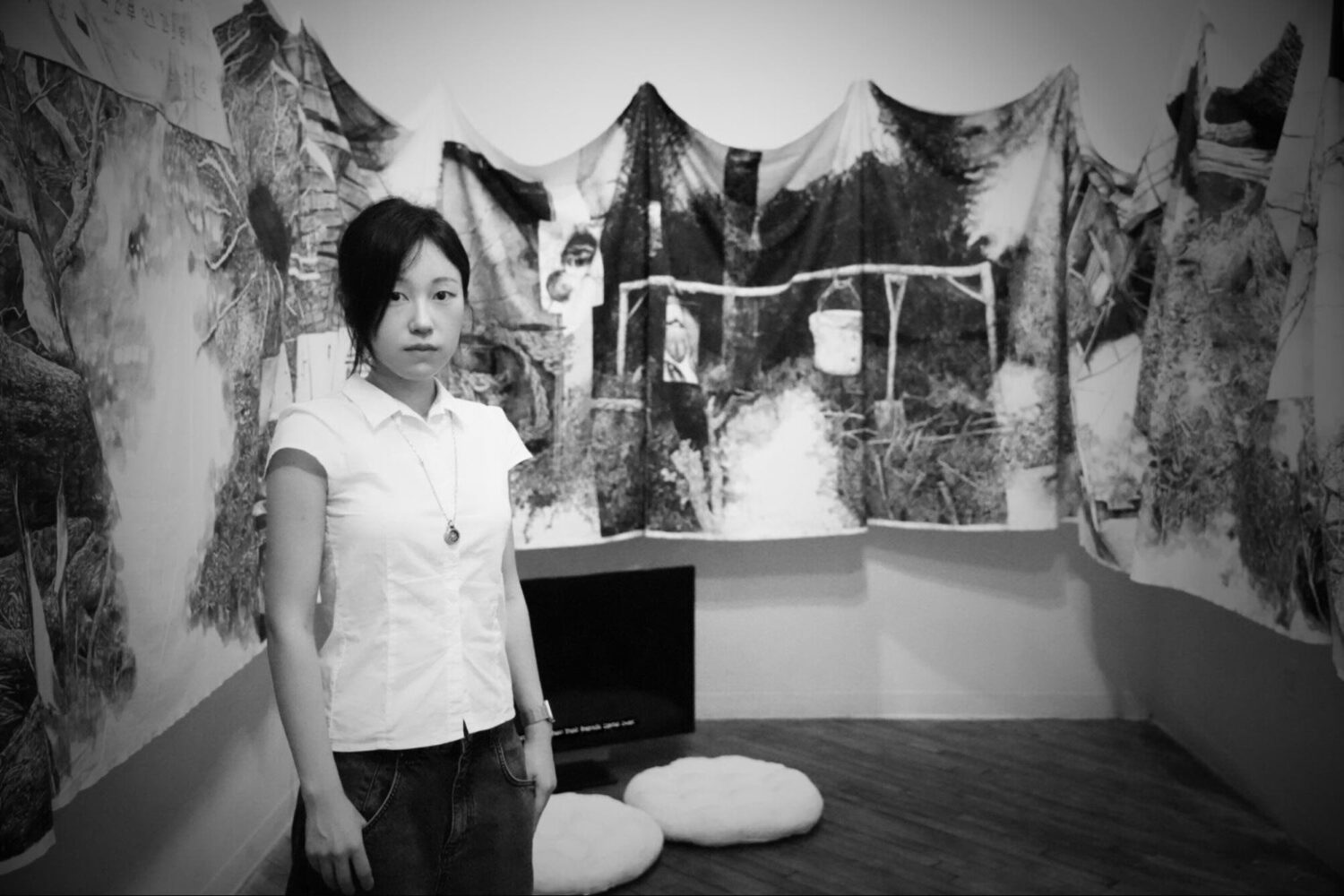
Portrait of Guava Rhee at Grizzly Grizzly, In Other Words behind her.
Website / Instagram:
Grizzly Grizzly Website: https://www.grizzlygrizzly.com/
Grizzly Grizzly Instagram: https://www.instagram.com/2xgrizzly/
project ieerie Website: https://ieerie.com/