
 Jon Stojan
jinseok choi’s solo exhibition Before the Last Spike is a profound exploration of immigrant labor, collective memory, and historical erasure. Through an innovative use of sculpture, installation, and reclaimed materials, choi sheds light on the often-overlooked contributions of immigrant workers in shaping industrial and cultural landscapes. His work not only engages with historical injustices but also advocates for labor visibility and social justice, making a significant contribution to contemporary discourse on migration, labor rights, and artistic activism.
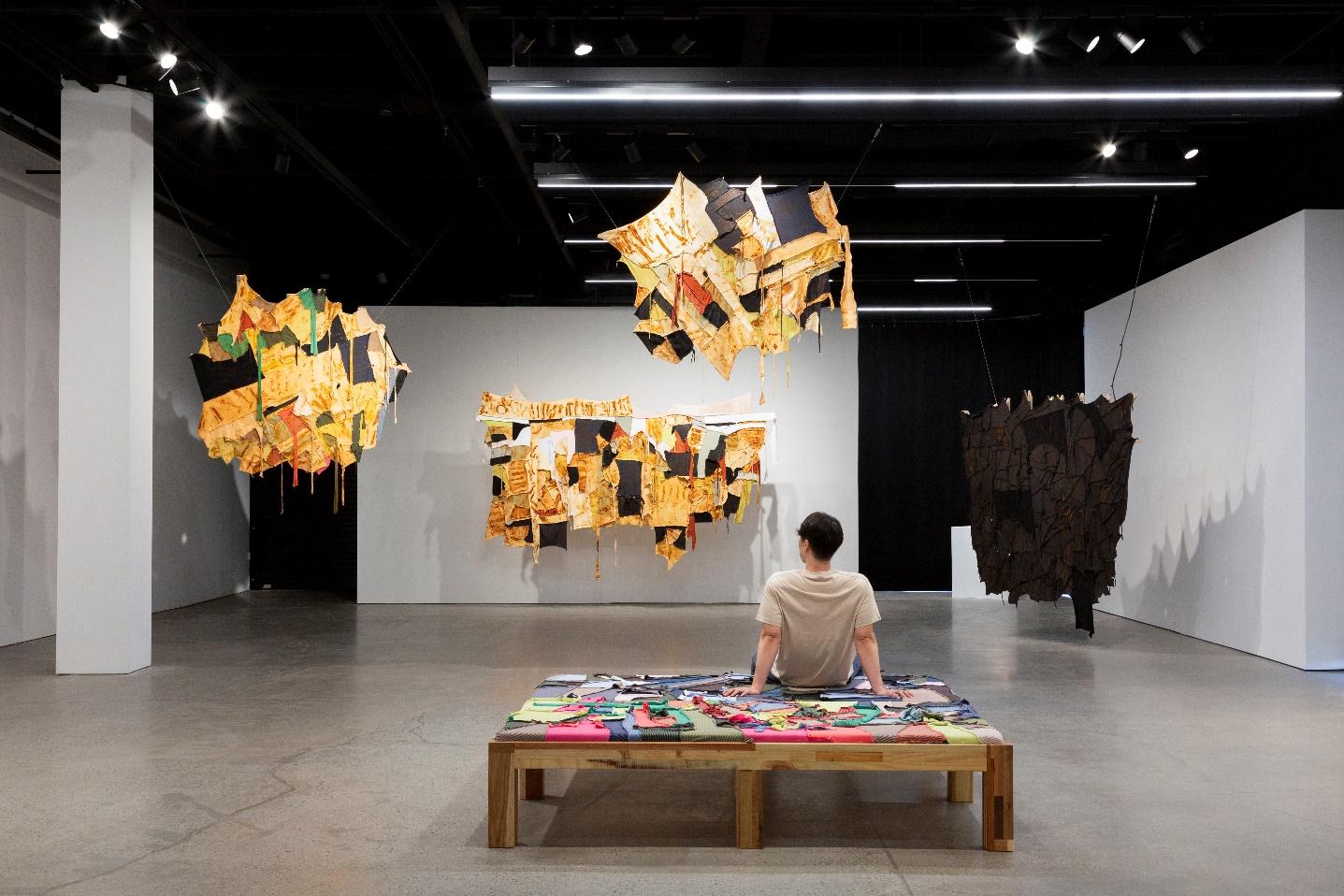
Photo Courtesy: jinseok choi
Rewriting History Through Art
One of the exhibition’s focal points is a critical response to the famous “Champagne Photo,” taken in 1869 to celebrate the completion of the first transcontinental railroad in the United States. While this image has become an iconic representation of industrial progress, it deliberately excludes the Chinese immigrant workers who played a fundamental role in its construction. choi addresses this historical omission through Before the Last Spike, an installation of rust-dyed fabric imprinted with railroad spikes. This work serves as both an homage to these forgotten laborers and a call to acknowledge the systemic erasure of immigrant contributions in American history.
choi’s work extends beyond historical critique to highlight ongoing labor struggles. By incorporating fabric remnants from Los Angeles garment factories, he draws parallels between past and present labor conditions, emphasizing the persistence of exploitative practices in industries that rely heavily on immigrant workers. His ability to weave historical narratives with contemporary realities underscores his role as an artist engaged in social advocacy.

Photo Courtesy: jinseok choi
Materials as Testimonies of Labor
choi’s artistic practice is deeply rooted in materiality, with each material carrying its own historical and symbolic weight. His sculptural works, such as We Return and Town Square, are composed of wood scraps and sawdust—byproducts of his own labor as a professional woodworker. These materials, often discarded and overlooked, become central to his storytelling, transforming waste into powerful representations of resilience and labor history.
In We Return, choi integrates traditional Korean masks with woodworking remnants, drawing from Korea’s folk performance traditions that historically served as social critique. By repurposing these cultural artifacts within a contemporary immigrant labor context, he reclaims and redefines laborer identity. This synthesis of cultural heritage and modern struggle illustrates his ability to bridge different histories and geographies, reinforcing the universality of labor exploitation and perseverance.
Labor, Rest, and Communal Spaces
A recurring theme in choi’s work is the relationship between labor and rest. In Between Our Palms, he molds incense sculptures from sawdust, shaping them with the imprint of human hands in a gesture reminiscent of prayer. These forms are not generic, they are created from the pressed palms of choi’s friends and colleagues, individuals who have directly or indirectly supported his artistic practice and the realization of this exhibition. By capturing both the physical trace of their hands and the negative space between them, the work powerfully symbolizes unseen labor, care, love, and interdependence. Between Our Palms emphasizes that no work, artistic or otherwise is created in isolation; it is always embedded within a network of collective support and shared effort.
His use of sawdust—an industrial byproduct that is both hazardous and disposable—further underscores the precarious conditions faced by many workers. The transformation of this waste material into objects of rest and reflection echoes the resilience and adaptability of laborers in the face of systemic neglect.
Similarly, Idleground addresses issues of public space and social exclusion through communal seating structures inspired by the Pyeongsang, a traditional Korean public bench. Constructed from discarded materials, this work invites viewers to physically engage with the piece, fostering dialogue and interaction. By creating spaces that encourage connection and reflection, choi challenges the increasing privatization and fragmentation of public life, advocating for inclusivity and accessibility.
Beyond the Gallery: choi’s Role as a Cultural Advocate
jinseok choi’s impact extends beyond artistic expression; his work serves as a platform for dialogue on immigration, labor rights, and historical justice. Having worked as a fabricator, studio assistant, and art handler, he is intimately familiar with the often-invisible labor that sustains the creative industry. His sculptures and installations not only highlight industrial labor but also critique the undervaluation of skilled craftsmanship within the art world itself.
His practice aligns with broader social movements advocating for immigrant recognition and labor equity. Through his work, he brings awareness to marginalized histories and contemporary struggles, making significant contributions to discussions on cultural memory and policy reform. His ability to translate historical injustices into compelling visual narratives positions him as an important figure in contemporary art and activism.
Before the Last Spike is more than an exhibition—it is a call to action. choi’s ability to transform overlooked materials into poignant reflections on labor and history elevates his work beyond aesthetics into the realm of social advocacy. His contributions to the discourse on immigrant labor, historical recognition, and material storytelling establish him as an artist whose work carries cultural and societal significance. By making visible the invisible labor that shapes our world, choi’s practice not only reclaims history but also actively reshapes the narrative of immigrant contributions to contemporary society.
Words by Liuxuan Lyu