
 Michael Atkinson
 Metrograph’s new homeboy release Gazer, a freshman volley whose festival odyssey included the Directors’ Fortnight at Cannes, could quench any appetite you still retain for rough, kleptomanic, shot-in-our-hood, who-needs-investors-or-experience DIY indies — like they used to make, back when “Sundance” meant something to some people. The whiffs of carbonic stress left behind by the piecemeal Newark shoot (largely on weekends over two years, we’re told) is this kind of movie’s raison d’être — the polish that an extra half mil in the budget would’ve bought would ruin the vibe. First-time director Ryan J. Sloane (love his byline in the PR: “an electrician turned filmmaker from New Jersey with no credits you’d recognize”) makes a tangy stone soup out of next to nothing, as if 1998 were yesterday.
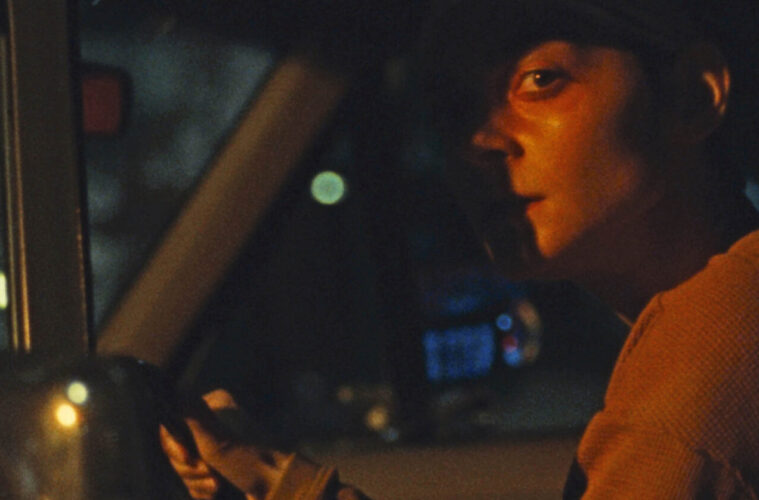
Self-financed so you can smell it (via Sloane and star/co-writer/partner Ariella Mastroianni’s bank account), Gazer trafficks in well-worn movie terrain — given its production modesty, it’s the kind of movie for whom derivativeness is easily read as homage, and the shoplifting only begins with Christopher Nolan’s Memento. Starved-bird trauma victim Frankie (Mastroianni) is an odd-job nomad and voyeur in the Jersey night shifts with a boatload of secrets — primarily, she has dyschronometria, a degenerative condition that disconnects her from the passage of time. We’re not told for a good stretch what her problem is, but we figure it out: If she’s not diligent, she’ll phase out and hours could pass (which doesn’t suck as a neurological metaphor for life in the 21st-century here and now, not to mention, Covid). So, like Memento’s hero, Frankie leaves herself markers and signs, mostly via cassette recordings she makes, guiding herself in the future: “Look around: what do you see?”
Naturally, this inwardly vexed lost one is drawn, in the Hitchcock Vertigo mode, to a shady plot, once a sketchy woman (Renee Gagner) spots Frankie in a survivors of suicide therapy group (shades of Fight Club), and offers her a simple $3,000 job: help her disappear, by driving her car to the shore and leaving it there. Too late, Frankie realizes there’s a body in the trunk, the woman has vanished, and no one is who they say they are. Nevertheless, because she’s a widow with a daughter, who’s living with her pissed-off mother-in-law, Frankie has to find the schemestress and get the payout, leading her into Newark’s scrubbiest corners. (It’s Jersey at its Jersey-est.)
You begin wondering, given the many ghosts of other films haunting Gazer, if the disappeared woman was ever real — and, in fact, Frankie’s impaired cognizance nicely contorts this low-rent mystery setup. Often, in a cut or a series of dissolves, time passes in ways neither we nor Frankie can fully track; as in Memento, consciousness itself feels like a film that’s being malevolently, or haphazardly, re-edited as we watch it. Frankie’s tapes don’t always work — running or hiding from mysterious forces, she’ll blank out and day will turn into night, leaving the usual gearwork of the what-happened-next genre storytelling spinning in thin air.
Shooting on 16mm but working with a sharp-eyed widescreen palette, Sloane knows how to turn the screws, if in the end his heroine’s fraught subjectivity seems rather limited. The attempts to hyperextend the POV with dream sequences lifted straight from Videodrome only adds to the strain — in fact, at almost two hours, this pocket-size movie manages to wear out its welcome after a while, repeating and hyperextending Frankie’s subjective travails. The self-conscious set-piece lifts, from Blow-Up, The French Connection, The Conversation, Blue Velvet, etc., only add drag. The tiny ship also starts to list under the weight of a whole lot of meh neighborhood acting, although Mastroianni is fine and Tommy Kang rings true as a reserved detective trying to figure things out. (The score, by Steve Matthew Carter, seems to think this is a big action movie, and oversells every beat.) All told, the film fairly seethes with ingenuity, however much it must frequently do battle with its lack of originality.