
 Will Jones
Driven by a deep commitment to social responsibility, Ruvim Echiusciu actively utilizes music as a meaningful force for community connection, cultural exchange, and positive impact. His involvement with charitable initiatives, such as performing in support of the Bible Society of Moldova, demonstrates his belief in music’s power to uplift and unify.
Through founding and leading musical groups and outreach projects, he exemplifies how artists can contribute positively to society beyond performance alone. This approach is particularly vital in environments where social fragmentation is a concern, as shared musical experiences are known to foster powerful bonds and boost community pride.
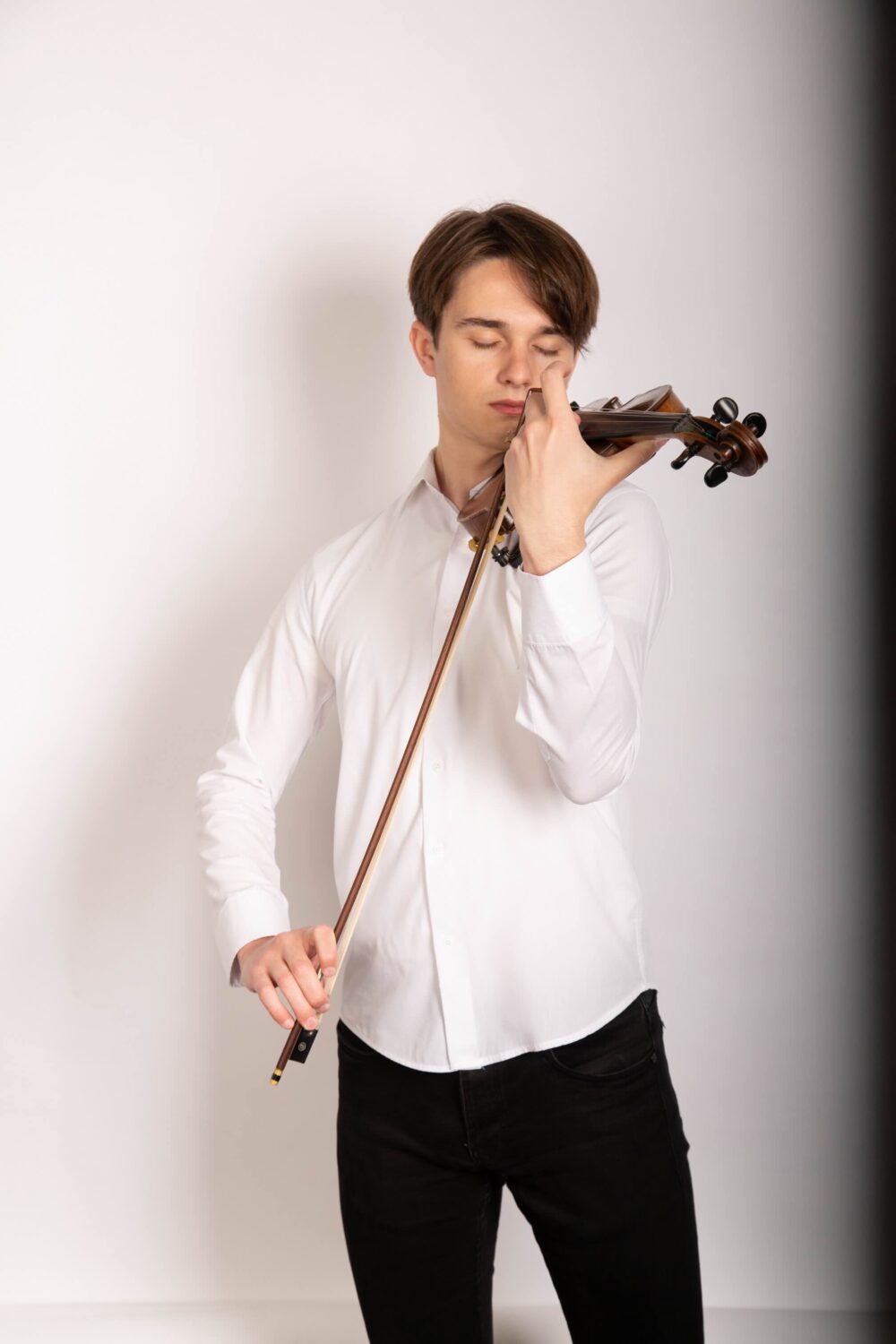
Echiusciu is an accomplished violinist recognized for his extensive international experience with symphonic, chamber, and touring ensembles. Currently pursuing a Bachelor of Music in Violin Performance at Belhaven University, he has earned recognition as an Exemplary String Player and featured performer in the Best of Belhaven concerts.
His professional journey includes performances with esteemed groups such as the Mississippi Symphony Orchestra and the Moldovan National Orchestra, as well as a notable tour across 50 cities in Romania with the Concertino Accordion Band. Dedicated to using music to connect and uplift, Echiusciu founded and led a professional string quartet in Chișinău, Moldova, managing everything from repertoire to logistics.
His musical versatility spans classical masterworks to contemporary compositions, reflecting his passion for cultural exchange. Echiusciu’s work taps into a fundamental truth: music connects with people in a way that feels different from other forms of communication.
Music acts as a universal language, transcending cultural barriers and creating unity. His mission is guided by core principles, experiences, and a clear vision of music’s potential. By examining how he utilizes music to encourage spiritual contemplation, strengthen social bonds, and connect diverse cultures, we gain insight into his impactful approach.
Inspiration rooted in service
For Echiusciu, the motivation to use music for social impact is not an afterthought but the very foundation of his artistic identity. His work is guided by a profound sense of calling that places service above personal acclaim, reframing performance from a display of skill into an opportunity for meaningful connection.
He believes his musical gift is a tool designated for a higher purpose, an idea that shapes every aspect of his career. This aligns with a faith-driven approach that encourages artists to take their message where it is needed most.
This conviction is articulated clearly in his own words. “For me, everything begins with God,” Echiusciu states. “I believe that every ability, every inspiration, and every opportunity is a blessing from Him. Music is a gift I received not for personal fame or recognition, but as a tool for service.”
This philosophy directly informs his actions, pushing him to seek out venues and contexts where music can minister to the emotional and spiritual needs of the audience. He moves beyond traditional concert halls and into the heart of the community.
He further elaborates on the moment this purpose crystallized for him. “When I realized that through the violin I could speak of God’s love, bring comfort, inspiration, and even lead people to reflect on eternal truths, I understood that my calling as a musician is not just to perform—it is to serve,” he explains. “My Christian worldview has shaped in me a deep desire to bring peace, hope, and truth through music.”
A conduit for spiritual awakening
A pivotal experience in Echiusciu’s journey was his work with the Bible Society of Moldova, which provided a powerful demonstration of music’s ability to create an atmosphere of reverence and introspection. During these performances, he witnessed firsthand how a carefully chosen piece could become a profound spiritual encounter for the audience.
This experience solidified his understanding of music as a key that can unlock deeper emotional responses, catalyzing reflection. Research supports this, showing that music is often a primary “trigger” for inducing what individuals describe as a spiritual experience.
Recalling a specific event, Echiusciu shares, “One of the most touching moments was my performance with the Bible Society of Moldova, where I played Via Dolorosa. This piece, which reflects the path of Christ to Golgotha, filled the room with reverence and silence.”
In that moment, the music was not just a collection of notes but a narrative that guided the audience through a shared spiritual reflection. It created a space where the historical and emotional weight of the story could be felt collectively.
The impact on the audience was immediate and deeply moving. “People weren’t just hearing music; they were encountering God’s truth,” he observes. “After the concert, several attendees came to me with tears in their eyes, saying how deeply the music touched their hearts. It was then that I realized how powerfully music can be used by God as a tool for spiritual awakening and healing.”
Designing programs with purpose
The process of selecting music for community projects is, for Echiusciu, a practice of deep intentionality that blends spiritual seeking with artistic rigor. It is not enough for a piece to be technically impressive; it must also carry a message that aligns with the spiritual and cultural context of the audience.
This approach involves a period of reflection and prayer, seeking guidance to ensure the musical program serves its ultimate purpose of creating a meaningful connection.
“Before creating a program, I pray and seek God’s direction,” Echiusciu explains. “For me, it’s not just about choosing beautiful music, but understanding what God wants to say through me to this audience.”
This spiritual discipline is the starting point of his curatorial process, underscoring his belief that the music itself is a form of communication with a purpose that transcends the performance. He then considers the specific needs of the community, ensuring the chosen repertoire will resonate emotionally and culturally.
This thoughtful preparation aims to create a holistic experience for the listener. “I consider the spiritual and cultural context and try to combine artistic excellence with deep meaning,” he says. “It may be a well-known hymn arranged in a fresh way or a classical work capable of stirring the soul. My goal is for each listener to leave with an internal experience of God’s presence, regardless of their faith or background.”
The musician’s social responsibility
Echiusciu champions the view that musicians have a vital role to play in society that extends far beyond the confines of the concert hall. He believes that the gift of music comes with a responsibility to engage with the community and address social needs.
This philosophy aligns with the growing concept of “artivism,” where art is used as a medium for social change. By taking music directly to places of need, artists can provide comfort, foster unity, and bring healing.
He finds inspiration in historical figures who embodied this principle. “I believe that a true musician is not only a performer but also a servant,” Echiusciu asserts. “A powerful example for me is the cellist Pablo Casals, who during wartime brought peace and comfort by playing music on war-torn streets. He believed, as I do, that music has no nation, no race. It is a universal language given by God to transcend all human divisions.”
This perspective frames music as a powerful tool for reconciliation and a force that can unite people across deep divides.
This sense of duty is particularly strong for artists of faith. “Casals refused to perform for oppressive regimes and chose instead to use his art as a moral and spiritual witness. That deeply inspires me,” he continues. “Especially for Christian musicians, it’s not enough to stay within concert halls. We are called to go where people are hurting, to bring light through our gift. If we don’t use the talents God gave us to bring healing and hope, we’re missing the very heart of our calling.”
Leadership through service
Founding and leading musical groups dedicated to outreach has provided Echiusciu with profound lessons in a specific type of leadership—one grounded in service, humility, and a shared sense of mission. In a socially driven artistic environment, success is measured by community impact and spiritual connection.
This requires a leadership style that prioritizes the team and the community over personal recognition. Effective leadership in such mission-driven arts organizations often hinges on clear communication and a strong connection to core values.
“These experiences taught me that leadership is first and foremost about sacrificial service,” Echiusciu reflects. “Inspiring other musicians to join outreach projects, where the goal is not applause but souls, has taught me to rely on God’s guidance, to listen carefully to the needs of the team, and to cultivate unity.”
This approach fosters a collaborative atmosphere where every member feels valued and connected to the mission, shifting the focus from a top-down hierarchy to a collective effort.
Maintaining the group’s focus on its core purpose is paramount. “Keeping a spiritual atmosphere is key, because our main goal is not performance perfection but impact,” he emphasizes. “This process has shaped me in humility, collaboration, and the constant pursuit of God’s will in every initiative.”
The transformative power of music
For Echiusciu, the ultimate validation of his work comes from the direct, personal responses of his audience. He has frequently witnessed moments where his music has catalyzed profound emotional and spiritual experiences, affirming his belief in its power to connect people to something greater than themselves.
These encounters are a recurring theme in his outreach, providing tangible evidence of his positive impact.
“This has happened many times — both after solo performances in churches and during my full solo concert last year, where I played pieces like Grieg’s Sonata in C Minor and other classical and sacred works,” he recalls. The consistency of these responses across different venues and programs highlights the universal appeal of his mission.
It demonstrates that music offered with intention and purpose can create a space for deep connection and reflection.
The nature of the audience’s feedback speaks directly to the success of his mission. “People came up afterward thanking me, saying they felt the presence of God, that the music helped them pray, reflect, and find peace,” Echiusciu shares. “For me, that is the highest goal of music—not just to impress, but to transform. If someone draws closer to God because of my playing, then I know I’ve fulfilled my calling.”
This transformative impact is affirmed by research, which shows that listening to religious music correlates with increases in life satisfaction and self-esteem, and a decrease in anxiety.
From ego to mission
Engaging in charitable and community-focused work has fundamentally reshaped Echiusciu’s artistic vision, shifting his priorities from personal achievement to missional impact. This evolution represents a profound change in his relationship with his art, his audience, and his creative process.
Where his focus might have once been on technical perfection, it is now centered on the potential for his music to serve, heal, and connect.
“Before, I focused more on technique, repertoire, and career,” Echiusciu admits. “But as I got involved in projects where the focus was on people and God’s glory, my vision changed. I began searching for music that doesn’t just ‘impress’ but truly ‘moves.'”
This search for emotionally and spiritually resonant repertoire has become the cornerstone of his artistic practice, guiding his choices and shaping the character of his performances.
This internal shift has had a liberating effect on his artistry. “My music now is no longer about ego, but mission,” he explains. “I’ve become freer creatively because I no longer depend on the audience’s opinion. I play for the Lord. That shift changed everything: my style, my repertoire, and my relationship with the stage.”
Building cultural bridges
Looking to the future, Echiusciu envisions a role for himself as a cultural ambassador, using his unique multicultural background as a foundation for building bridges between diverse communities. Born into a Turkic-speaking minority in Moldova and shaped by experiences in Russia, Romania, Turkey, and the United States, he possesses a rare perspective on the interplay of different cultures.
This personal history is the lens through which he views his mission to use music as a tool for unity, a form of cultural diplomacy that leverages the “soft power” of art to foster mutual respect.
“I am grateful to God that He allowed me to be born at such a unique time and place, where many cultures and values were poured into me from the very beginning,” he says. “I was born in the Gagauzia Autonomous Region in Moldova, a Turkic-speaking minority within a Moldovan cultural setting. Because of Moldova’s Soviet history, we also spoke Russian.”
This rich tapestry of influences, which includes time spent with his uncle, a respected professor and conductor in Turkey, and extensive touring in Romania, has given him a deep appreciation for cultural exchange.
His fluency in five languages and his diverse life experiences are assets he intends to leverage for a greater purpose. “Now I live in the United States and am ready and excited to share all of these experiences and inspirations,” Echiusciu states. “I see my future in building bridges between cultures, sharing the Gospel, and bringing God’s peace through music. Music has the power to unite people and to show that in Christ, we are one, no matter our background.”
The work of Echiusciu represents a powerful synthesis of artistic excellence, profound faith, and unwavering social commitment. His journey illustrates how a musician can move beyond the traditional role of a performer to become a community leader, a spiritual guide, and a cultural bridge-builder.
By intentionally wielding music as a tool for service, he not only creates moments of beauty but also fosters tangible social and psychological benefits, from strengthening community bonds to enhancing individual well-being. His mission serves as a compelling testament to the enduring power of music to heal, unite, and transform lives, offering a resonant model of how art can be a profound force for good in the world.