

 Michele Stueven
When Clare Staples came to Los Angeles, she was a big shot producer, and her house in West Hollywood was party central. The best of the Brits in the business who came to film in LA would just hang out at the house. It was a constant flow of Simon Cowells and Ryan Seacrests.
At the height of her career, she hit a certain age, got sober, and wanted more out of life.
“It was a hedonistic life in a way, very materialistic and very glamorous from the outside,” Staples tells LA Weekly at her Skydog Ranch high up in Malibu’s Decker Canyon. “I hit 50 and really felt burnt out from the high energy and the values. I sat and took a really hard look at what truly made me happy, what my own values were, and what my purpose should be for the next half of my life. It was a deep dive. I didn’t want to be in this world anymore. I wanted to do something more meaningful.”
Horses had always been her happy place throughout her life. When she got in trouble at home as a child, she’d run away to the stables where her mother would drop her off to school. Breathing in the smell of the horses was therapeutic and would give her peace.
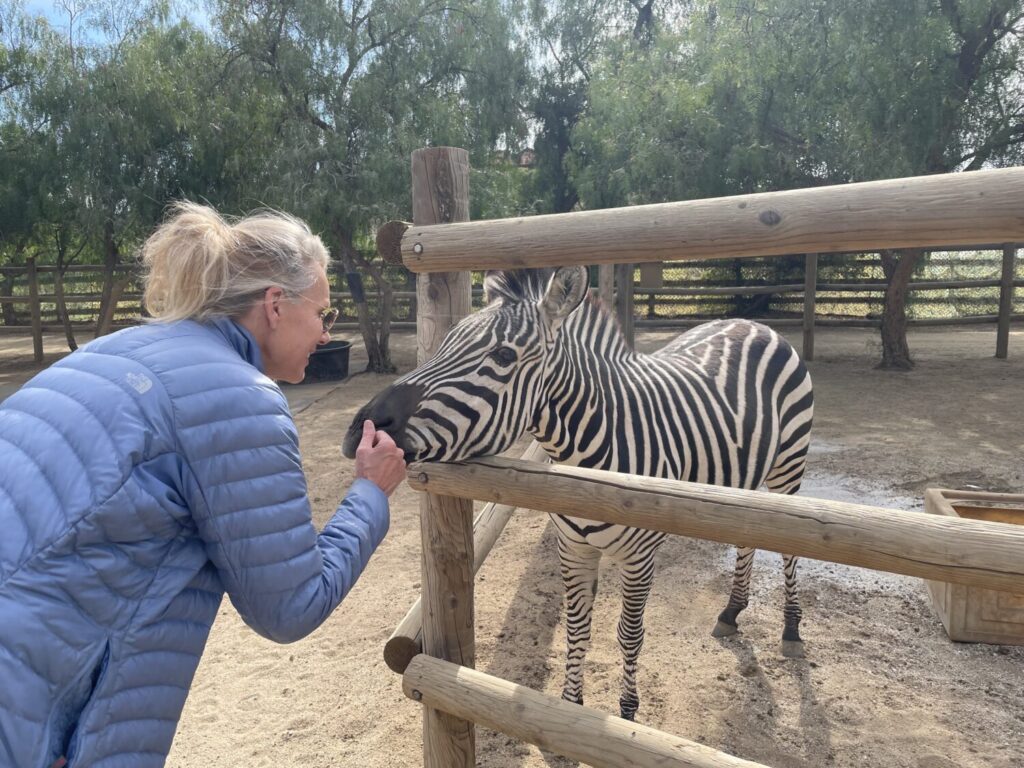
Clare Staples at Skydog Ranch with rescued zebra (Michele Stueven)
She started taking nature walks in Beachwood Canyon and, with her good friend, Welsh actor Matthew Rhys, discovered the nearly 100-year-old Sunset Ranch in the Hollywood Hills. With that came a whole new community where Staples would sit, ride, turn out horses, and talk about life.
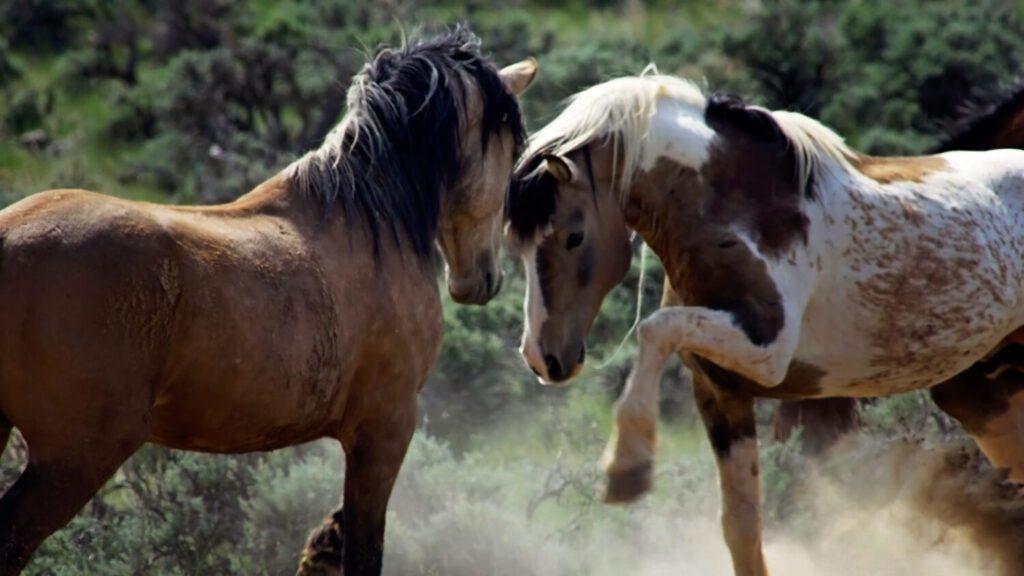
“It was there I learned all about mustangs,” she says. “I found out they were wild horses on western public lands. I realized the horrible places they were landing after being rounded up by the Bureau of Land Management. I would see these horses on Facebook that were in trouble in kill pens. Little by little, all signs were pointing to me doing more of that and rescuing more. I completely fell in love with these horses and the idea that they were born wild, grew up wild, and had instincts that had been honed for decades and sometimes hundreds of years, like survival of the fittest. They captured my imagination, and I fell in love with them.”
She and Rhys both flew up to Reno, where auctions take place, and several mustangs the government has rounded up go through prison programs where prisoners gentle them, ride and train them for three months, and auction them off after that. They went inside the Carson City Correctional facility and found two mustangs, Jimmy and Buddy. The prisoner who had trained them said they were closely bonded and couldn’t be separated.
As they rode Jimmy and Buddy through the hills and looked up at the Hollywood sign, Rhys and Staples talked about what they could do for the plight of the American Mustang.
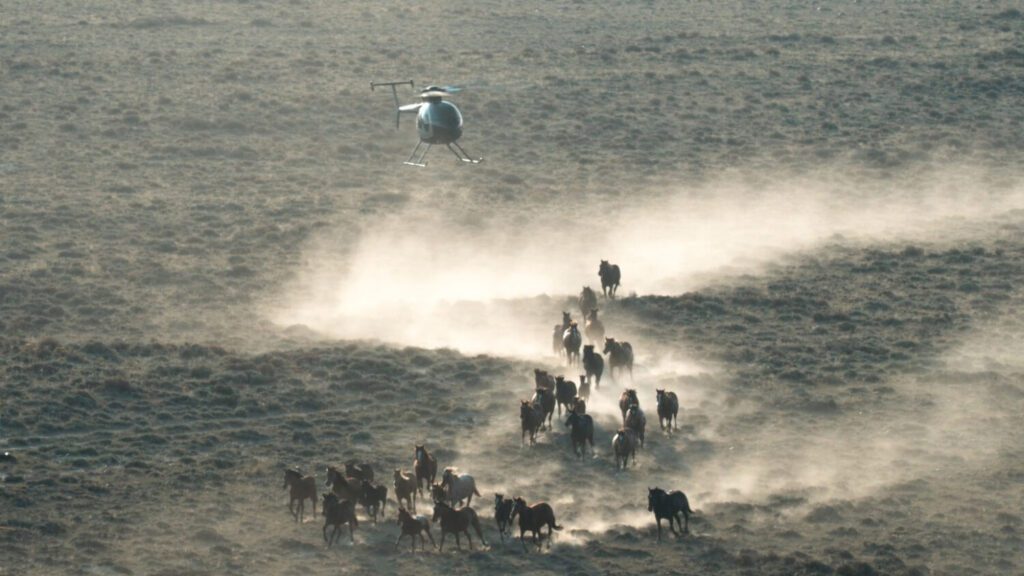
Mustang roundup (Courtesy Blue Zeus)
The answer was Skydog Ranch and Sanctuary.
She still has Buddy and Elvis. They now live on the 9,000-acre sanctuary in Oregon, where they can run wild with another 350 horses and donkeys that were born wild, rounded up, found themselves in dire living conditions, and were rescued by Staples. There are 11 at the Malibu ranch, which is more for aged horses with special needs.
“We just bought another ranch in Santa Ynez, which we’re in the process of ramping up, building paddocks, fixing the barns,” says Staples, who had to evacuate the entire Malibu facility during the Woolsey Fire. “We’ve got six horses there already. We’re doing the same there, taking the older horses that don’t do well in winter, have arthritis, or need special medication, and seniors who need extra care. Oregon is more for the wild horses that can just run free.
“There used to be two million wild horses across America roaming with buffalo,” she says. “Over the years, when railroads and barbed wire fencing came in, there were mustangers, who would go out and just slaughter mustangs and bring them back to rendering plants. They were used for dog food and chicken feed. They were so overhunted and overkilled that it got down to about 20 or 25,000, almost near extinction.”
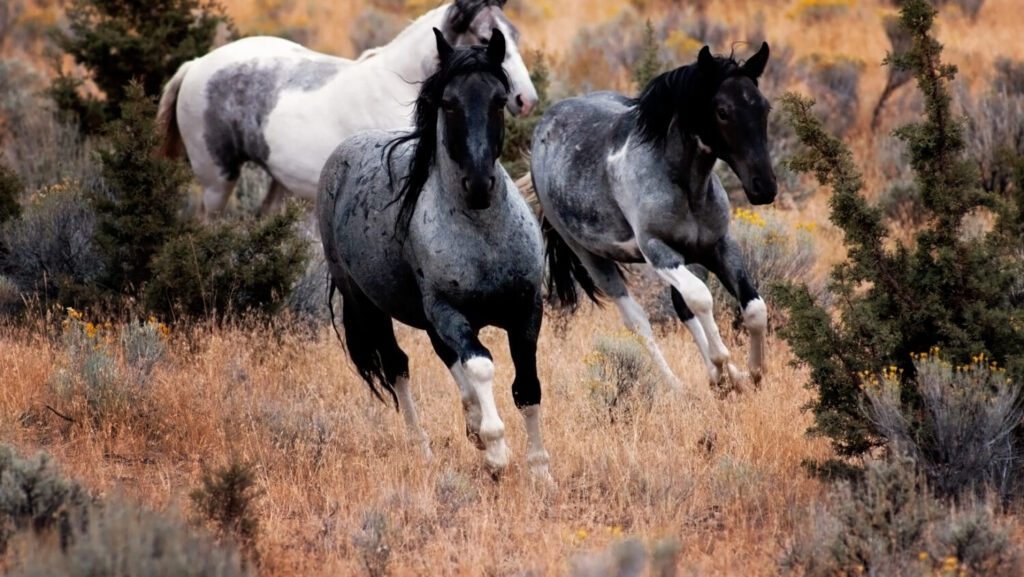
Courtesy Blue Zeus
She started following advocacy groups that would photograph the roundups and track down the location of each animal, many of which were separated from their families. Through exhaustive research and relentlessly hounding the BLM on the whereabouts of the animals, Staples was able to reunite the wild horses with their families. She shot video of the tearful reunions, which ended up going viral on The Dodo.
The most moving reunion has been chronicled in the Gerard Butler-narrated documentary Blue Zeus, which recently had its West Coast premiere at the Newport Beach Film Festival.
“After Blue Zeus got rounded up, I’d check on him every day in this advocacy group that went to the roundups and took photos and video to make sure that the horses were not being cruelly treated by the handlers,” says Staples from the living room of her Spanish-style ranch house decorated with wild mustang portraits throughout.
“There was a picture of Blue Zeus and a video of him and his family being chased by a helicopter into a trap,” she says. “I thought there must be a way to find him and bring him and his mares and offspring to the sanctuary. They ended up being taken to a men’s high-security prison in Colorado. It shut down for COVID, so you couldn’t get in there to see the horses. I kept pestering them to allow me to adopt Blue Zeus. Eventually, there came a break in the shutdowns, where you could fly again. They took 64 of these older stallions, which were now geldings, to a park in Colorado. I flew up and was looking around everywhere. Lo and behold, there he was. So I bid on him and won him for $25. Sometimes they’ll go for just $1. I took a few more that were in such bad shape I didn’t think they’d survive much longer, about 22 overall.
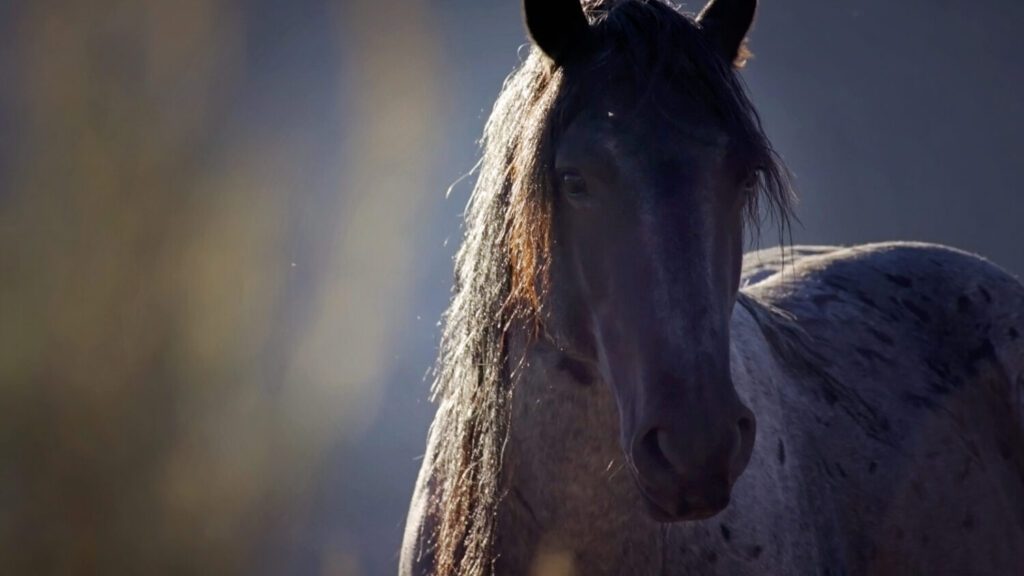
Blue Zeus
“We loaded him up in the trailer and hauled him away,” says the qualified EAGALA Equine Therapist. “I raced to Denver airport, got on my plane home, and the hauler who was driving them from Colorado to Oregon. The next morning, he arrived with the other horses. He was so thin. He would always stand away from the other horses and look out at the horizon. He was looking for his family. Out on the range, the most important thing to a stallion is his family; they’ll die to protect them and fight other stallions for them.”
“So I started calling them again,” says the Skydog Ranch founder. “They have one adoption event at the prison just for the annoying nine people like me who have bugged them the most to adopt horses that they know. So I went back up to the men’s high security prison, where you can only take a pencil. They gave us four hours. They all have tags around their necks with a number. I’m going through pen after pen looking for his family. I had pictures of them all. In the end, unbelievably. There’s this little group of horses that breaks away, and it was his three mares, the two juveniles, and two-month-old babies that had been rounded up while the mares were pregnant. It was a family of eight horses. Black Zeus and his family now run wild on 1200 acres near Bend, Oregon. I went from watching him on social media to looking at him outside my window.
Donate here on Giving Tuesday.
Courtesy Blue Zeus