
 Kalyn Corrigan
Towards the end of writer-director Michael Angelo Covino and co-writer Kyle Marvin’s latest collaboration, Splitsville, a young boy on the precipice of disappearing yet another one of his neighbor’s expensive jet skis casually turns to his friend and says, “You never really know what something’s worth until you sink it.” Funny as it seems, this one line can arguably act as the film’s entire mantra. This was so much the case, in fact, that the filmmaking duo found themselves divided on whether or not they should include it in the final cut. “I think it’s a line that probably is more on the nose than … we toiled with it,” Covino admits. “But he’s really talking about a jet ski, and the fact that he’s gonna steal it and sink it. So, it works.”
“We don’t understand the value of something unless we understand what we sacrifice to get it,” adds Marvin. “That is the beauty of what we’re exploring with this. Even if it’s still just a big comedy, we’re exploring love and sacrifice.”
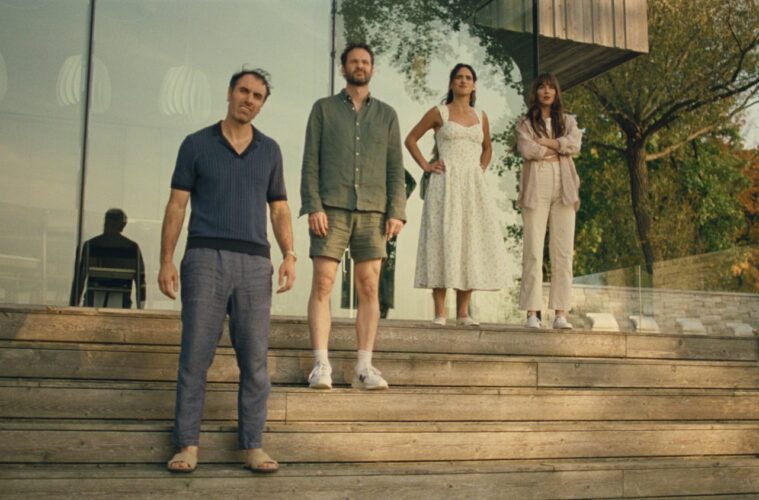
In the film, dissatisfied newlywed Ashley (Adria Arjona) asks her husband Carey (Marvin) for a divorce, prompting him to quite literally run away. He lands at his friend Julie (Dakota Johnson) and Paul (Covino)’s lakeside home, where he relays the news, and inquires about the secret sauce to their seemingly perfect union. He’s shocked to learn that his friends have an open marriage, claiming that the real key to their success is their refusal to bend to the rules of monogamy. What happens next is a rambunctious love rhombus wherein all parties involved swap and experiment and test the boundaries of romance, all in the hopes of learning how to be happy. But is this kind of lifestyle ever truly sustainable, or is it just the marker of people who eternally covet thy neighbor’s wife? Covino and Marvin hope to unpack such relationship complexities in this self-proclaimed “unromantic comedy.”

Adria Arjona and Kyle Marvin in “Splitsville” (Courtesy of NEON)
“I think ‘romantic comedy’ makes you think of a certain structure of a film,” says Marvin. “And I think we were interested in dismantling that structure a little bit.”
“There’s elements of it that are romantic and comedic,” Covino chimes in. “But I think why we started calling it an unromantic comedy is, when you go into watching a rom-com, you have two people and they meet, but they would never be with each other. There’s a reason why they’re pulled apart, or there’s this big barrier, and then the movie is oriented around them overcoming that big hurdle, that obstacle in front of them, that mountain in front of them, and finding each other at the end, and falling in love. And there’s pitfalls, or it’s not the right time, but that framework feels very — I don’t want to say generic, but it feels very tried and true. We threw that out the window from the first second of this film. The plot points don’t match up with a romantic comedy. They’re almost diametrically opposed to it.”
“Which sort of feels romantic, in a weird way,” Marvin further explains.
Almost like an old married couple, Covino sits at his partner’s side and finishes his sentence: “The messier it is, the more romantic it is.”
Splitsville premiered to rave reviews at the Cannes Film Festival, where it earned a six-minute standing ovation, but this is hardly Covino and Marvin’s first time garnering attention as a team. Their 2019 film The Climb (expanded from a short film that they took to Sundance), also written, directed, and starring the duo, won them the Un Certain Regard award against stiff competition in a category that recognizes emerging talent. For a minute there, the film put them on the map as established filmmakers, earning a place in theaters around the globe in late March 2020. But just as things were looking up, the pandemic hit and cinemas shut down, along with the rest of the world.
Still, setbacks had never deterred them before, and they wouldn’t let it sway them now. They spent much of lockdown diligently writing, and set themselves up to have 80 For Brady fall in their laps, a charming nonfiction feature about a crew of female football fans whose lifelong dream has always been to go to the Super Bowl and meet quarterback Tom Brady. Given the cast, enlisting actresses like Jane Fonda, Sally Field, Lily Tomlin and Rita Moreno, the movie stole hearts from football fans and cinema lovers alike. And of course, it didn’t hurt that they had the three-time MVP on deck.

Dakota Johnson (Courtesy of NEON)
All this to say, Covino and Marvin have more than earned their day in the sun. After all, the pair have been working together for well over a decade.
“We met 15 years ago on a commercial that he cast me in,” says Covino, jabbing a thumb at his friend, “And then we started producing and making commercials together. He was working in advertising, I was trying to get by as a filmmaker-slash-production-assistant, whatever people would pay us as.”
As Marvin notes, the two would “mess around on set after commercials,” thus sparking the genesis of their naturally evolving partnership. Over time, the pair began to realize that as writers, they complemented each other — a feat not always made so easy, no matter how gifted the artists at play. “In terms of the friendship, I think it’s only gotten stronger as time has passed and we’ve done more together. It informs the film in many ways, because we’re together on this from the very get-go to the very end of it.”
Covino also points out how their bond enriches the absurdist vibe that they’re aiming for, making it easier to translate for audiences, as well as their cast. “With our comedy, there’s a permission to let it not be funny, a permission to throw it away, to let the joke not be a big punchline, and let it find a rhythm,” he says. “When we get to act together, it’s like, ‘Oh, okay, this is the tone of the film,’ and it makes it much easier for everyone else to just get, to snap into it.
Although Splitsville contains many similar idiosyncrasies to its predecessor, The Climb, one of the most exciting updates on the former is the co-creators’ decision to put their leading ladies more at the forefront, enlisting the aid of the wildly talented stars Johnson and Arjona.
“In many ways, friendship is a baseline of the whole experience of this thing,” muses Marvin. “And I think what we were interested in is bringing other people into our fold, and Dakota and Adria — adding those additional layers and people who could play in our sandbox, and click into what we were trying to accomplish, and really grow in a deeper, more meaningful way.”
It’s a smart decision that quickly pays off, as both women easily demonstrate their effortless ability to keep pace with their onscreen husbands.
“They’re wildly funny in their own ways,” remarks director Covino. “I mean, Dakota is so sharp, and she can be so funny in a very sort of dry, minimal way — or she can nail a punchline in a scene. Because she embodies the character so fully, she innately just has incredible comedic timing. And Adria is just fearless with where she will go and what she will try. As the director, it’s incredible, because when you put Adria in a scene, I’m like, ‘Oh my god, I have to reel her back in,’ or ‘I don’t, I’m just gonna let her go and see where she ends up,’ and maybe it makes the cut, maybe it doesn’t, but it’s a gift to work with two incredible actresses like that, who will just go for it, and give you gold in very different ways.”
Granting his cast permission to feel a certain sense of freedom as performers on set undoubtedly added to the foursome’s palpable chemistry.
“You’re always allowing for a sense of play and collaboration,” says director Covino. “And when you bring in people as talented as the cast that we put together on this film, they are going to have better ideas than us. We would be very stupid to go, ‘No, no, no, read the words.’ But at the same time, it’s about creating time for that before we’re on set.
“One of the things about the approach to directing this film is that it is a little bit more dialed in, meaning we’re making deliberate choices with the camera on the day that don’t really give us a ton of latitude later. We didn’t cover the scenes traditionally, where it’s like, ‘Let’s start with a wide, let’s move into mediums, let’s get our closeups, and then go to inserts. We sort of did like, ‘Okay, we’re shooting the whole scene from here, and then at this point, this is gonna move over here, then it’s gonna live on this person’s face.’ In that way, you don’t really have as much room for improvising with some of the scenes.”
Marvin tacks on, “I will say as a performer, in going on that process where the scenes would really play out in long takes, or we would cover the scene from a single perspective, one of the things that both Adria and Dakota did beautifully is, a lot of the jokes are set up and then paid off way later. It takes a lot of patience as a comedian, you want to jump and hit that joke. And I think something that they did that we love is, just to let it roll out. Not try to land a joke, just try to live the scenes naturally, and let the comedy of the scene play itself out.”
In the movie, when Paul learns that Carey has slept with his wife Julie, he immediately punches him in the face, open marriage be damned. What follows is a lengthy, clumsy, adrenaline-fueled, sloppy fight, which sheds light on the filmmakers’ brilliance. Their tired swings and uncoordinated attacks not only ground the story in reality — it’s also just really funny to watch.
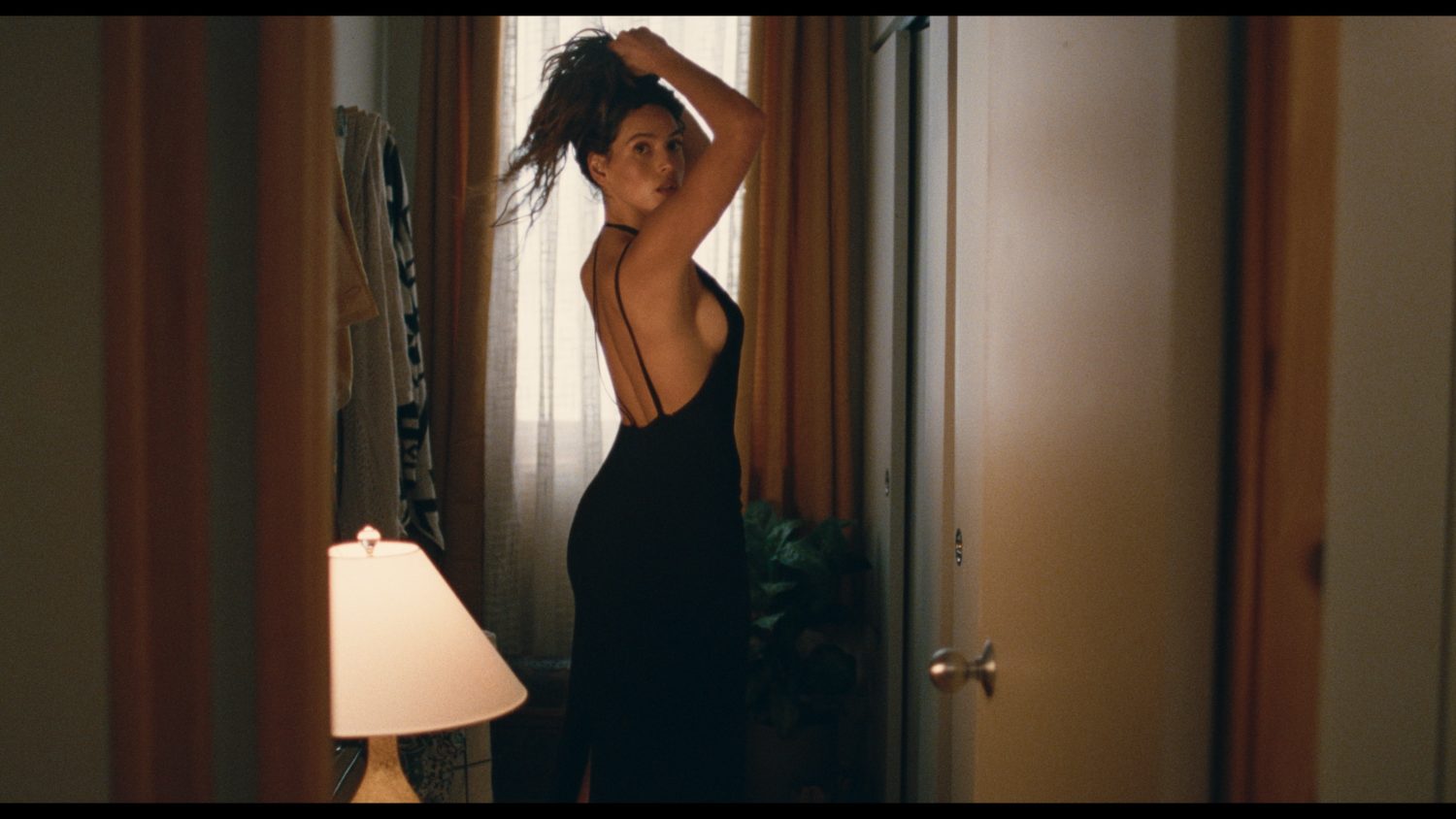
Adria Arjona (Courtesy of NEON)
“It was definitely something we did consciously to make it feel clumsy and awkward and exhausting, because if you really fight someone and you’re not a fighter, it doesn’t last very long before you’re out of breath and tired and throwing bad punches,” explains Marvin, “And so we really wanted to weave that into the fight sequence.”
Covino expands, “But we also were shooting it continuously, so we didn’t have to act by two and a half minutes into the fight, and flipping onto a table, I was out of breath, you were out of breath. We were trying to catch our breath just to say the lines.”
Marvin nods along, looking visibly wiped as he does so, a nostalgic glimmer of pain twinkling in his eye. “It was something from the get-go we wanted to do ourselves,” he remembers. “So, we did everything, we did all that fight sequence ourselves. We didn’t use stuntmen for that because we wanted to experience it, and also because it was naturally a way for us to live in those scenes, and have those comedic moments that are woven into it.”
Director Covino notes, “There’s something you can do when you have your actors performing stunts that you can’t do when you have a stunt performer, which is combine the very visceral, physical action of a stunt that’s occurring with comedy, you can tie them together in shots where you go, ‘Oh, this is really happening.’ I think subconsciously, it creates an effect where you go, ‘Am I really watching these guys beat the shit out of each other?’ And that was our intention. We were hoping that by the end, people would feel like a little bit of a fly on the wall.”
As uproariously hysterical as Splitsville is (there’s a moment involving a rollercoaster that is hands down the funniest scene of the year), it also carries some very painful themes. Striking that balance between comedy and tragedy has been a concept that the filmmakers have been exploring since their early days, resulting in their most powerful interpretation of the blending of genres to date.
“I think they go hand in hand,” says Marvin. “I think a lot of times, the things that we laugh at is, when we watch someone going through something that makes us uncomfortable, or experiencing someone else’s pain, knowing that it’s onscreen and they’re going to be fine, I think allows you to sort of laugh and release, to give relief on that. They’re intrinsically tied to each other in a way.
“There’s a reason why people going through extremely emotional situations uncontrollably start laughing,” director Covino jumps in. “Laughter is a pressure release valve for some of these things. Our bodies are wired to when you’re experiencing tragedy, or you’re experiencing discomfort, or you’re experiencing something that you can’t necessarily handle, laughter becomes a salve for that. And I think we recognize that physiologically, but we also recognize that in storytelling. They so perfectly go together, even though they seem like they’re on opposite ends. The deeper you feel, the more tragic the situation is, the more ripe that is for comedy, the more ripe it is for brutal, surprising laughter.
“Because laughter comes from a surprising nature, like, ‘I didn’t expect that’ — [then] it’s set up perfectly. So, just from a structural standpoint, it’s exciting to go into these realms of, how far can we go into this darkly tragic area for this character, and how far can we push what this character is going through, because there’s just more comedy to be mined.”
But Splitsville doesn’t just stand out for its wickedly impressive genre blending. It’s also beautifully shot, prioritizing aesthetic appeal in a way that doesn’t often characterize many romantic comedies. Some of the most critical scenes are framed behind glass surfaces, giving the viewer the illusion of being an outsider looking in.
“There’s this theme of goldfish in this movie,” says director Covino. “We constantly found ourselves in bathrooms, and shooting through glass, almost like we’re watching a bunch of goldfish in a fish bowl. Our brilliant cinematographer, Adam Newport-Berra and I, and Kyle, we really got into what we wanted for the style of the film, and for how we lens the film.
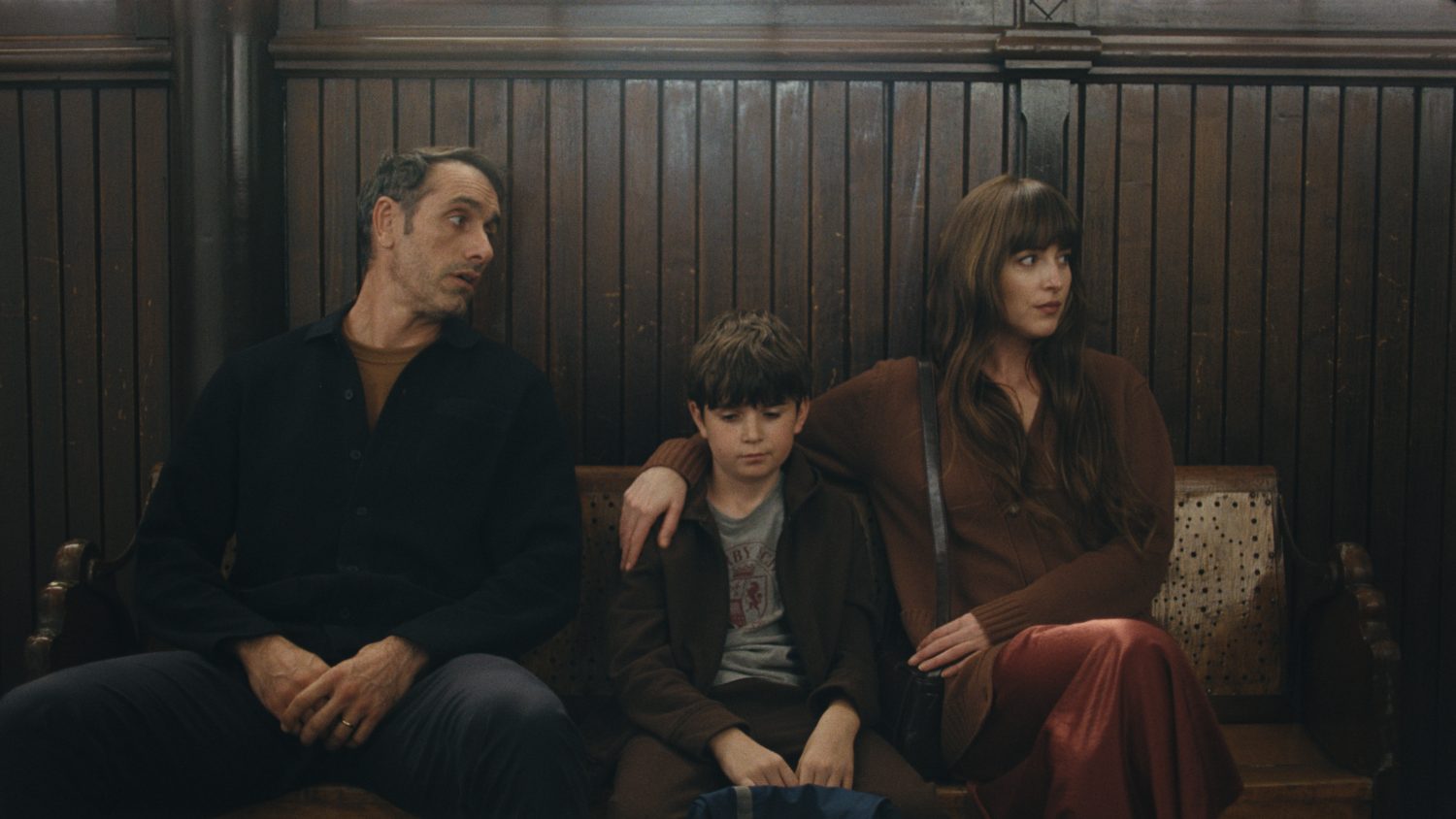
“In intense moments, we move into these very clean closeups — which we use a lot in this film, but we’re using it on a very wide lens. So, the features are ever so slightly distorted, and they’re less beautiful. It’s not the typical lensing you would get in a romantic comedy, because it’s not that flattering, because the camera is two feet from the person’s face.
(Courtesy of NEON)
“But at the same time, you’ll go from those closeups to popping out to these wide masters, almost revealing what is going on. And so, we use these wide shots to take us out of the intimacy, so we’re constantly going back and forth between perspectives.”
By jumping between the subjective perspective of the foursome, and popping back out to the objective observer watching from behind the glass, Covino innovatively uses the camera as a tool to view each moment from juxtaposing viewpoints.
Overall, the duo hopes to elicit the same awe they felt watching old seventies remarriage movies, an unexpected source of inspiration that the filmmakers dove into enthusiastically.
“When we started looking back to films from the ‘70s, I was surprised to find that a lot of what they were struggling with, or what they were trying to explore at that time, felt really relevant to the things that we thought were really contemporary, and were just of this time,” smiles Marvin. “It made me realize that we’re not alone in being a generation trying to understand how to make relationships work within the context of their society.”
Covino agrees wholeheartedly. “I think we were really excited about the idea of making a comedy that was oriented around earnest emotions and real characters. We stumbled into this whole well of films, mostly seventies films from Italy, France, and America, but that were just like screwball sex comedies, and it just sort of clicked. It felt like we gravitated toward writing in that style, and in that way.” Grinning, he continues, “A lot of the situations and the characters in the film are things that we’ve either personally experienced, or friends of ours, or family members of ours, or close people in our circle. So, you write a lot of things and you throw it all together. And then you find people coming out of the woodwork going like, ‘Hey, that’s me!’ When they see the film, they’re like, ‘Wait a second!’” He laughs, “I’m like, ‘No, no way! That’s not you!’”