
 Nia Bowers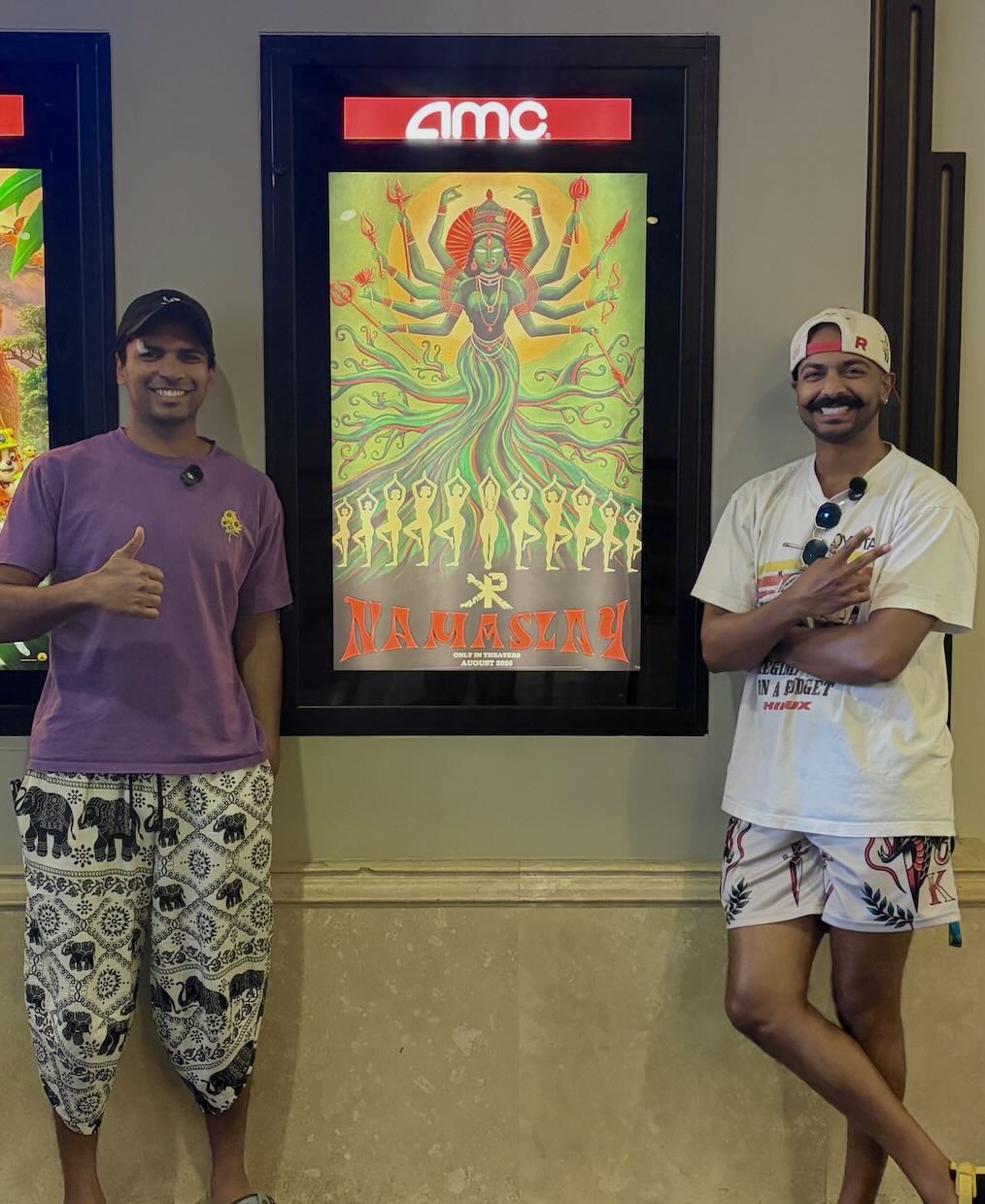
Completing a movie is only half the battle for independent filmmakers. The other half is convincing audiences to leave their homes and buy a ticket. That’s no small task in an entertainment landscape dominated by billion-dollar franchises, spray-and-pray advertising campaigns, and intellectual property that arrives preloaded with audience awareness.
Rish and Kanish understood that long before cameras rolled on Namaslay. While many filmmakers treat marketing as something that begins after a film is finished, the brothers insist audience awareness was part of the equation from the very beginning.
“We knew even while writing the script that the marketability of the movie was important,” say Rish and Kanish. “After reading our drafts, many people (including industry veterans) told us that Namaslay had undeniable commercial appeal.”
That confidence has shaped nearly every aspect of the film’s rollout ahead of its August 2026 theatrical release. One visible example is the placement of Namaslay’s poster in movie theaters. Studio films routinely occupy that real estate. Independent productions rarely do.
“Since we didn’t have the vast resources of a major studio, we worked with a very small, scrappy marketing team to bring the poster to theaters,” the filmmakers explain. “It’s extremely important that audiences see our poster in the halls of the theater, so that they feel confident that the movie itself should be seen on the big screen.”
The strategy reflects the broader philosophy behind Junghal Studios, the production company founded by the brothers. Conceived outside the institutional studio system, the company was built around the idea that ambitious, filmmaker-driven stories need not sacrifice their identity to reach an audience.
That ethos has become a recurring theme throughout Namaslay’s campaign. Rather than framing the project as a modest independent feature punching above its weight, Rish and Kanish have emphasized the scale already embedded in the finished film.
“We feel that we don’t need to trick audiences with some marketing gimmick to convey the cinematic scale of Namaslay; we just need to show them what we’ve already made,” the brothers say. “All we need to do is get the movie in front of people, in any form, and they’ll recognize its quality. We don’t need thermometers to convince someone else that the sun is on fire.”
That philosophy extends from the trailer to the poster campaign to the still photography now circulating online. If the old Hollywood marketing model was built around dominating physical space, today’s battlefield looks very different.
“People look at their phones far more often than at any outdoor billboard,” they explain. “Today’s biggest billboard is in your pocket.”
For independent filmmakers, social media has changed the equation. Beyond audience targeting and analytics, it offers something previously reserved for studios and traditional gatekeepers: direct communication with moviegoers. The result is a marketing ecosystem where authenticity can genuinely compete with sheer scale.
“The best thing an independent filmmaker can do to outcompete a major studio is make a fantastic film,” they say. “The best type of marketing has always been, and will always be, word of mouth.”
As Namaslay’s campaign gathers momentum, the film has increasingly become a test case for what independent filmmakers can accomplish without the infrastructure of a major studio behind them. If its rollout suggests anything, it is that knowing exactly what you are may be the most effective marketing tool available.