
 Nia Bowers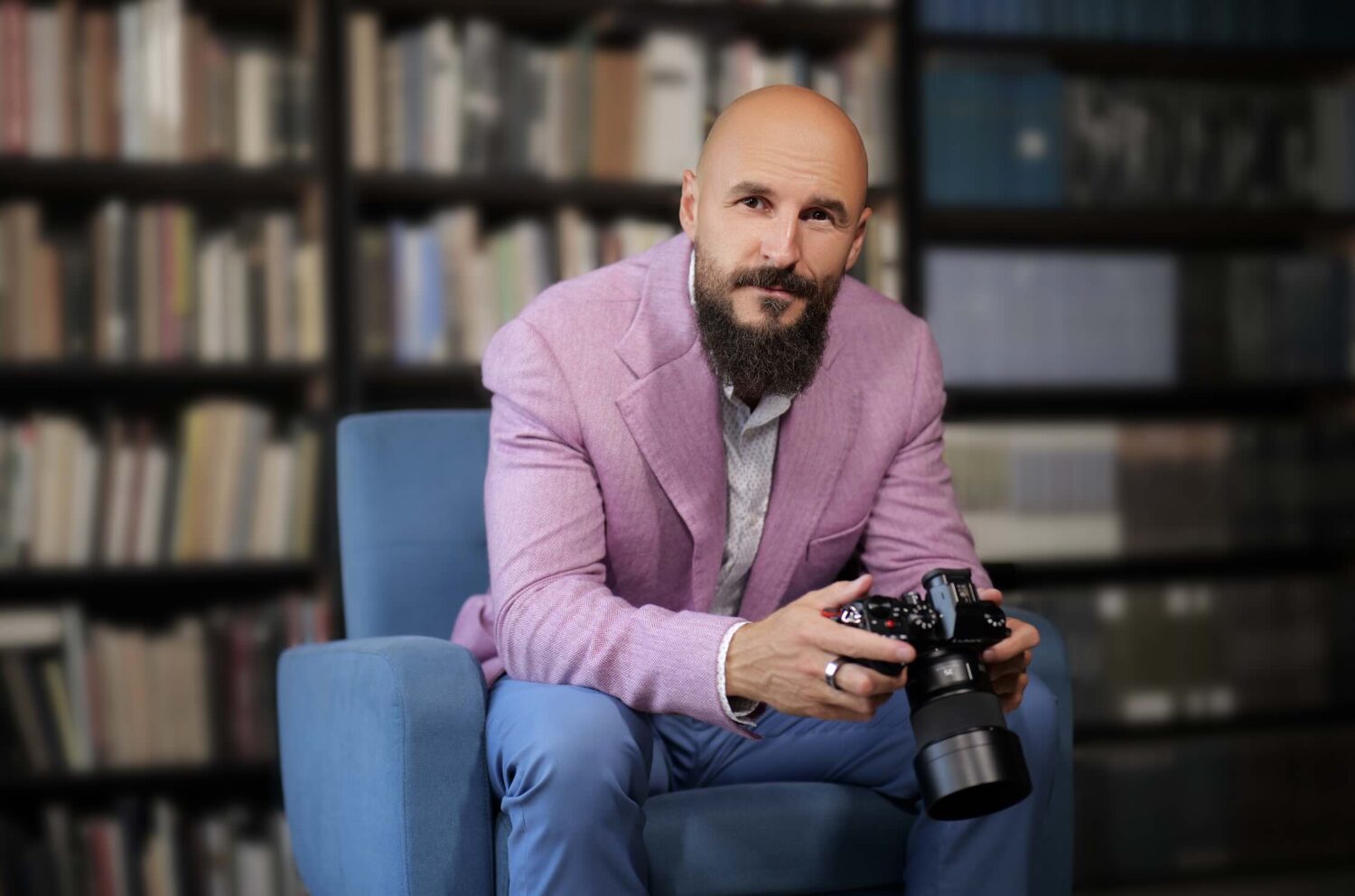
Vadimas Zizas’s photo archive
After years in Lithuanian media, entrepreneurship, publishing and documentary production, Zizas started over in the United States – this time in English. His expanding podcast network now reflects a career built across countries, formats and audiences.
When Vadimas Zizas was growing up in Lithuania, Los Angeles was less a place on a map than an image transmitted through a screen. American movies offered palm trees, wide streets, sunlight and a cultural scale that felt almost impossibly distant from the post-Soviet environment around him. Years later, after building businesses, producing media, writing books and becoming one of Lithuania’s early podcast personalities, he would arrive in the United States and confront a much harder question: what happens when the dream is no longer distant and you have to build a life inside it?
For Zizas, the answer became Apollo the Original – an English-language, long-form interview platform developed after his move to the United States. The project is now the center of his creative work, but it did not begin as an overnight rebrand or a casual experiment with YouTube. It emerged from more than a decade of entrepreneurship, digital media, public speaking, documentary work, self-development content and hundreds of interviews conducted before he ever tried to build an American audience.
The scale of the project has changed quickly. Materials assembled by Zizas in 2026 show more than 145,000 subscribers on the principal Apollo the Original YouTube channel, another roughly 40,000 on a separate shorts channel, and more than 250,000 Instagram followers. Across the two YouTube channels, he reports close to 20 million views. Since 2023 alone, he says he has produced more than 160 long-form episodes – many running two hours or more – and more than 700 short-form clips. Those numbers matter, but they are only the most visible layer of a story that started long before Los Angeles.
Before the Podcast: Business, Fitness and Learning How to Build an Audience
Zizas’s first professional identity was not media personality. After studying business management, he entered entrepreneurship and built a retail business that he later sold. That period gave him practical experience with branding, sales, customer behavior and the daily uncertainty of building something without a guaranteed audience – skills that would later prove surprisingly transferable to independent media.
He was also deeply involved in fitness for roughly a decade, and that interest became one of the entry points into his earliest interview work. By 2016, when podcasting was still far less established in Lithuania than it is today, Zizas began recording conversations with people from the fitness community. The initial concept quickly broadened. The point was no longer simply to talk about training. He became interested in the lives behind expertise: how people formed convictions, built careers, survived setbacks and made decisions.
Lithuanian publishing material for his first book later described him as one of the early figures to make sustained use of the podcast format in the country. His earlier Zizas Podcast archive grew beyond 100 videos, while his interview output expanded into hundreds of conversations over time. Just as importantly, he began treating digital media as an ecosystem rather than a single show.
In 2017, he launched an online education platform, Life Academy, previously known as Zizas Academy. The platform collected hours of instructional and self-development material from Lithuanian speakers and educators, extending his work beyond interviews into structured digital education. He also participated in documentary production and sold projects to Lithuanian national television, giving him experience with traditional broadcast standards alongside the looser, more direct language of online media.
Vadimas Zizas’s photo archive
Writing as a Parallel Career
The same themes that appeared in Zizas’s interviews – decision-making, responsibility, self-examination and personal change – also became the foundation of his books.
His first book, ‘(Ne)Adekvatus As,’ was published in Lithuania in 2019. The book combined autobiography with self-development and was framed around a simple question: how much of a person’s life is shaped by conscious choices, and how much by habits accepted without examination? Published descriptions of the book also point to difficult personal experiences, including the early loss of his mother, as part of the context behind his focus on resilience and personal responsibility.
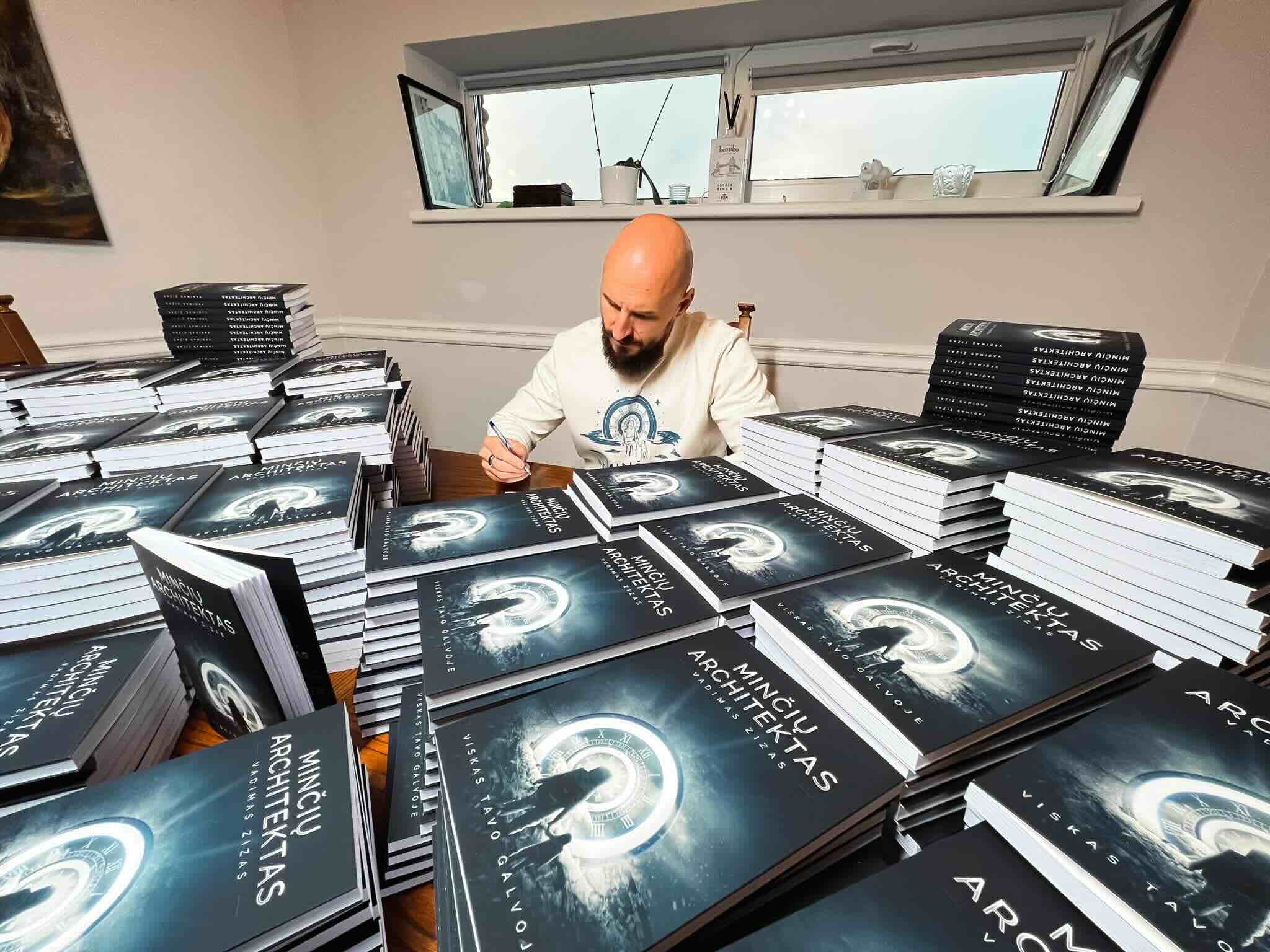
His second book, ‘Minciu architektas’ (‘Architect of Thoughts’), followed in 2022. At approximately 180 pages, the book was conceived in a more intimate form: as a long letter to his son. Zizas wrote about the principles, mistakes and lessons he wanted his child to be able to revisit later in life. The book continued his interest in self-discipline and decision-making, but with parenthood changing the audience he imagined while writing. Rather than addressing an abstract reader, he was writing toward a future conversation with his own family.
By then, the books and the Lithuanian-language media work had given him a recognizable platform at home. But the same success also clarified a limitation. Lithuanian is spoken by only a few million people. For a creator who increasingly wanted to interview guests from different countries and place those conversations before an international audience, the language that had built his career also defined its natural ceiling.
Why America – and Why Start Over?
The United States had occupied Zizas’s imagination since childhood. In a 2025 interview with VoyageLA, he recalled learning English partly through movies and role-playing video games because he expected that he would eventually live in America. Hollywood, in particular, represented not simply entertainment but the possibility of operating at a larger cultural scale.
The romantic idea of America, however, was very different from the practical reality of immigration. Moving meant leaving behind the easy advantages of recognition. In Lithuania, his name was connected to years of public work. In the United States, most viewers had no reason to know who he was. The network had to be rebuilt. The interviews had to work in a second language. Guests had to trust a platform that was still establishing itself in the American market.
That reset is central to understanding Apollo the Original. Rather than translating his existing Lithuanian show word for word, Zizas built an English-language identity from the ground up. ‘Apollo’ came from Apolinaras, his second given name, giving him a name that English-speaking audiences could pronounce easily. ‘The Original’ reflected the kind of conversations he wanted to create – discussions in which guests could speak beyond promotional talking points and present something closer to an unfiltered version of themselves.
The premise sounds simple: sit down with someone and keep talking. In practice, long-form interviewing asks more of both host and guest than short media appearances do. There is no three-minute segment to hide behind, no single headline to carry the entire exchange. A two-hour conversation has to sustain curiosity, change direction naturally and leave room for contradiction, humor, discomfort and reflection.
The Long Conversation as a Format
Apollo the Original developed around that endurance. Zizas’s episodes frequently move across categories instead of staying inside a guest’s job title. A filmmaker can end up talking about faith. A bodybuilder can discuss fear, recovery or happiness. An actor’s career can become a doorway into conversations about immigration, cultural identity or family. The result is less like a conventional interview and more like a recorded attempt to understand how a person connects the different parts of his or her life.
That range is visible in the guests and subjects documented in his earlier U.S. work. Special-effects and makeup artist Dan Crawley, whose credits include projects such as ‘Watchmen’ and ‘X-Men: Days of Future Past,’ joined Zizas for a conversation that moved from practical effects and CGI into artificial intelligence, the future of filmmaking, labor concerns in entertainment and religion. Actor and producer Ivan Djurovic appeared in a discussion that ranged from his Serbian heritage and experiences in Hollywood to family values and social division in the United States. Professional bodybuilder Kris Dim joined an episode that used bodybuilding and horror as unexpected starting points for a broader discussion about psychology, motivation and finding meaning in difficult experiences.
Those episodes illustrate one of the platform’s defining habits: guests may arrive with an obvious public identity, but the interview does not necessarily stay there. Zizas tends to treat expertise as the beginning of a conversation rather than its boundary.
Filmmaker Bryan Cortez, who had followed Zizas’s work, described his interviewing approach as one that creates space for candid, multi-dimensional conversations. That description also captures why the format has continued even as social platforms increasingly reward shorter and faster content. The long episode is the product; the short clips are distribution. One creates depth, while the other creates discovery.
“The long episode is the product; the short clips are distribution. One creates depth, while the other creates discovery.”
A Media Operation Built in Two Speeds
That distinction has become increasingly important to the way Apollo the Original operates. A single long-form episode can generate numerous short clips, each focused on a moment, argument, story or surprising exchange. Those clips travel across YouTube Shorts and Instagram, where viewers may encounter the show for the first time without having watched a full interview.
The strategy explains the scale of output reflected in Zizas’s recent materials. Since 2023, he reports producing more than 160 extended episodes and more than 700 short clips. The two-format model demands a constant production cycle: identifying guests, researching them, recording the conversation, editing the full episode, identifying moments that can stand alone, packaging them for social media and then doing it again.
The audience figures show how sharply the project has expanded. In recommendation letters prepared around his 2023 U.S. work, Apollo the Original was described as having just over 50,000 YouTube subscribers and more than 12 million accumulated views. By the time VoyageLA profiled him in December 2025, Zizas said the channel was approaching 90,000 YouTube subscribers and his Instagram following had reached roughly 150,000. In the 2026 materials, the principal YouTube channel had climbed beyond 145,000 subscribers, with a second shorts channel adding tens of thousands more, while Instagram had passed 250,000 followers.
Growth at that pace changes the nature of an independent show. A podcast can begin as a creative project, but once an audience becomes large and geographically diverse, it starts functioning like a small media company. Editorial choices, production consistency, platform analytics, guest selection and distribution become interconnected. The host is also a producer, programmer and audience strategist.
Vadimas Zizas’s photo archive
The Third Book: A More Personal Turn
While Apollo expanded in the United States, Zizas continued writing in Lithuanian. His third book, ‘Dviveidis’ – described in his English-language materials as ‘Hypocrite’ – was completed and published in early 2025. The nearly 200-page book closes a trilogy that began in 2019 and continued in 2022.
The third volume is noticeably different in emphasis from the first two. Its structure moves from outward-looking subjects – war, propaganda, movies, music, education, social conflict – toward an extended account of Zizas’s own spiritual change. Chapters examine atheism, Catholicism, his personal ‘awakening,’ Protestant Christianity, repentance and what he describes as being born again.
That spiritual shift had already begun appearing in his public interviews. Zizas has spoken about arriving in the United States as an atheist who was skeptical of organized religion and then gradually becoming a Christian after attending church in America. The new book turns that change into a central narrative rather than a side note.
Its core, however, is not simply theological argument. In the materials accompanying the book, Zizas describes empathy and love for other people as its foundation. The progression across the three books is revealing: the first focused heavily on changing oneself, the second on transmitting lessons to his son, and the third on the moral and spiritual framework through which he now interprets the world around him.
Immigration, Reinvention and the Cost of Beginning Again
The polished version of a transatlantic creative career can make reinvention look cleaner than it is. Zizas’s own descriptions of immigration are less romantic. He has spoken about arriving without the familiar network of friends, family and professional relationships that existed in Lithuania. For an established personality, anonymity can be both liberating and destabilizing: it gives a creator permission to rebuild, but it also removes the social proof that once made opportunities easier to secure.
That tension runs through the Apollo story. He did not arrive in Los Angeles as a new creator. He arrived as an experienced creator whose experience was largely invisible to the new audience he wanted to reach. The task was therefore not to learn how to make media from scratch, but to prove that the skills developed in one country and language could travel.
English added another layer. Long-form interviewing depends on timing, humor, follow-up questions and the ability to notice what a guest has not fully explained. Doing that work in a second language raises the difficulty considerably. Zizas’s decision to keep the conversations long made the challenge even greater, but it also accelerated the process of building fluency and an American-facing on-camera identity.
There is a practical stubbornness to the strategy: publish often enough that the new body of work eventually becomes larger than the explanation of what came before. More than 160 long episodes later, Apollo the Original no longer needs to be understood only as the American extension of a Lithuanian career. It has become a distinct archive of its own.
What Makes a Conversation Travel?
The central challenge facing any interview show is not access to microphones or cameras. It is relevance. Thousands of podcasts can book interesting guests. Far fewer can persuade viewers to spend an hour or two listening to a conversation with someone they may not already know.
Zizas’s answer has been to organize the show around human stakes rather than a single professional niche. Career details matter, but they are rarely the endpoint. Episodes are designed to move toward the experiences underneath the resume: ambition, disappointment, belief, discipline, family, identity, health, fear, success and the decisions that alter a life.
That approach also gives the show flexibility. It can host people from film, bodybuilding, business, entertainment or other fields without requiring the audience to care equally about every industry. The connective tissue is the person rather than the category.
There is also a geographic logic to the project. Los Angeles gives an interviewer access to a dense concentration of people whose careers already cross borders – actors, filmmakers, entrepreneurs, creators, athletes and specialists from around the world. For someone whose own professional identity was formed between Lithuania and the United States, that kind of environment makes sense. The city itself becomes part of the format: a place where people arrive with different accents, histories and ambitions, then try to explain who they are now.
From a National Audience to an International One
Zizas’s career can be read as a series of expansions in scale. A fitness-focused interview became a broader podcast. A podcast became an education platform and documentary work. Public speaking became books. A Lithuanian-language audience became a reason to experiment with English. A long-form YouTube channel grew into a network of full episodes and short-form distribution.
The numbers are larger now, but the underlying mechanism is familiar: ask questions, package ideas clearly, publish consistently and use one format to feed another.
That continuity matters because the internet tends to make creative careers look as though they begin at the moment an algorithm notices them. In Zizas’s case, the American audience is seeing the most recent phase of work that started years earlier in a much smaller media market. The apparent acceleration in the United States rests on experience accumulated in Lithuania – hundreds of interviews, public-facing projects, business experiments, books and the trial-and-error process of learning what makes people keep listening.
The Next Version of Apollo
For Zizas, Los Angeles was once the destination. It is now the operating base.
The next challenge is less about proving that the show can exist and more about defining what it should become as its audience grows. Larger reach can tempt creators to narrow their subject matter around whatever performs best. Apollo’s identity, by contrast, has been built on range. Preserving that range while improving production, attracting stronger guests and sustaining frequent releases will determine whether the platform develops from a successful creator-led channel into something more durable.
The third book adds another dimension to that evolution. Writing remains a slower, more private counterweight to the relentless production cycle of digital media. Podcasting is responsive: a guest says something unexpected and the conversation changes. A book is the opposite. It forces the author to sit with an argument long enough to decide what he actually believes. Zizas now works in both modes.
That combination may be the clearest description of his career so far. He is an interviewer interested in other people’s stories and an author repeatedly trying to reorganize his own. He is a Lithuanian creator who built a public identity at home, then accepted the anonymity of starting again in America. And he is a long-form host working inside an online culture that increasingly rewards brevity.
The child who once imagined California through Hollywood movies eventually reached the place he had been watching from afar. But arrival turned out not to be the ending. It simply changed the question from ‘How do I get there?’ to ‘What do I build now that I am here?’
For Apollo the Original, the answer continues to be the same deceptively simple act that started Zizas’s media career years ago: sit across from another person, turn on the cameras, and keep the conversation going long enough for something unexpected to happen.