
 Nia Bowers
Photo Courtesy of Monotronic
Monotronic does not quietly drift into your feed. Guitars crackle, synths flare, and the rhythm section keeps tugging the music toward the dancefloor, even when the lyrics lean inward. Waiting for You arrived on January 20, 2026, and reached 2.4 million streams in its first month, then the band watched the momentum spill out of headphones and into real rooms. Recent videos for Looking Away, Kids of Summer, and Sun Song premiered at #1 on VEVO, and a sold-out fall tour ran through Denver, Seattle, Portland, San Francisco, Los Angeles, Phoenix, plus two dates in Texas.
Brazil sits among Monotronic’s strongest markets, right beside Mexico, the Netherlands, the U.K., and the U.S., a project built for music lovers worldwide. The focus tracks, Looking Away and Kettle Song (Yama Yama), act like two entrances into the same world, one immediate and bright, the other more hypnotic and circular. Behind it all stands Ramsey Elkholy, the writer and producer who treats the band less like a fixed lineup and more like a living cast.
A Band Built On Motion
Ramsey Elkholy never wrote songs in a single room with a single life behind them. Academic work took him to many places, including India and Southeast Asia, and field research brought him to the jungles of Sumatra for long stretches. Music study followed. Road miles followed, too. Curiosity became a habit, then a compass. Monotronic’s genre-defying sound shows that.

Photo Courtesy of Monotronic
Amidst all that, New York gave that roaming energy a home base, and Monotronic formed as a rotating collective with Ramsey at the helm, writing and producing the songs while leading on guitar. Players orbit the core and change over time, so the project is always injected with new energy, going in new directions, while staying true to Elkholy’s original concept. Monotronic runs on a simple rule: every part should feel connected, like one long sentence spoken by different voices. Guitars do not just sit on top of the beat, and the beat never hides in the background. Space matters, too, since the pauses carry as much tension as the chorus.
Collaboration stays central, even when the credits feel like a plot twist. Close Enough credits Mohini Dey and Omar Hakim as featured players, a pairing that adds weight to the groove while keeping the song’s pop clarity intact. The rotating-collective idea makes room for moments like that, while the writing voice keeps the whole project recognizable from track to track.
Songs That Hold Two Maps
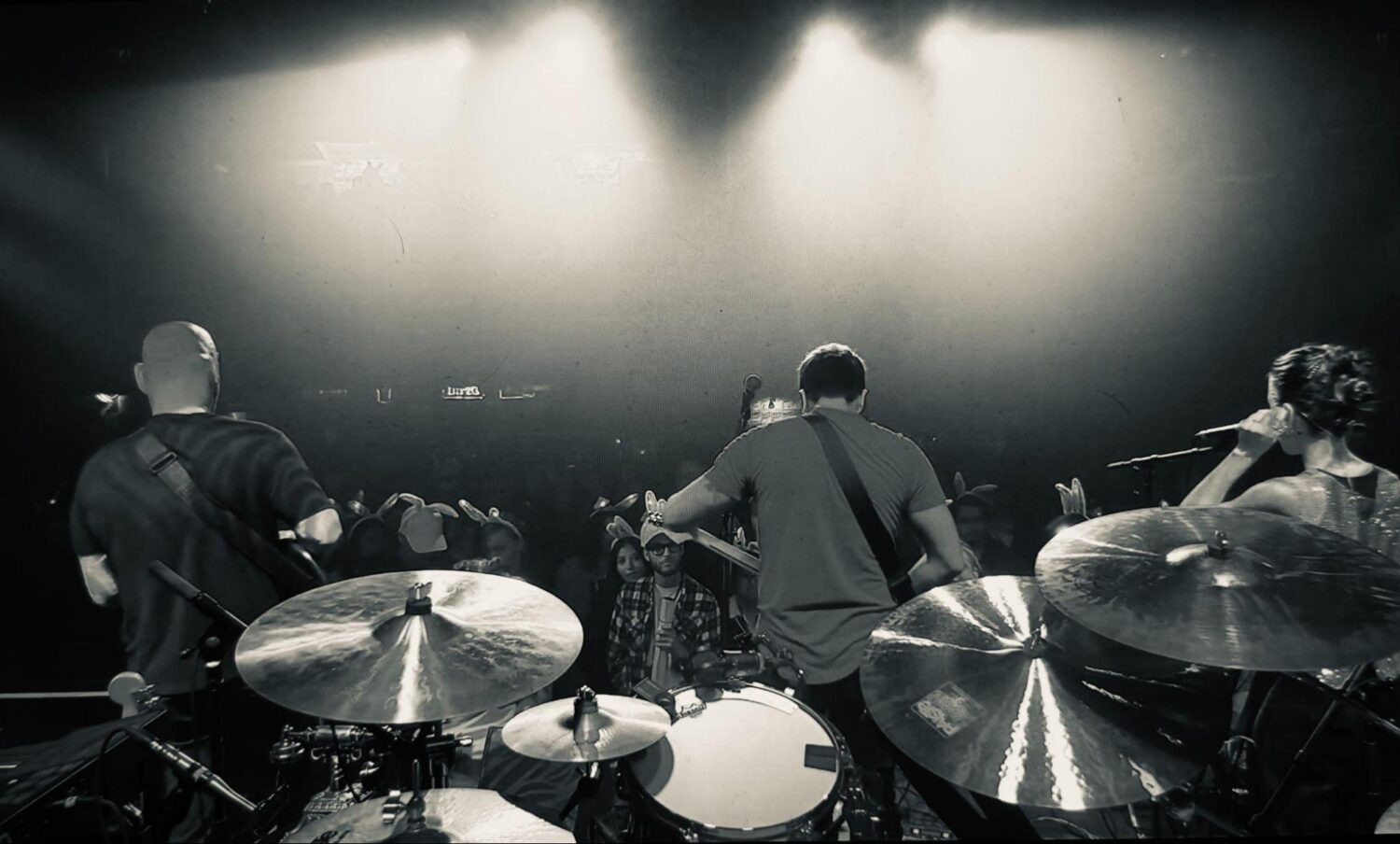
Photo Courtesy of Monotronic
Heat rises off Waiting for You in small, fast furies. Choruses lift quickly, then verses slip into texture and detail, like a camera panning across a street before settling on a face. Indie rock bite and electronic shine share the same frame here, and the songs keep stepping forward rather than circling a single mood. Indietronica can tilt cold and distant in the wrong hands, yet Monotronic keeps it human, with hooks that land on the first pass and keep the listener engaged throughout.
Focus tracks Looking Away and Kettle Song (Yama Yama) sit on opposite sides of the same coin. Looking Away pushes forward with bright momentum and clean hooks, the kind that can light up a festival afternoon or a long commute. Kettle Song (Yama Yama) moves differently, with patterns that loop back and land like a chant, pulling the listener deeper rather than faster. Both songs carry the album’s main tension, since restlessness can feel like both freedom and fear at once.
Visual language carries the same continuity. Ramsey produces the music videos, so the world on screen matches the world in the speakers, even when the live lineup changes around him. Looking Away plays like a short scene built for replay, with images that invite a second look instead of handing everything over in one easy burst. A band can lose its identity when the cast rotates, yet a strong visual signature can keep the center of gravity steady. This is why Monotronic works.
Stage Proof And A Global Signal
A sold-out tour changes the way a record breathes. Songs that felt private in headphones become communal once a crowd starts singing back. Monotronic’s fall run proved the project can fill a room in Denver, Seattle, Portland, San Francisco, Los Angeles, Phoenix, and even Texas, without sanding down the edges that make the music feel alive.

Photo Courtesy of Monotronic
Tension shows up again onstage, and that is where the rotating format can either crack or catch fire. Live chemistry can fall apart when musicians feel like strangers, so the band leans into responsiveness instead of perfection. Parts stretch, then snap back, and the grooves feel played rather than pasted. Monotronic’s live set carries an unspoken language. The band builds tension, releases it, then snaps back into the hook with precision. Feeling travels through the rhythm and the spaces between notes.
Brazil’s connection to Monotronic’s rise makes intuitive sense. Dance floors, indie rooms, and pop radio all share listeners who chase rhythm first, then fall for melody, then stay for mood. Monotronic lives in that overlap, threading guitar energy through electronic pulse and letting world rhythms sit in the mix as natural rather than exotic. Momentum now looks less like a single lucky spike and more like a pattern, built across borders and carried across borders by people who hear their own motion in the songs.