
 Nia Bowers
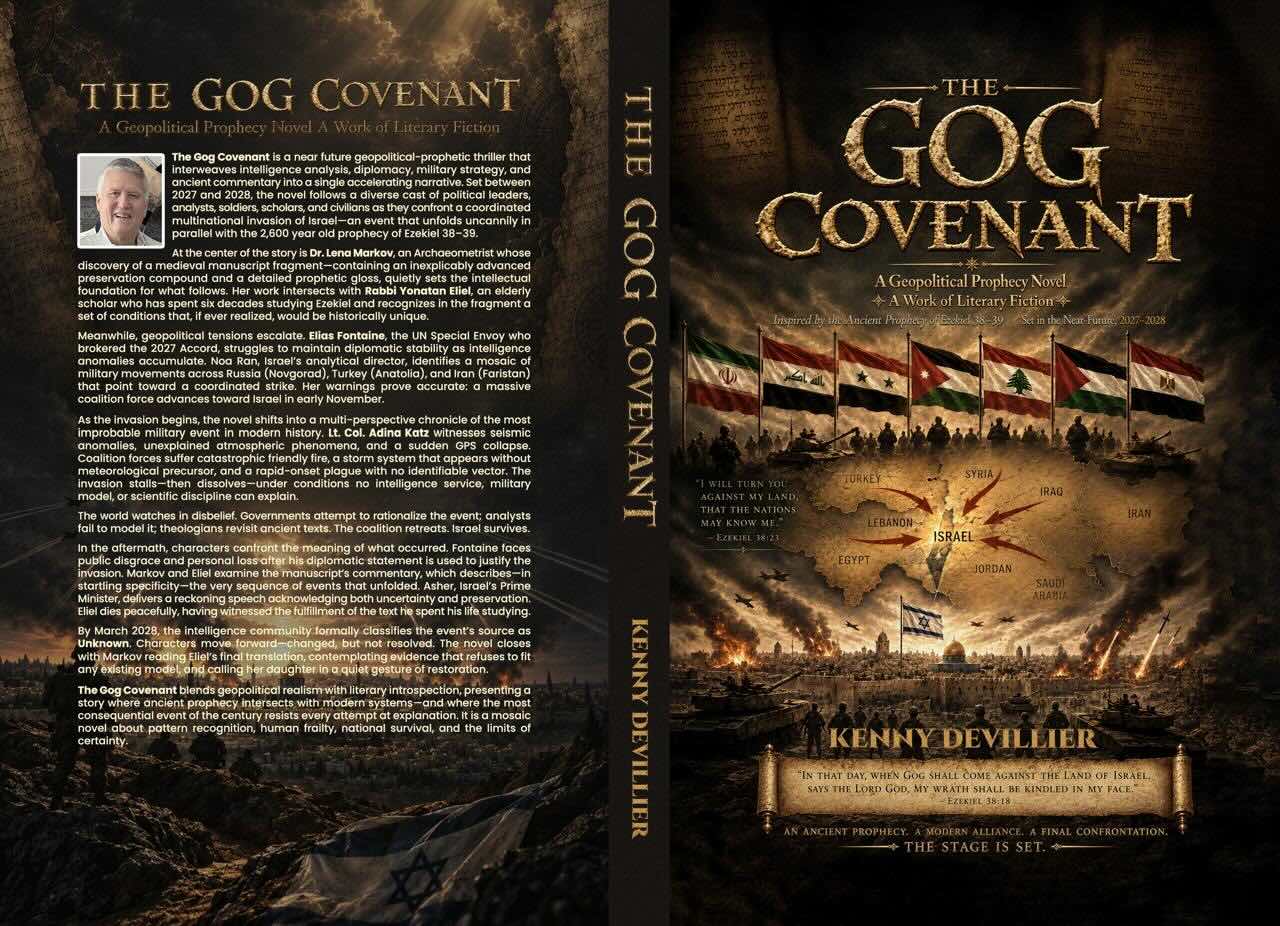
What happens when an ancient biblical passage inspires a fictional international crisis? In The Gog Covenant, author Kenny Devillier considers this question through a near-future setting shaped by geopolitical tensions, intelligence assessments, military decisions, and competing interpretations of Ezekiel 38–39.
Set across 2027 and 2028, the novel imagines a confrontation involving Yisrael and a coalition of regional powers. Through political leaders, intelligence professionals, military personnel, and religious scholars, Devillier presents a crisis that different people struggle to understand.
Rather than following one character exclusively, the narrative moves between perspectives with distinct responsibilities and beliefs. This structure allows readers to consider how professional experience influences the way people interpret the same unfolding events.
An Ancient Passage Inspires a Modern Fictional Crisis
Ezekiel 38–39 provides the biblical foundation for the novel’s imagined conflict. These passages describe Gog, a coalition of forces, and an attack against a restored Israel, raising enduring questions about prophecy and interpretation.
Devillier uses this material as literary inspiration rather than presenting his fictional narrative as proof of fulfilled prophecy. That distinction allows readers to consider the religious and geopolitical questions without confusing imagined developments with verified historical events.
The novel places ancient scripture alongside modern institutions, military planning, international negotiations, and intelligence reporting. This approach invites readers to consider how inherited interpretations might influence the way people understand an uncertain present.
Different Professions, Different Ways of Seeing
One defining feature of the novel is its collection of characters who approach the crisis differently. Each person brings distinct professional responsibilities, personal assumptions, and methods of interpreting the unfolding events.
Dr. Lena Markov, an archaeometrist at Hebrew University, examines an ancient parchment fragment and investigates its unusual preservation compound. Her work begins with physical evidence, careful observation, and questions that cannot be answered through assumption alone.
Rabbi Yonatan Eliel approaches the material through decades of studying Ezekiel and its interpretive traditions. His involvement introduces a distinction between understanding an ancient commentary and deciding what its words might mean for present circumstances.
Noa Ran, director of the Israeli National Intelligence Analytical Division, examines military movements and logistical preparations. Her responsibility is determining whether separate reports indicate a larger coordinated threat, requiring analytical discipline under considerable pressure.
These different perspectives allow the novel to consider how people approach the same evidence from different professional positions. Their disagreements make interpretation part of the story rather than a question with one immediately accepted answer.
Geopolitics Beyond the Headlines
The political landscape draws upon familiar regional relationships while establishing fictional national identities. Yisrael represents Israel, while Novgorad, Anatolia, and Farsistan correspond to Russia, Turkey, and Iran within the novel’s constructed setting.
These fictional counterparts allow Devillier to imagine political developments without claiming that the story’s specific events have happened in reality. The setting draws upon recognizable international concerns while giving the fictional conflict its own political framework.
Viktor Kazarov, the leader of Novgorad, approaches problems through practical reasoning and searches for explanations when events challenge his expectations. Meanwhile, Anatolia’s foreign minister, Kerim Arslan, uses the language of peacekeeping to describe military activity.
These character choices highlight the distance that can emerge between official terminology and what observers believe they are witnessing. Public statements, military assessments, and diplomatic choices become part of the struggle to define a rapidly developing crisis.
The Human Questions Behind Strategic Decisions
Although international politics provides the novel’s framework, its characters face questions that strategy alone cannot resolve. Miriam Asher, Yisrael’s prime minister, must make decisions about mobilization and civilian alerts while information remains incomplete.
Her responsibilities illustrate the difficult choices facing leaders who cannot postpone action until every uncertainty disappears. Decisions made inside the war room affect thousands of people whose lives extend far beyond official briefings.
The novel also considers people whose responsibilities reach beyond government offices and command centers. Dov Berkovitch, a reservist and pharmacist, leaves his Shabbat dinner to travel north after receiving an emergency call.
That small detail connects a national military crisis with an ordinary life suddenly redirected by events. Readers see how international tensions can interrupt familiar routines and demand immediate personal sacrifices.
Making Room for Questions Rather Than Easy Conclusions
The relationship between evidence and belief remains important throughout Devillier’s fictional world. Characters encounter events that challenge their established explanations, yet they respond through different professional, intellectual, and religious perspectives.
Some seek additional evidence, others revisit familiar interpretations, and still others struggle to reconcile professional understanding with what they witness. This variety allows the novel to consider religious questions without treating every interpretation as settled.
Markov’s scientific training, Eliel’s scriptural scholarship, and Noa’s intelligence work represent different methods of examining incomplete information. Their perspectives invite readers to consider what people can establish, what they believe, and what remains unresolved.
The novel does not require readers to adopt one character’s interpretation as their own. Instead, it places contrasting approaches alongside one another and allows their differences to inform the narrative.
For readers interested in geopolitical thrillers, biblical literature, or near-future political fiction, this combination offers several points of entry. The novel brings these interests together within an invented crisis, using competing viewpoints to examine how people respond when familiar explanations become difficult to maintain.
Ultimately, The Gog Covenant presents ancient prophecy as the starting point for a modern fictional question rather than a predetermined answer. Its combination of geopolitical conflict, professional investigation, and religious interpretation encourages readers to consider the relationship between belief, evidence, and uncertainty.

About the Author
Kenny Devillier is an author interested in reimagining biblical texts within modern geopolitical situations. Before beginning his writing career, he retired from the information technology field, where theoretical and data-driven analysis formed part of his professional work.
He has been married for 41 years, and together they have two adult children and two much-loved fur babies.
Website: https://kenny-devillier1.netlify.app
https://www.facebook.com/kennydevillierofficial
https://www.linkedin.com/company/kenny-devillier