
 Will Jones
Few culinary environments test a chef quite like a major international event. Behind the spectacle seen by the public are hospitality teams operating on demanding schedules, preparing food at scale while maintaining consistency, presentation, and quality.
For Chef Gourang Beeyani, that kind of environment became an important chapter in a career built on professional cooking. While working at Sheraton Grand Doha Resort & Convention Hotel in Qatar, Beeyani was selected to support the hotel’s Food & Beverage and outdoor catering operations associated with the FIFA World Cup Qatar 2022. His selection followed his work in the hotel’s high-volume banquet operation, where he had taken on responsibility for culinary production readiness, organization, coordination, and execution during demanding functions.
It remains one of the defining experiences of his career.
“The biggest challenge has been learning to perform consistently in environments where there is very little margin for error,” Beeyani says of the experiences that prepared him for the World Cup. “I learned to stay composed, communicate effectively, take ownership of my area, and respond quickly instead of simply waiting for instructions.” That journey, from banquet kitchens in Doha to one of international sport’s largest events and then to restaurant concept development in Miami, helps explain the kind of culinary professional Beeyani is working to become.
Earning the FIFA opportunity
Beeyani’s career grew out of the less glamorous but essential work of high-volume hospitality. At Sheraton Grand Doha Resort & Convention Hotel, he worked in banquet operations, an environment in which production priorities, timing, and service requirements could change quickly. His responsibilities included preparing his area for service, coordinating production and execution, and responding to changing demands.
Even as a management trainee, Beeyani began attracting attention for his willingness to take responsibility beyond the work assigned to him. Bhavesh Utekar, one of his previous supervisors at the hotel, recalled that Beeyani would organize production priorities, coordinate preparation with the cooks around him and make sure his section was ready for service rather than waiting for someone else to address a problem. “He did this from the start, without being asked to, and the cooks around him came to rely on him,” Utekar says.
Beeyani was then selected for the World Cup operation. Ayush Tyagi, then Director of Food & Beverage at Sheraton Grand Doha Resort & Convention Hotel, said trainees were not normally considered for that level of responsibility. Beeyani was chosen after his performance in the banquet kitchen.
One incident during the World Cup shows why. As Beeyani’s team was preparing for a demanding service, an unexpected change in production requirements put his section behind schedule just as service was starting. A delay in his area could have affected the readiness of the wider catering operation. Rather than waiting for the problem to escalate or for a supervisor to step in, Beeyani reorganized the work. He identified which items were most pressing, reassigned preparation among his cooks, and organized tasks that could be completed in parallel.
Tyagi says the episode stood out because “a trainee recognized an operational risk, made decisions under pressure, directed other cooks, and took responsibility for an area on which the larger operation depended.”
During the FIFA assignment, Beeyani worked in an international, large-scale culinary operation involving food production, quality and presentation, coordination between culinary and Food & Beverage teams, and strict service timelines. “I was drawn to the culinary industry because food combines creativity with discipline and the ability to create an experience for people,” Beeyani says. “As my career developed, I became particularly interested in going beyond just making dishes. I wanted to understand how a chef can develop concepts, organize teams, maintain consistency under pressure, and create culinary programs that can also contribute to the restaurant industry.”
His contribution during the tournament period was subsequently recognized with a Certificate of Appreciation citing his “outstanding performance and lasting contribution” in outdoor catering during the FIFA World Cup Qatar 2022.
From global hospitality to Miami
Beeyani’s career later took him to the United States, where his work at Ghee Indian Kitchen in Wynwood, Miami introduced a different challenge. The World Cup tested operations at scale. Restaurant work gave him an opportunity to experiment with culinary development and how an idea becomes a repeatable guest experience.
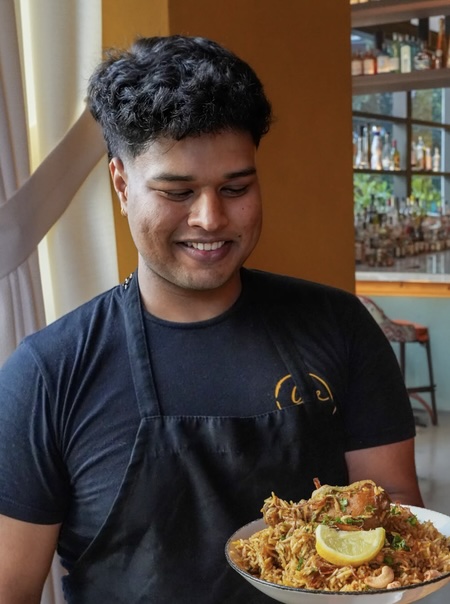
That thinking can be seen in his involvement with Biryani Nights, the Friday-night program Beeyani created at Ghee Indian Kitchen, Miami. The idea revolves around serving biryani, a traditional Indian dish, live in the dining room from a large traditional cooking vessel. The regional style of the biryani rotates monthly among Hyderabadi, Kolkata, Lucknowi, and Kerala traditions.
According to Michael Moss, General Manager of Ghee Indian Kitchen in Wynwood, Beeyani proposed the concept and then helped turn the idea into an operating program. He developed recipes for each of the regional styles and was involved in menu development, production planning, preparation, kitchen organization, staffing, timing, quality control, and service execution.
One of the key steps was making sure the program did not rely solely on him. Beeyani trained a team of 11 cooks in Dum cooking for Biryani Nights, preparing the broader culinary team to execute the program consistently. “This was not a situation in which Chef Beeyani merely prepared food for an event designed by others,” Moss says. “He was directly involved in conceiving and implementing the initiative and remained responsible for its culinary execution.”
Creating the idea was only the beginning. The real work came in building the recipes, production processes, and team capabilities necessary to execute that idea repeatedly. “What sets me apart is my combination of culinary creativity and operational execution,” he says. “I don’t look at a dish only from the perspective of flavor. I think about how the concept can be produced consistently, how the team will execute it, how quality can be maintained during service, and ultimately how the culinary idea can create value for the restaurant.”
The business results during the same period reflect the success of the program. Across the first six program Fridays documented by Ghee Indian Kitchen, net sales increased by approximately 49%, 50%, 36%, 28%, 34%, and 17%, respectively. Restaurant revenue is influenced by numerous factors, so those figures cannot reasonably be attributed to one chef or initiative alone, however, Moss cites Beeyani’s leadership as an important contributor.
For Beeyani, the experience showed that culinary creativity and restaurant operations do not have to exist separately. “Seeing a culinary concept generate guest interest and measurable commercial results reinforced my belief that chefs can influence both creativity and business performance,” he says.
Building on Indian culinary identity
As Beeyani looks ahead, Indian cuisine remains central to what he wants to build. His longer-term ambition is to continue developing as a chef and culinary leader while creating concepts that combine Indian culinary identity with modern restaurant experiences. Eventually, he hopes to build his own culinary business.
His experiences have also shaped several principles about the profession that he believes are useful for chefs early in their careers.
First, learn to perform under pressure without compromising on quality. Beeyani’s World Cup experience taught him that the moments when time is shortest are exactly when organization and communication are most important.
Second, take bias for action. Don’t wait for a title before taking ownership. Beeyani was still a management trainee when his willingness to take on responsibility helped earn him a place in the World Cup operation.
Third, look beyond the dish. The development of Biryani Nights taught Beeyani that a good culinary idea has to work operationally. A chef may create a memorable recipe, but a restaurant program also requires sourcing, preparation, training, staffing, timing, quality control, and consistency.
Beeyani’s culinary expertise has not gone unnoticed. The Chaîne des Rôtisseurs, an established international gastronomic society with a presence in 79 countries and such notable members as Julia Child and Robert Mondavi, honored Beeyani for his skill and innovation at Ghee Indian Kitchen. In October, the organization’s Greater Miami Bailliage recognized his “culinary excellence, gracious hospitality, and dedication to the art of the table,” demonstrating his status as a rising player on the global culinary stage.
Ultimately, Beeyani wants to be known for more than individual dishes. “I want my career to demonstrate that a chef can be both a culinary creator and an operational leader,” he said. His career is still unfolding. But from Doha to Miami, Beeyani has built his journey around a consistent idea: good food is only the beginning. The harder task is turning culinary creativity into an experience that guests can enjoy, and a restaurant can sustain.