
 Will Jones
Siblings Ria and Armaan Damani, a data science student and an electrical engineering and computer science student from San Diego, turned their Westwood apartment into a home for her fashion and his music for under $5,000.
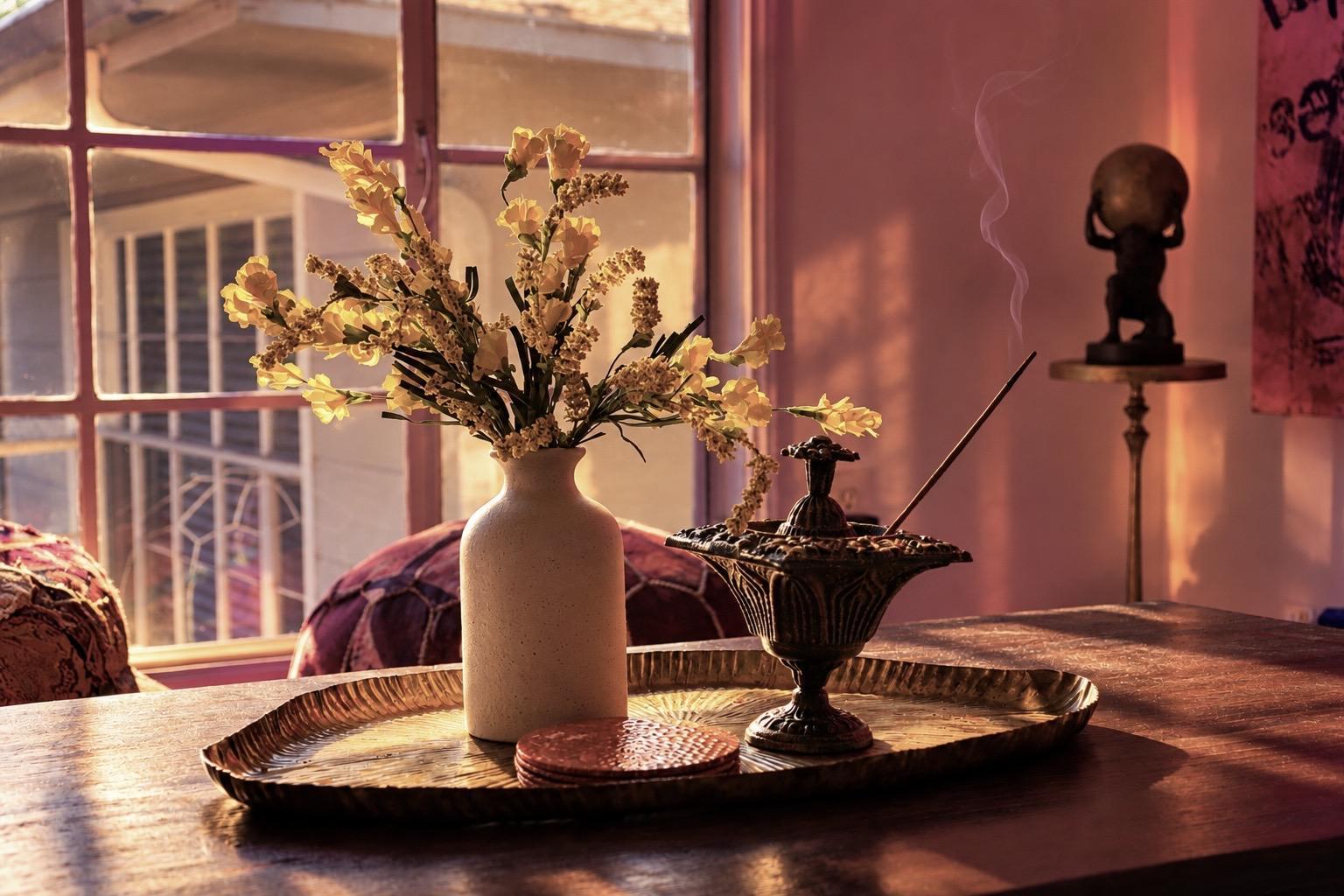
Photo by Ria Damani
At golden hour, the late sun comes through the tall multi-pane windows of Ria and Armaan Damani’s Westwood living room, throws a grid of shadows across the white walls and turns two large canvases to coral. The pink one reads “Social media is fake.” Please enjoy your real life!” The surrounding apartment was built to do exactly that.
Ria studies data science. Armaan, two years older, studies electrical engineering and computer science. Both spend their weeks on numbers, systems, and code, and when they moved into their first shared apartment, they designed it for two moods, warm and sunlit by day, glowing and jewel-toned after dark. They furnished it for under $5,000, counting everything except the electronics, and it looks like a family home collected over decades.
A Project They Assigned Themselves
The siblings grew up in San Diego. Whenever they were assigned a project together as kids, they found a way to work as a team, so when they signed a lease in Westwood, they gave themselves one more. They would design the apartment side by side, as a way to bond and to mark the move.
Agreement came quickly on some things. “The Chinese cabinet was the first thing we both said yes to without even discussing it. The first fight was the living room canvases. I thought the pink one was too loud, and he thought loud was the point,” Ria says. Armaan remembers the outcome a little differently. “She’ll say she came around. I’d say the room settled it. Once the olive rug went down underneath them, they weren’t loud. I won that one, but she won most of the others.”
Each brought a practice of their own. Ria is a fashion designer, and Armaan is a music producer and DJ. Both show up in the rooms, her eye in the fabrics on her bed and his music in the instruments on his wall and the record player in the living room.
The Mix
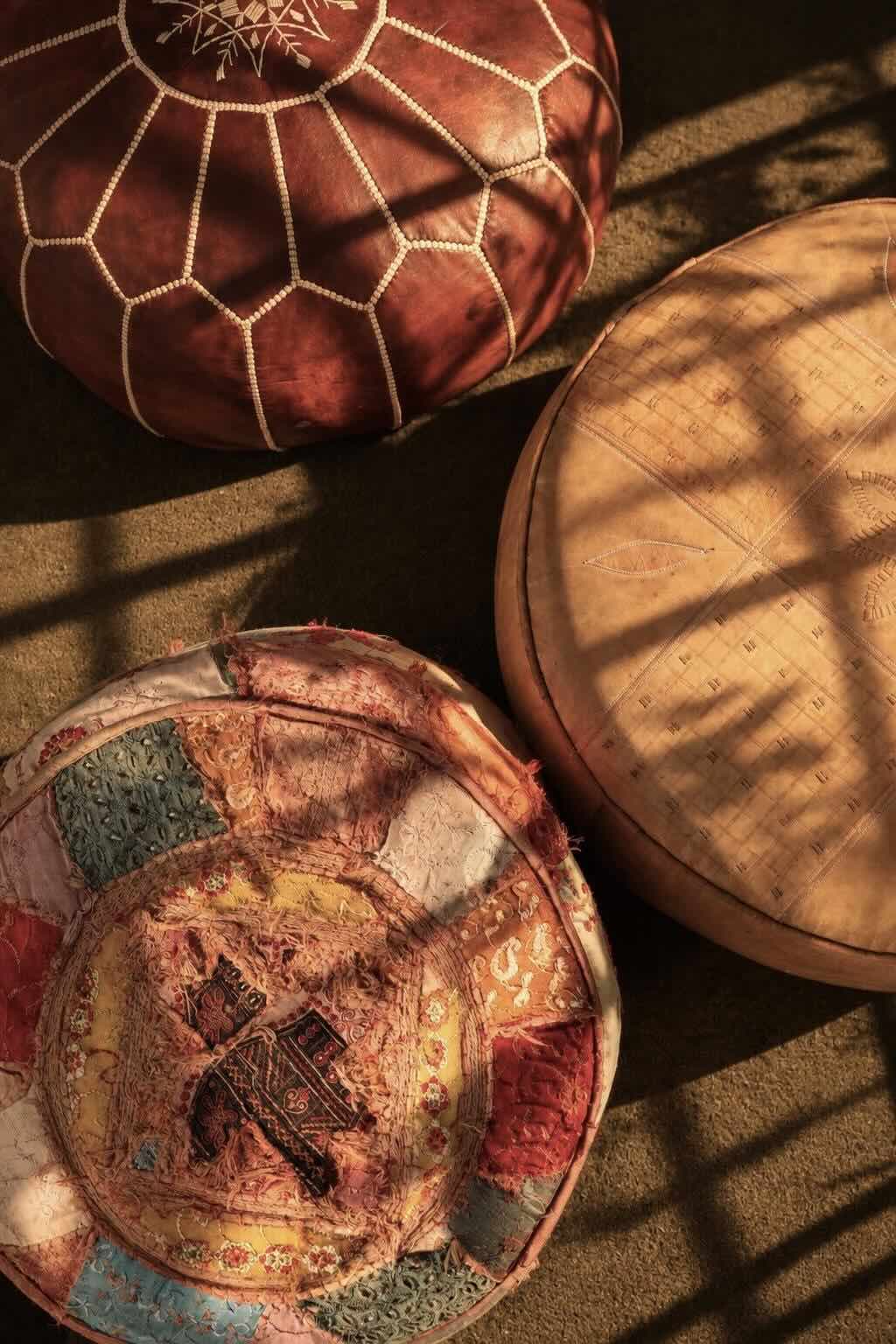
Photo by Ria Damani
Most of what they bought is vintage or secondhand, much of it from Facebook Marketplace. The white walls and oak floors stay quiet, and the color comes from found pieces in terracotta, rust, cognac, and deep blue, tied together with brass and copper. The pieces come from everywhere, including a painted antique Chinese cabinet, a Senufo-style coffee table, Moroccan leather poufs, carved Indian wood and contemporary art from Cuba, Mexico City, and the Middle East.
“In engineering, you set your constraints first and build inside them. We did the same thing here: a budget, one color family, and one answer to it in every room. The rules are what let us take risks with everything else.” Armaan says.
For Ria, the logic came from data. “Data science is finding the pattern in a lot of noise, and scrolling Marketplace is exactly that. There are thousands of listings, and you’re looking for the five that fit what you already have. Once we locked the palette, I could tell in a second if something belonged.”
Golden Hour in Westwood
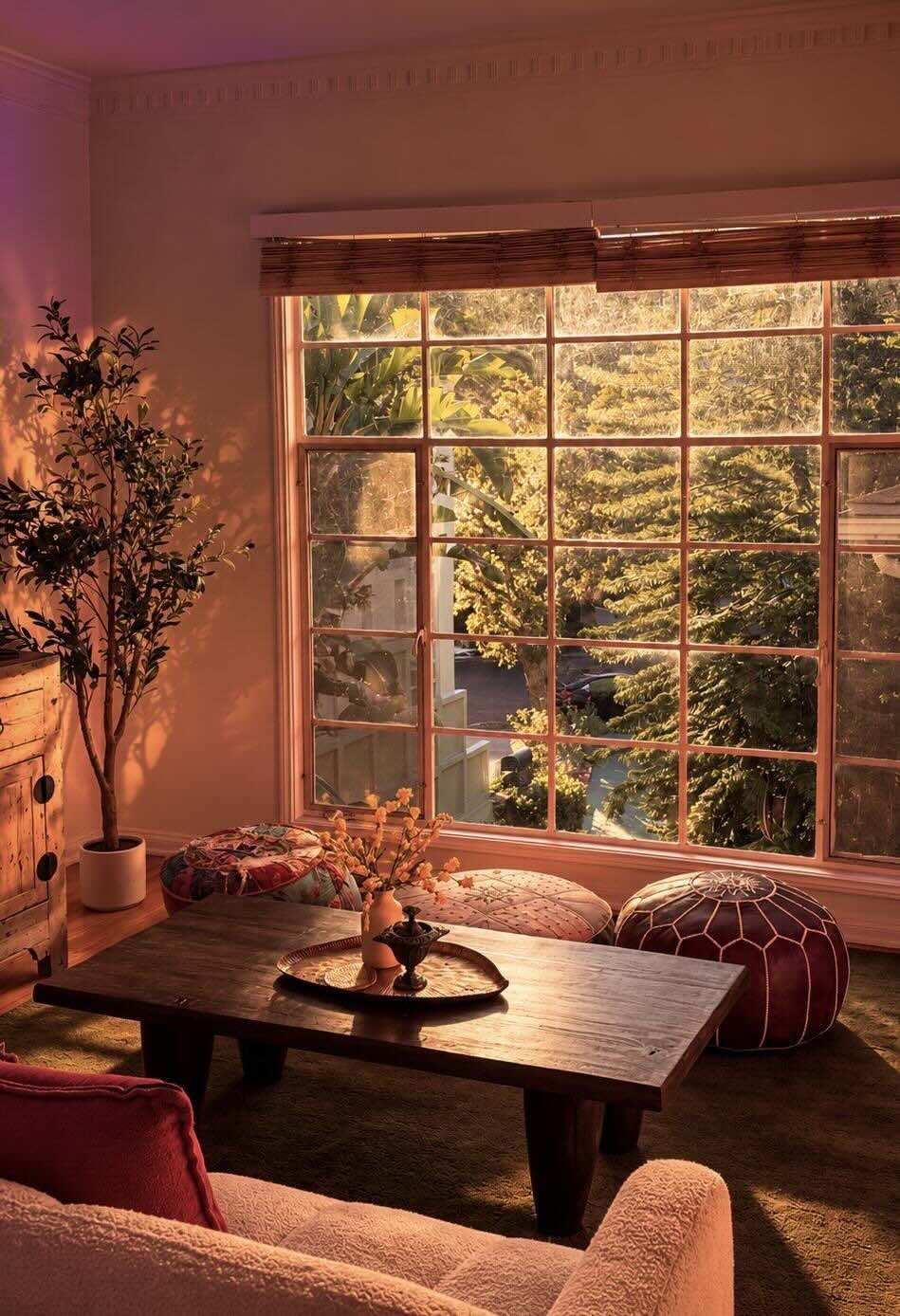
Photo by Ria Damani
The living room is the apartment’s loud, sunlit heart. A cream bouclé sofa faces the windows and their woven bamboo shades, a solid olive rug keeps the floor quiet so the art and textiles can be loud, and a faux olive tree stands in the corner.
The canvases are by the Cuban artist Mecánica Distributiva. The hot pink one on the left reads “Social media is fake. Please enjoy your real life!” The red-orange one on the right reads “Follow your f***ing dreams, not me.” Under the hand-lettering, both are layered with ghosted packaging marks, barcodes, and the word “Smiles” stamped over and over, a joke about branding that suits a home made for real life. Along the baseboard below, rustic wood planter boxes are packed with roses in oxblood, burgundy, black, and ivory.
The coffee table is a long, low Senufo-style piece in dark, near-black wood on chunky tapered legs, after the carved furniture of West Africa’s Senufo people. A ribbed brass tray holds a speckled cream bud vase of yellow blooms, a stack of hammered copper coasters and an ornate cast-metal incense burner. Behind it, a bronze-finish Atlas kneels on a slim gilded pedestal with the globe on his shoulders. The floor seating is three poufs, one in chocolate Moroccan leather with white petal stitching, one in natural tan leather with an embroidered motif, and one in a patchwork of embroidered fabrics in rose, saffron, teal and cream, frayed at the edges.
In the corner, an antique Chinese cabinet in butter-yellow paint, chipped to bare wood at the edges, with black iron ring pulls and a round iron lock plate, holds a turntable and a pair of bookshelf speakers. Above them is a Tiffany-style lamp of coral roses and violet flowers hanging from a bronze vine. This is where Armaan’s music meets the room. “Music is in every room, even the ones without speakers. The violins are on my wall because that’s where I started, classically trained, long before production. The turntable usually has a deep house record on it, and at golden hour that corner is my favorite place in the apartment.”
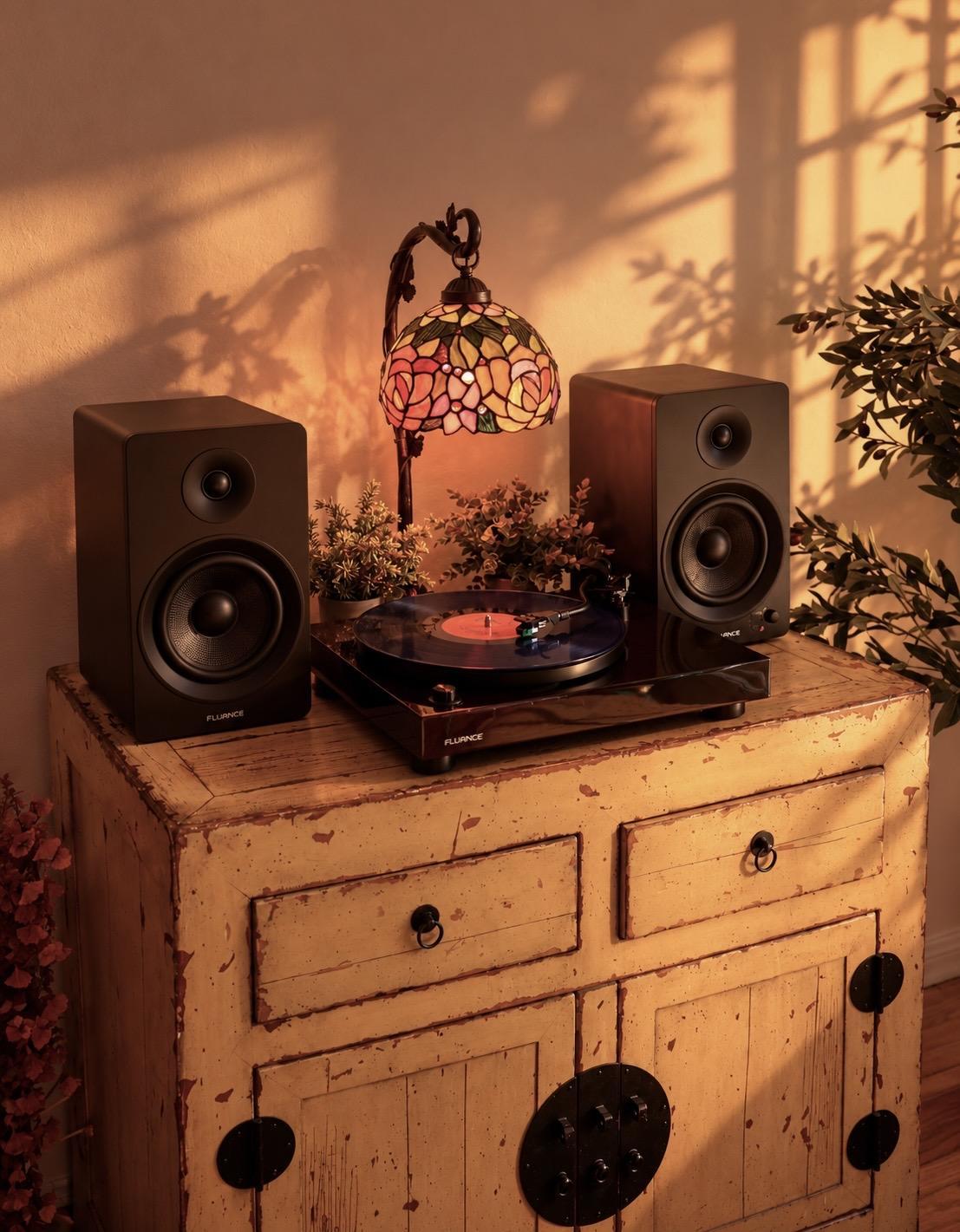
Photo by Ria Damani
Under the Wisteria, After Dark
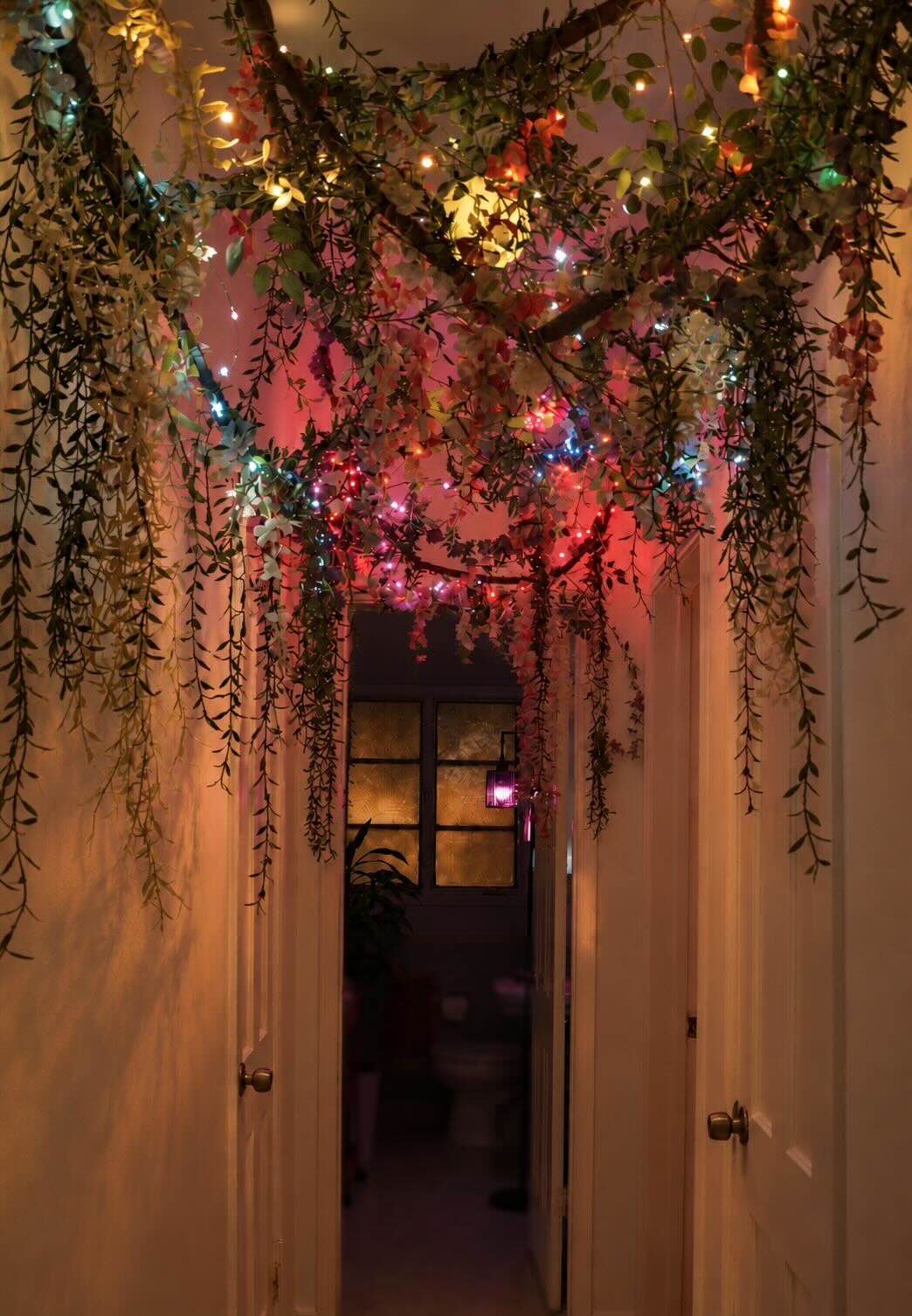
Photo by Ria Damani
After dark, the apartment runs on lamps, candles, fairy lights, and a soft pink-violet ambient glow, and each room takes on a color of its own. The hallway is where it is at its best. The siblings strung bare branches across the ceiling of a plain white corridor and wound them with faux wisteria in white, pink, and peach, with trailing greenery hanging to door height. Fairy lights in warm white, pink, red, and blue run through the branches and light the blossoms from inside, turning the walls rose-gold. Walking to the bedrooms means walking under an arbor.
The Amber Hour
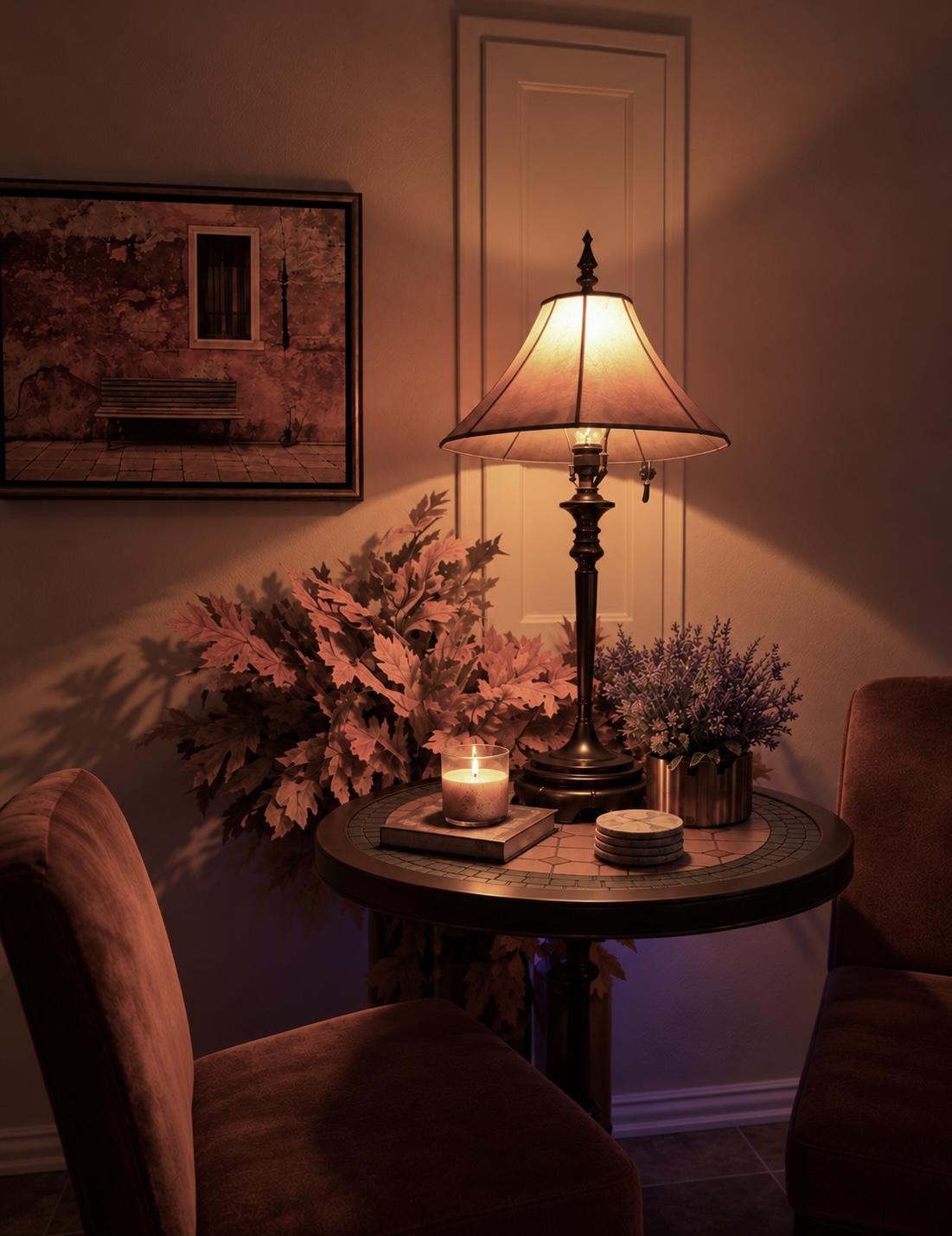
Photo by Ria Damani
The kitchen nook becomes a candlelit café for two. A round bistro table with a mosaic top of terracotta tiles and a bronze rim stands between two velvet chairs, under a vintage lamp with a flared bell shade on a turned bronze column. A candle burns on a book beside a brass pot of lavender and an armful of autumn oak leaves. Above it hangs a framed painting of a weathered Mediterranean wall, with a bench beneath a shuttered window. Asked about the best find in the apartment, Ria has an answer ready. “The best find was the turntable. The item is so unusual that it’s automatically a conversation piece. It’s still the first thing people ask about.”
Ria’s Room, Cut From Cloth
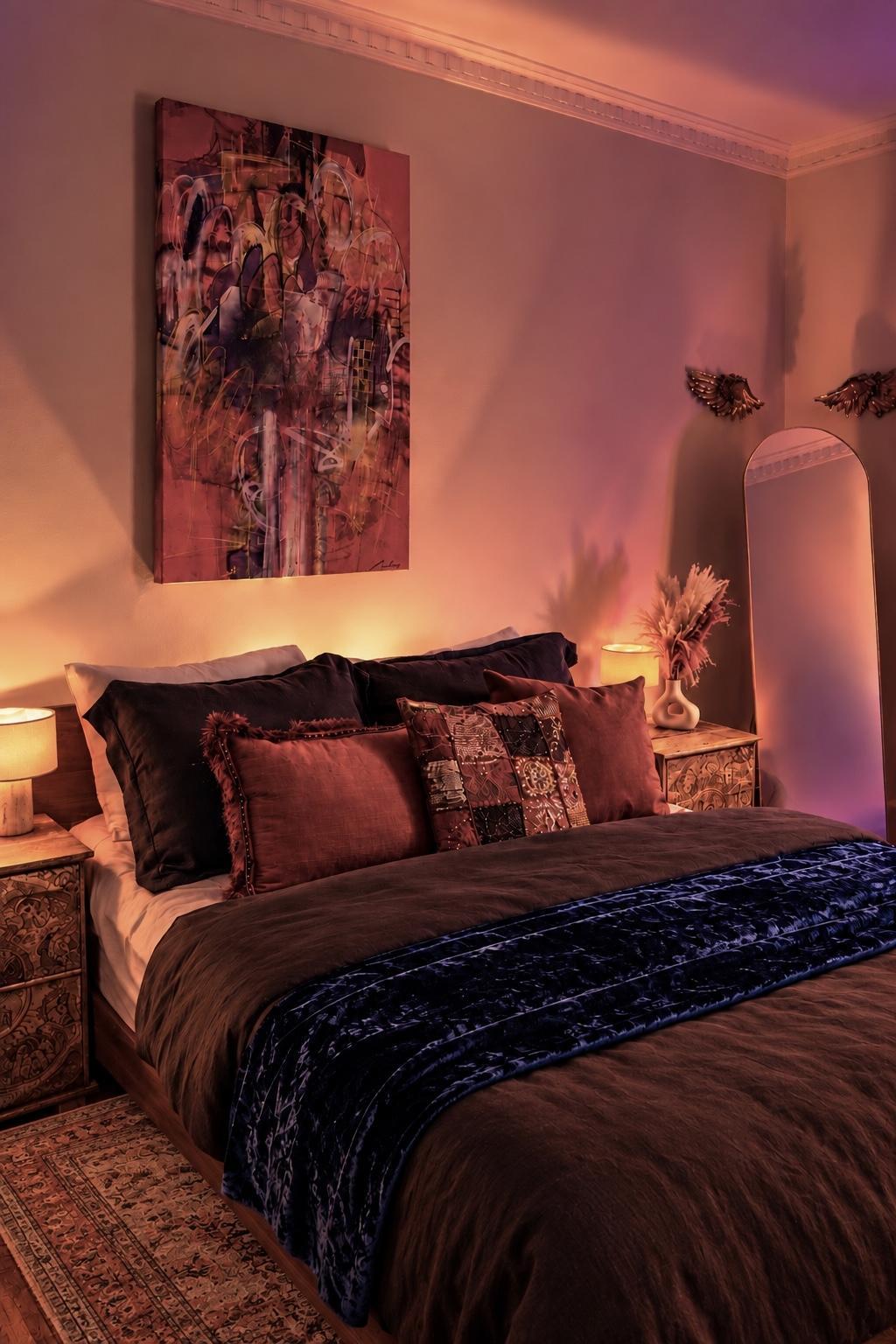
Photo by Ria Damani
Ria’s room is the fashion designer’s room, and the bed is where it shows most. She chose and combined every fabric on it the way she would build a look. The base is a chocolate-brown washed-linen duvet with espresso shams, matte and relaxed. On top are a rust pillow edged in fringe and beads and a square of sequin-and-embroidery patchwork, with a deep blue crushed-velvet throw across the foot, the single cool note in a warm room. Linen, fringe, sequins, and velvet, held to brown, rust, and blue, each catches the light differently. “I dress a bed the way I’d style a look. You start with a quiet base, so the linen is matte and a little undone. Then you add texture with the fringe, the beading, and the sequin patchwork. And there’s always one piece that breaks the palette, which is the velvet. Every fabric on that bed catches the light differently, which is why the room looks best at night,” she says.
Over the bed hangs a large graffiti-style abstract from the Castros gallery in Mexico City. In the corner, a pair of gilded angel wings is mounted just above an arched gold floor mirror. At night, travertine lamps glow amber on hand-carved nightstands, the ceiling picks up a soft violet light, and the sequins and gold catch all of it. Her brother notices something else first. “The bed. It has a designer feel. Every pillow is a different texture, and somehow none of them fight. In my room that would look like chaos. In hers it looks finished.”
Armaan’s Room, Strings Attached
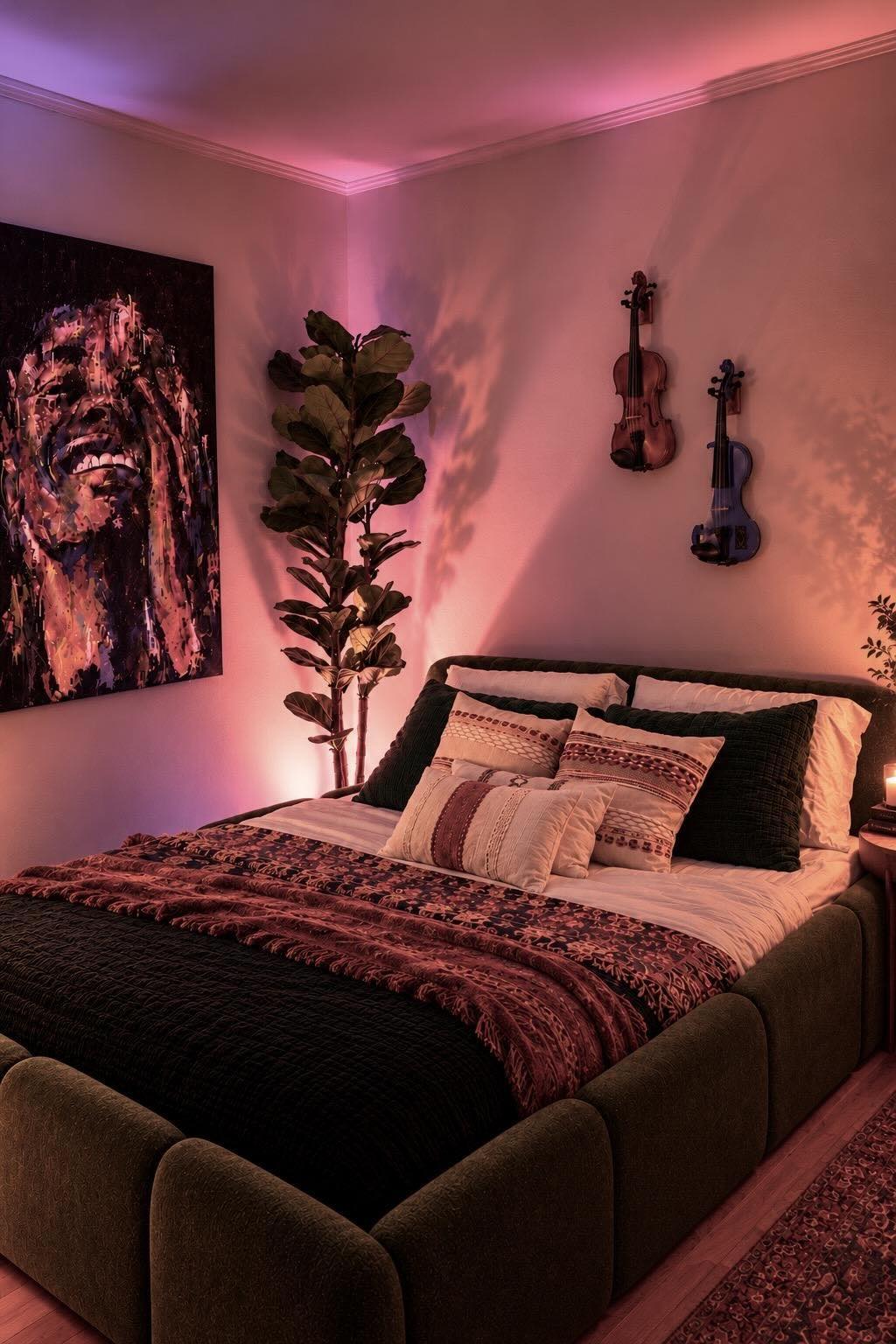
Photo by Ria Damani
Armaan’s room is built around his instruments. Two violins are mounted side by side on the wall, a traditional acoustic in red-brown varnish and a bright blue solid-body electric. Hung together, they are the two halves of his sound, classical training on one side and electronic production on the other, and they are his answer to Ria’s fabrics across the hall.
The bed is a low, modular cloud bed in olive chenille, built from rounded, cushion-like segments and made up with dark quilted bedding, woven cream pillows and a fringed rust-and-black throw. On the wall hangs a print by the Middle Eastern contemporary artist Shai Yossef, a palette-knife portrait of a figure laughing with head thrown back. In the corner, a fiddle-leaf fig throws leaf shadows across the wall. After dark, pink and violet light washes the ceiling and walls, a single candle burns by the bed, and the room becomes a listening lounge. Ria’s verdict on her brother’s room is short. “The violins. He hung his whole sound on the wall, the analog half and the electronic half. That’s my brother in one look.”
Real Life, Please
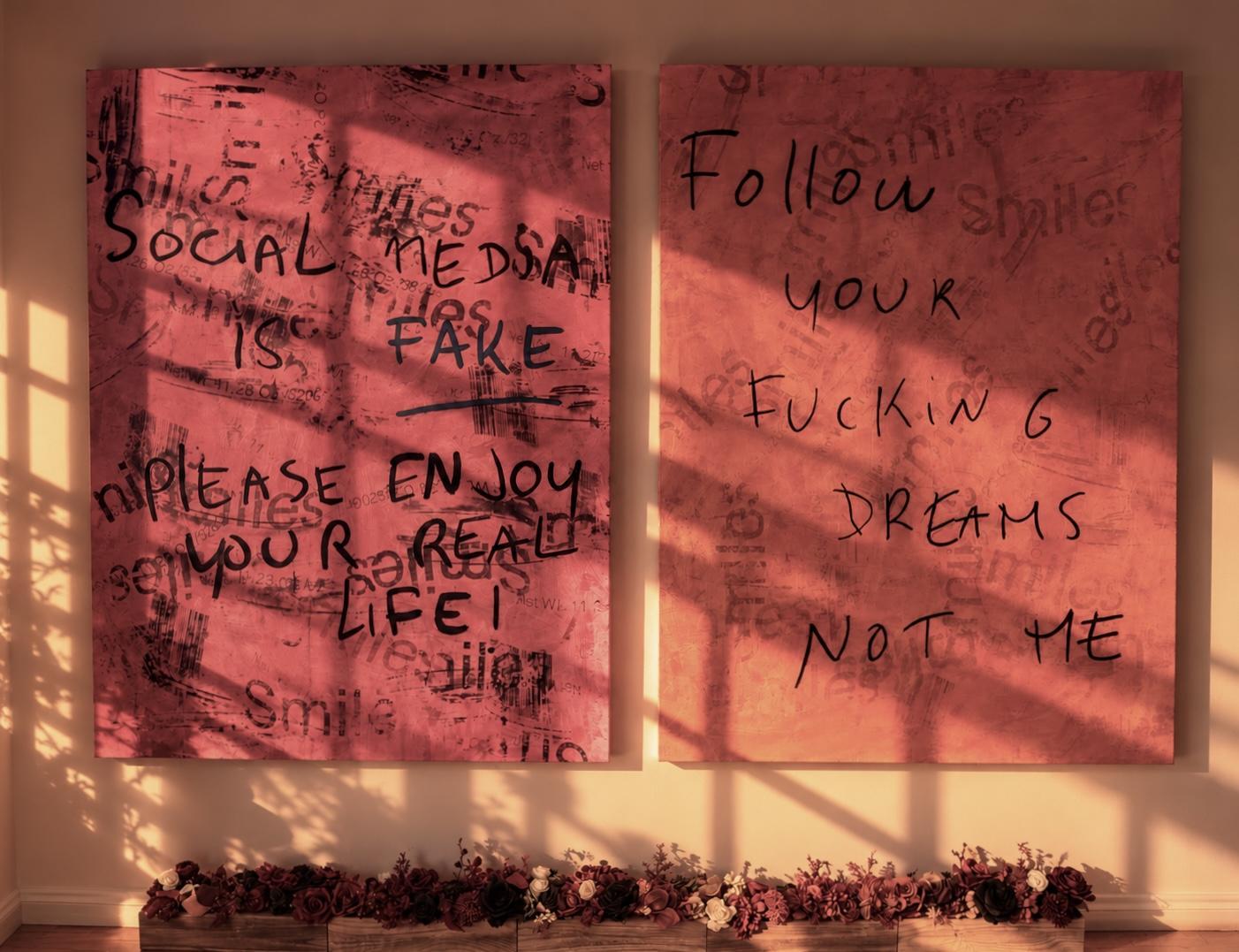
Photo by Ria Damani
Ria and Armaan photographed the apartment themselves, in both of its lights. By day it is a sunlit room for friends and records. By night it is a lit arbor, a candlelit café and two bedrooms washed in their own color. The pink canvas over the rose bed asks visitors to enjoy their real life, and two siblings who study systems built a home for doing that at both ends of the day.
“We’ve been doing group projects together since we were kids, so this was just the biggest one yet. We learned how to disagree, sort it out, and still end up on the same page. Now we get to live inside the result.” Armaan says.