
 Will Jones
“Going paperless” in music has been an aspiration for years. The promise was always compelling—carry an entire library, search instantly, annotate freely—but screens were too small, glare too aggressive, battery too unreliable, or ecosystems too pricy. As a result, even in 2026, many musicians still hedge: a tablet for convenience, paper for performance.
That’s exactly the gap a new generation of 14-inch tablets is starting to close—and in doing so, it’s reframing what the “best tablet for musicians” actually means.

A Screen That Matches the Medium
The single biggest unlock is size. At 14.3 inches with a 3:2 aspect ratio, the NXTPAPER 14 is one of the few tablets that actually matches the proportions of printed sheet music. That matters more than resolution or refresh rate ever will in this category.
Unlike most Android tablets that skew tall, or iPads that lean wide, this format lands exactly where musicians expect their eyes to move. The usable screen area is effectively equivalent to a full letter-sized page—slightly exceeding it in practice—meaning scores can be displayed at near-native scale.
That single shift solves a cascade of real-world problems. Musicians no longer need to zoom mid-performance, annotations remain legible without adjustment, and dense orchestral parts retain their structure. In landscape, the screen is large enough to comfortably display two pages, replacing the dual-tablet setups many users have relied on.
This directly reflects what users have been saying: once the screen is large enough, the device no longer feels like a workaround and starts functioning as a true replacement for paper.
For pianists, conductors, and ensemble players, this eliminates the cognitive friction of constantly adjusting the view. For gigging musicians, it removes the need for dual-tablet setups.
Built for the Real Conditions of Performance
The NXTPAPER line’s defining feature is its nano-textured display, designed to reduce fatigue over hours of reading.
Unlike glossy panels that produce sharp reflections, this surface diffuses light into a softer, more uniform layer. In practice, that makes annotation more tactile and the overall viewing experience closer to paper. Many users describe it as slightly “resistant” under a stylus, which is exactly what you want when marking phrasing, cues, or fingerings.
Under strong direct light, the same diffusion that softens reflections can spread them across the screen, given the tablet’s moderate brightness ceiling. But in the context that actually matters, one musician, one stand, controlled stage lighting, the trade-off is coherent. The display avoids harsh luminance spikes and incorporates hardware-level low-blue-light technology backed by TÜV certification, helping maintain visual comfort during long rehearsals and performances. It prioritizes consistency and comfort over peak brightness, which aligns with long rehearsal sessions far more than with spec-sheet comparisons.
Workflow Is the Real Product
The reason musicians adopt digital is control. A well-configured tablet setup enables:
- Instant search across thousands of scores
- Structured tagging by composer, ensemble, or performance
- Rapid setlist creation and reordering
- On-the-fly annotations that persist across performances
On a smaller tablet, these advantages exist but feel constrained. On a 14-inch canvas, they scale properly. Navigation feels less constrained, annotations are more precise, and transitions between pieces are more fluid. The device fades into the background, which is exactly what musicians want.
Beyond the screen, the NXTPAPER 14 makes a series of pragmatic decisions that align with how musicians use their devices.
One of the longstanding trade-offs in digital sheet music has been between comfort and responsiveness. E-ink devices offer a paper-like appearance but suffer from latency. Traditional tablets respond instantly but introduce glare and fatigue.
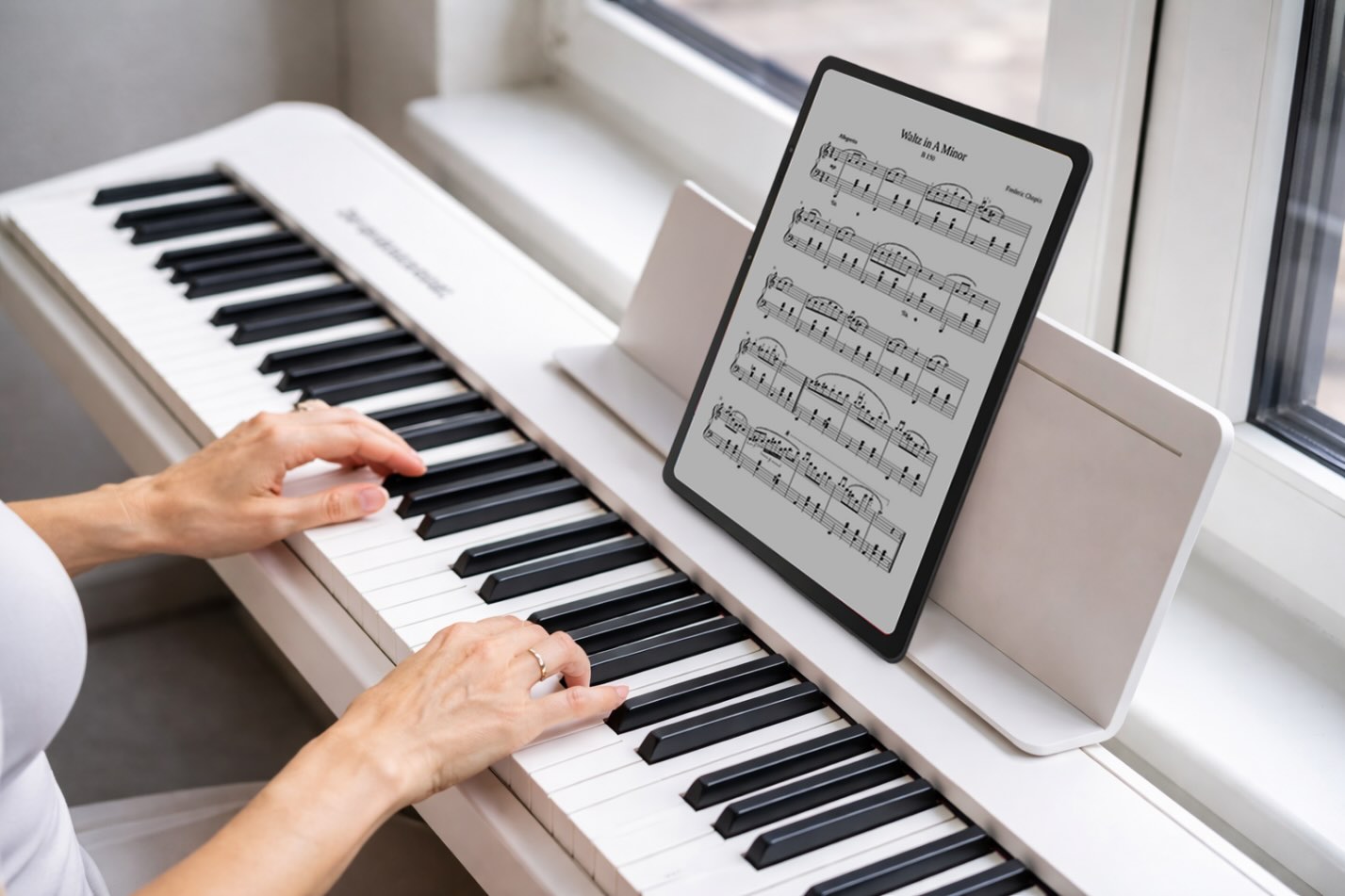
The NXTPAPER 14 bridges that divide. It retains full responsiveness, allowing musicians to turn pages, jump between sections, and annotate scores in real time without interruption. There is no perceptible delay to anticipate, which is critical in live settings where timing cannot be compromised.
Priced under 400 dollars, it includes 256GB of storage with SD card expansion, which directly addresses the reality of large music libraries. Unlike more locked-down ecosystems, this allows musicians to scale their collection without replacing the device. A stylus and protective case are often bundled, reducing setup friction and making the tablet immediately usable out of the box.
Battery life is consistently strong—lasting multiple sessions or even days—which is critical in environments where charging is not always convenient. Even peripheral issues, like poor venue lighting or cramped stands, are effectively minimized. The device standardizes the experience across environments.
An increasing number of professional musicians are replacing paper scores with digital alternatives on stage, raising expectations for how tablets perform in live settings.
Devices like the TCL NXTPAPER 14 suggest that the answer is increasingly yes. By focusing on scale, readability, and responsiveness, it addresses the core limitations that held earlier tablets back. For musicians, that changes the equation. Paper is no longer the default because it is safer. It becomes a choice rather than a necessity.