
 Will Jones
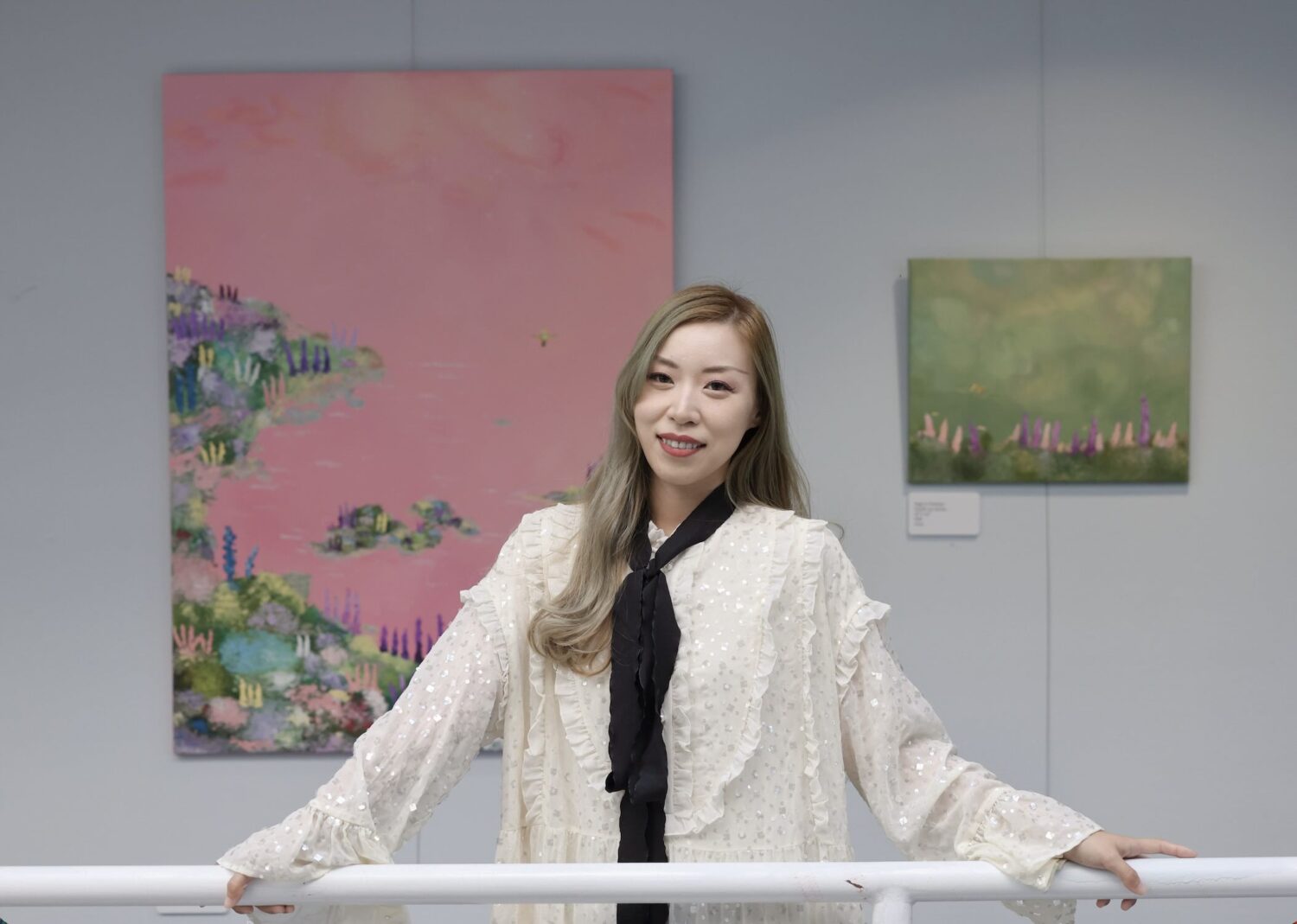
For cross-cultural contemporary artist Mengyi Grace Wang, a flower is never simply a flower. It is a metaphor that carries the memory of one place while blooming in another — a bridge between cultures, identities and competing ideas of home. That idea is now on the wall, literally, in Blooming in Roots, Wang’s solo exhibition at the Costa Mesa Senior Center, on view through Dec. 31 after Wang was selected as one of only three artists in the City of Costa Mesa’s official 2026 exhibition series.
It caps an unusually busy year. Wang’s paintings were shown at the Compton Art & History Museum in We Are the Land, which closed earlier this month, and at nonR Art Museum in China over the summer. In December her work travels to CICA Museum in Gimpo, South Korea, for the international group exhibition Message — her museum debut in the country. In March 2027, her work will make its debut at the Tokyo Metropolitan Art Museum in Japan as part of the 25th Japan International Art Exchange Exhibition, The USA Exhibition. Four museums and a solo show across four countries within a year, for a painter whose subject is, at bottom, what it means to put down roots somewhere new.
The clearest way into her work is a plant called velvet sage. Wang first noticed it blooming at the Summer Palace in Beijing on a childhood field trip. Years later she found the same flowers at Columbia Road Flower Market in London, where she was studying, and later still in gardens and front yards across the United States, where she now lives. The landscape had changed completely; something familiar remained.”
It is this experience of recognition across distance that sits at the center of my practice,” Wang shares.
Working primarily in acrylic on canvas, Wang combines Modern Impressionism with techniques and aesthetics drawn from traditional Chinese painting. Her canvases fill with flowers, plants, animals and expanses of pastel violet and vibrant green — imagery she treats as a visual language that crosses linguistic and cultural boundaries without translation. Nature in her paintings is both deeply personal and deliberately open-ended: velvet sage holds one memory for the artist and another for the viewer, and a flower tied to her memories of China may also grow in London or California, carrying someone else toward their own family, neighborhood or sense of belonging.
That exchange is essential to how Wang understands cross-cultural art. Rather than treating identity as something fixed by geographic borders, her paintings consider it as something continually shaped by memory, movement, environment and experience.
Blooming in Roots makes the idea explicit. The exhibition presents flowers, plants and nature as a universal visual language that crosses geographic boundaries and takes root in different lands. Plants can travel, adapt and flourish in soil far from where they began; the same species can bloom in several regions while acquiring a different cultural meaning in each. For Wang, people can do the same. “Roots” in the title are not only an attachment to geography but personal foundations, histories, memories and cultures. “Blooming” is the possibility of renewal and expansion without those roots having to disappear.
It is a particularly resonant proposition in Southern California, where identities, languages, histories and diasporic experiences overlap block by block. Wang’s work does not try to collapse those differences into a single experience. It looks for the points where they can meet.
A recurring influence is Xiao Man, or “Little Fullness,” one of the 24 solar terms of the traditional Chinese calendar. It names the moment when grains have begun to ripen but have not yet reached complete fullness. Wang’s paintings embrace the idea of being “almost full, yet not complete,” she says — “a state of becoming that symbolizes the beauty of growth in progress.”
Her flowers accordingly appear at moments of transition — blooming, shifting, emerging, approaching a seasonal turn — as flowers dissolve into skies and expressive brushwork moves between softness and raised, dimensional layers of paint. Rather than a still moment, Wang catches nature mid-transformation. That incompleteness mirrors life between cultures, in which identity does not arrive at a destination so much as accumulate: memories of one place coexist with experiences formed somewhere else, and new environments do not erase old roots but add a layer each time.
Where “identity” can easily become an abstraction, Wang keeps it elemental — the experience of recognizing a flower, an animal, a season or a landscape. Nature does not mean the same thing to everyone, and that is exactly what makes it useful to her: its imagery is understood without translation while its emotional meaning stays intensely individual. That tension lets her explore belonging without prescribing what belonging
should look like. Cross-cultural connection, her paintings suggest, does not require identical histories. Sometimes it begins with recognizing something familiar in someone else’s landscape.
Wang arrived at that position by living it. Born in China, she earned dual bachelor’s degrees in art and film and media studies at UC Irvine and dual master’s degrees in global communication from USC and the London School of Economics. A recipient of the Contemporary Art Pioneer Award and recognized by CCARTD as a Pioneering Contemporary Chinese Artist, she has exhibited at museums and art centers including the Sunshine International Museum and Shangyuan Art Museum in China and the Sasse Museum of Art in the U.S., and was chosen as a cover artist for Visual Art Journal from among 45 international artists. She is also a collaborative editor at ZAO Magazine, a U.K. nonprofit publication, where her research centers on cross-cultural communication and diaspora in contemporary art.
The thread continues beyond Costa Mesa. The Everlasting Fall, which captures the lotus in its final bloom before fading in late autumn, uses one of the most familiar flowers in Chinese culture to work through the same intersections of nature, memory and identity. It is scheduled to be shown in Message at CICA Museum from Dec. 2 through 20 — an exhibition built around meaning, communication and language, which is to say, around precisely the questions Wang’s flowers have been asking all along.
From velvet sage encountered in Beijing, London and the United States to a lotus carrying its memories across the Pacific, the proposition is a simple act of nature: a flower can take root in one place and bloom in another. Roots can travel. For Wang, the memories they carry can transform along the way, and something familiar can bloom again in an entirely different place.
Blooming in Roots is on view through Dec. 31 on the second floor of the Costa Mesa Senior Center, 695 W. 19th St., Costa Mesa; Monday–Friday, 8 a.m.–4 p.m. More at mengyigracewang.com/bloominginroots