
 Jacob Martus
As legislators target retail sales, online veterans like Kraken Kratom represent the industry’s evolution toward quality and transparency
The neon-lit smoke shops lining Sunset Boulevard are facing an unexpected inventory crisis. Between the vape cartridges and CBD gummies, a Southeast Asian botanical called kratom—once relegated to head shop corners—had quietly grown into a $441 million industry before California’s regulatory hammer came down.
Governor Newsom’s administration has launched an aggressive campaign to clear certain kratom products from retail shelves, leaving store owners with a stark choice: face daily $1,000 fines or risk losing their permits. But while brick-and-mortar retailers scramble, the online kratom market tells a different story—one where established vendors are leaning into lab testing, transparency, and consumer education rather than flashy packaging and convenience-store placement.
The Legal Landscape: What’s Really Happening
California’s kratom crackdown isn’t happening in a vacuum. Two key pieces of legislation are reshaping the state’s approach:
Current Legislative Actions:
- Assembly Bill 1088 (2025): Restricts sales to individuals 21+, establishes state-level regulation framework
- Senate Bill 758 (2025): Makes synthetic 7-hydroxymitragynine products a misdemeanor offense
- Administrative Actions: Statewide retail enforcement with $1,000 daily fines for violations
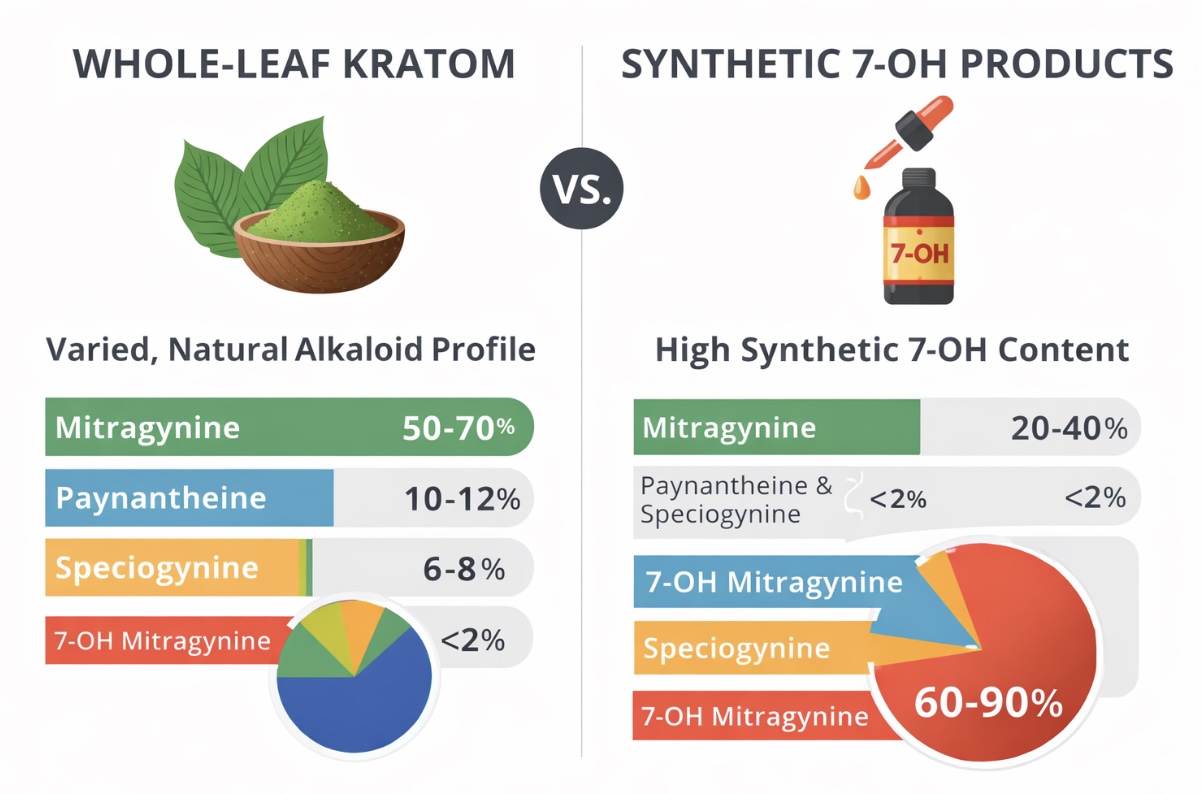
Much of the confusion centers on 7-hydroxymitragynine (7-OH), a naturally occurring kratom alkaloid that has been synthesized and sold in highly concentrated forms. Traditional whole-leaf kratom contains dozens of alkaloids in naturally occurring proportions. Synthetic 7-OH products, however, triggered regulatory concern due to their elevated potency, lack of dosing clarity, and inconsistent oversight.
“The issue isn’t kratom itself,” explains industry analyst Sarah Chen. “It’s the wild west of unregulated synthetic compounds being marketed as ‘just kratom’ to unsuspecting consumers.”
Quality Over Convenience: The Online Advantage
As California’s retail landscape shifts, many consumers are discovering what longtime kratom users already know: the most reliable products are rarely found in gas station coolers.
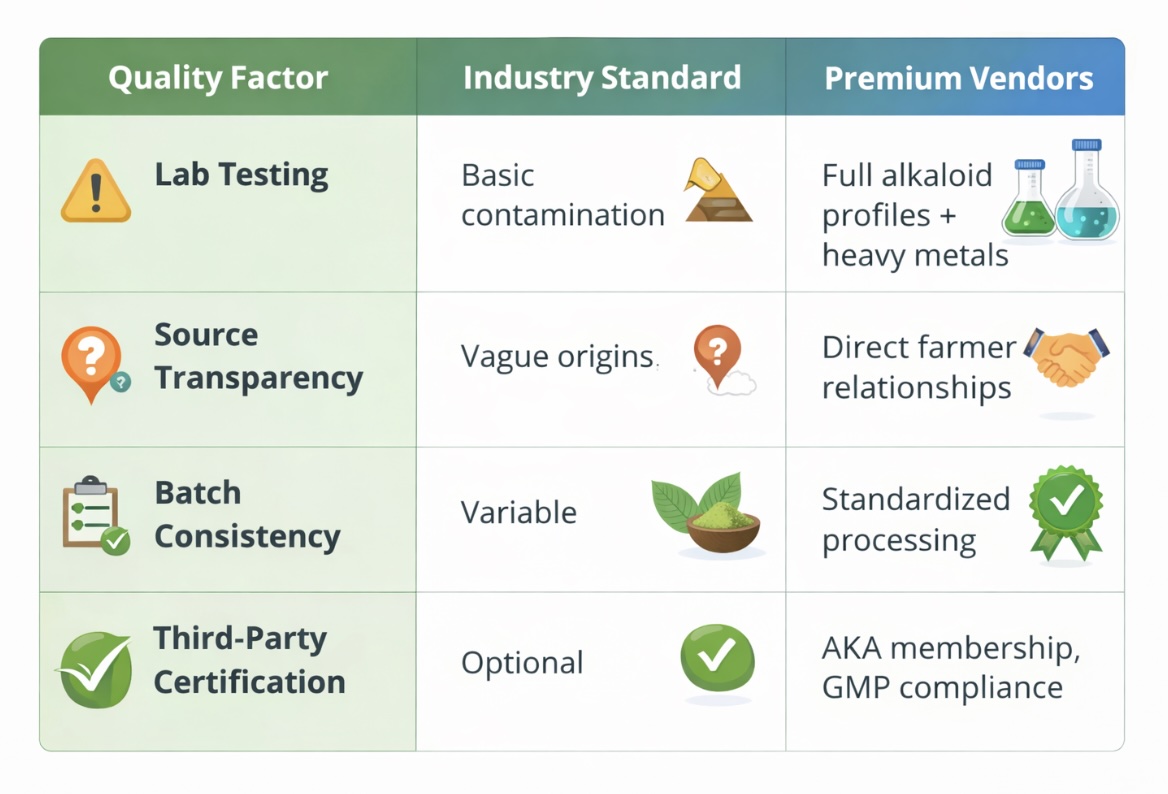
The online market has matured around quality standards that many retail outlets simply don’t have the infrastructure—or incentive—to maintain. Comprehensive third-party lab testing, Certificates of Analysis (COAs), age-verification systems, and transparent sourcing are becoming baseline expectations rather than premium add-ons.
What Separates Premium Vendors:
Full disclosure: I work at Kraken Kratom, so I see this shift from the inside. But what’s happening isn’t unique to one company—it reflects where the serious side of the industry has been heading for years.
Established online vendors have invested heavily in independent lab testing, GMP-compliant manufacturing processes, and American Kratom Association (AKA) standards. Not because it sounds good in marketing copy, but because regulatory scrutiny was inevitable. Companies that intended to operate long term understood that surviving in this category would require documentation, consistency, and transparency.
When legislators criticize “unregulated products,” they’re often describing loosely sourced convenience-store inventory—not vendors who have been publishing batch-specific COAs for years.
Navigating Regulatory Uncertainty
California’s retail crackdown may ultimately accelerate a trend that was already underway: consolidation around vendors prepared for oversight.
Comprehensive testing protocols, accessible Certificates of Analysis, and standardized processing are becoming competitive necessities. Vendors that invested early in quality systems are not scrambling to retrofit compliance—they’re refining processes that already exist.
This isn’t about altruism. It’s about sustainability. In a category that has long faced regulatory uncertainty, forward-looking companies built infrastructure designed to withstand it.
Key Industry Trends Emerging:
- Mandatory Third-Party Testing: Certificates of Analysis becoming standard practice
- Age Verification Systems: Proactive 21+ compliance ahead of legislation
- Educational Content: Vendors investing in consumer education vs. flashy marketing
- Direct-to-Consumer Models: Bypassing retail uncertainty with controlled distribution
- Alkaloid Standardization: Moving beyond generic “red/green/white” classifications
Consumer advocates are increasingly blunt: if a product doesn’t have recent lab testing, it shouldn’t be trusted. Certificates of Analysis verifying the absence of Salmonella, E. coli, heavy metals, and adulterants are becoming the baseline standard.
Beyond the Regulatory Storm
Paradoxically, California’s enforcement efforts may strengthen the industry long term by pushing out questionable products and raising expectations.
While retail stores face immediate disruption, online vendors with established quality protocols are seeing consumers seek out more reliable sources. Across online communities, the conversation increasingly centers on documentation, sourcing transparency, and consistency—not convenience.
What Consumers Should Look For:
- AKA (American Kratom Association) membership status
- GMP (Good Manufacturing Practice) certification
- Complete Certificates of Analysis for each batch
- Clear alkaloid content information
- Transparent sourcing and farming relationships
- Educational resources vs. medical claims
The Path Forward
As California’s legislative process unfolds, the kratom industry is facing a defining moment. The brands most likely to endure will be those that have already embraced documentation, testing, and operational transparency.
For Los Angeles consumers navigating this changing landscape, retail convenience may be fading—but access to rigorously tested products remains available through established direct-to-consumer vendors. Regulatory pressure, while disruptive, may ultimately professionalize a category that has operated for years in a gray zone.
The question isn’t simply whether kratom will survive California’s scrutiny. It’s whether consumers will begin distinguishing between rushed retail products and vendors that built their business models around long-term accountability.