
 Gideon Leek
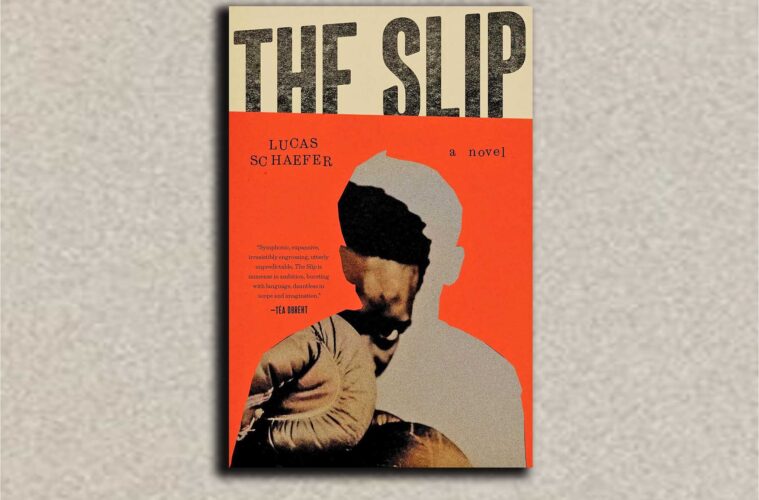
Nathaniel Rothstein, the hero of Lucas Schaefer’s The Slip, is violent, sexually frustrated, and racially envious. He’s also a pudgy dork who loves big fantasy novels and show tunes. When Nathaniel snaps at school lunch and throttles a fellow student, he finds himself expelled from the leafy suburb of Newton, Massachusetts, for the subtropic sun of Austin, Texas, to spend the summer of 1998 living with his ornery hippie uncle and volunteering at a nursing home. This isn’t a bad plan, but summer is a long time for a teenager. Plenty of high schoolers undergo a heat-activated metamorphosis; it just doesn’t quite work out for Nathaniel. He grows into something — it’s just not himself. At first, everything’s great: Nathaniel finds a mentor in his Haitian boss, David, and an appropriate outlet at a local boxing gym. Then, suddenly, Nathaniel’s “de-putzification” becomes a straight-up disappearance, a literal fade to black.
Back in 2017, Schaefer published a portion of the nascent epic that would become The Slip in the literary magazine One Story. He described the work-in-progress as “a novel-in-stories about an Austin boxing gym,” inspired by the real Austin institution R. Lord’s Boxing Gym (where he worked out) and the intense place-based documentary approach of Frederick Wiseman’s Boxing Gym. At some point over the past eight years, the novel-in-stories became a regular novel; Schaefer layered the Nathaniel plot on top of his location piece. The book is still rooted in vivid character studies, many revolving around the boxing gym, but Nathaniel’s ghost moves the reader between narratives. Each new perspective naturally emerges from the last, offering more clues, more context, more characters, with every new segment another fragment of a fractured mirror, each new addition getting the reader closer to reality. It’s Rocky in the style of Rashomon with a heavy rewrite from Philip Roth.
There’s not enough space to cover all the stories here, and frankly no way to do so without spoiling much of the novel — but let me at least give you the A plot. Why did Austin go so wrong for Nathaniel? Well, Nathaniel would have spent his summer “hiding under his floppy safari hat and trying to finish off whatever Skinemax-ed dragon trilogy he happened to be reading” if it weren’t for two things: the ribald mockery of his boss at the nursing home (a vocal expert on cunnilingus, wonderfully described as a sort of “debauched Jiminy Cricket”), and a big billboard promoting a Slavic sex line.
First, Nathaniel calls the sex line — spending his Hanukkah money sheepishly listening to canned spank material. Then, in a moment of madness, he starts channeling David. This works out big time. Not only does it get Nathaniel off, now one of the Russian girls wants to CALL HIM. “Yesterday,” she says, “you make me come harder than I have in sixteen years.” And they do it all over again. Suddenly, Sasha, the phone sex operator, is calling four times a day, demanding phone sex. But when she asks for a meetup, everything goes off the rails. Not only has Nathaniel been speaking with an “island lilt” borrowed from David, he’s been portraying himself as a 25-year-old Caribbean man: “Every time Nathaniel mentioned one of his own body parts — commanding Sasha to lick his this, to ride his that — he’d preceded it with a single word: Black.”
He panics. “How do you turn from white to black?” Nathaniel searches on Ask Jeeves (remember, this is 1998) and slowly begins to immerse himself in dubious racial science. He learns the difference between “a righteous-ragged eight rock” and a “tight-headed inky dink,” and how bodybuilders turn themselves “seal brown via intravenous injections of Melanotan II,” before he remembers something from class back in Newton: How the journalist John Howard Griffin used an anti-psoriasis drug and a heat lamp to conduct the Borat-style social experiment that yielded Black Like Me (a book that sold millions of copies in the ’60s and might still conceivably have been taught in 1998).
Nathaniel’s notion to turn himself Black so he can drive across town and sleep with a Russian sex worker is, of course, absurd. But not much more absurd than, say, Philip Roth’s The Human Stain — where a light-skinned Black man spends a lifetime passing as Jewish. Some people will find Schaefer’s novel offensive. Others will find it impossible. I don’t think it’s either.
Much of Schaefer’s commentary on race is masked under cynical Jewish humor. But even when he’s joking, Schaefer is savvy and sober about how race penetrates different aspects of American life. In white high schools, “each time [Nathaniel’s] teacher uttered the n-word as she read aloud” students would call out: “Mrs. Bartlett’s gettin’ jiggy wit it!” “Mrs. Bartlett’s a G!” In suburban tanning salons: “DreamSkinz was a land of restless suburbanites, a place for those who had white-flighted out of city centers and now, in a karmic twist, spent their days conspiring to darken.” In American Jewish enclaves: “Ten minutes on Megansett Beach … and this one turns into a Schvartze!” In juvenile detention: “For a white kid to end up in juvie? You had to do the most fucked-up shit imaginable. This one dude was in there for raping a horse.” And even in Nathaniel’s own transracial mission: “Did he look Black? More like he was midway through a teen tour of Jerusalem.” (Or, as uncle Bob puts it, “[His aunt] says he’s finding himself. I said, as what? Gunga Din?”)
But Nathaniel’s story is just the connective tissue. All the individual stories that build to his fate are equally rich. The young, likely transgender X (née Charles Rex) sits in the school library reading the Kever-Barr Manual of Mental Dysfunction, wondering what it means to feel out of place as a man but not violently hate your penis. The fading psychoanalyst Dr. Abruzzi recalls her own racial assimilation: “No one, it seemed, was in a rush to return the calls of a lady-doctor-in-waiting called Abruzzi. As a Robertson, it proved less difficult.” And my favorite, David, Nathaniel’s dirty-minded Haitian boss, on never quite loving Austin: “He’d see The Wizard of Oz and think back to his early time stateside as much the opposite, a denizen of bustling Emerald City blown away to live out his days with farm folk in black and white.” There are half a dozen more characters like this, all relating to Nathaniel and his appropriately ironic fate, and all hard to describe in much detail without spoiling the twist.
What else to say? There’s not much to take issue with. There’s a stolen joke from Superbad about a classmate doodling dongs all day. (“It was a downright Lolly-palooza in there. Sharpie dicks, colored-pencil dicks, dicks of all sizes.”) One joke compares an off-color nursing home resident to an extra from Frederick Wiseman’s Titicut Follies. This joke is funny but I have a pedantic problem: Extra is the incorrect term. Those were real inmates at Bridgewater, not actors! But that’s about all I could find to criticize. It’s a tremendously strong novel.
There’s a lot to admire here. The Jewish humor — Schaeafer describes the impossible physical qualities of Sasha as making up a “Mrs. Potato Head of tits and ass.” The period work — Donatello’s Bo Staff, Memoirs of a Geisha, Batman Forever, JNCO jeans. The throwaway bits — the sex line proprietor paraphrasing Tolstoy, “Happy penises are all alike.” “And unhappy penises? All alike, too.” The legitimate boxing instruction — “When you slip you should feel a twist in your torso.” “Keep your hands up. Bend your knees.”
This is a character-based pop novel done right: accessible, unpretentious, hard-hitting. Too universal to be literary fiction, too well-written not to be — the kind of bestselling savoir faire that made Stephen King and Jonathan Franzen household names. It’s not just that I liked it, it’s that I can imagine so many other people liking it — my little brother, my dentist, my old football coach.
But the thing I admire most is that Schaefer set himself such a challenge for a debut novel and that he succeeded. I can’t overstate how immiscible the mix of ingredients is in The Slip. It’s a matzo ball topped with fried plantain served between two slices of Texas toast. Schaefer takes an unpalatable mixture of ingredients and makes something light, piquant, and satisfying. From disparate, difficult parts comes a great Mrs. Potato Head. ❖
Gideon Leek is a writer who lives in Brooklyn.