
 Daniel Fusch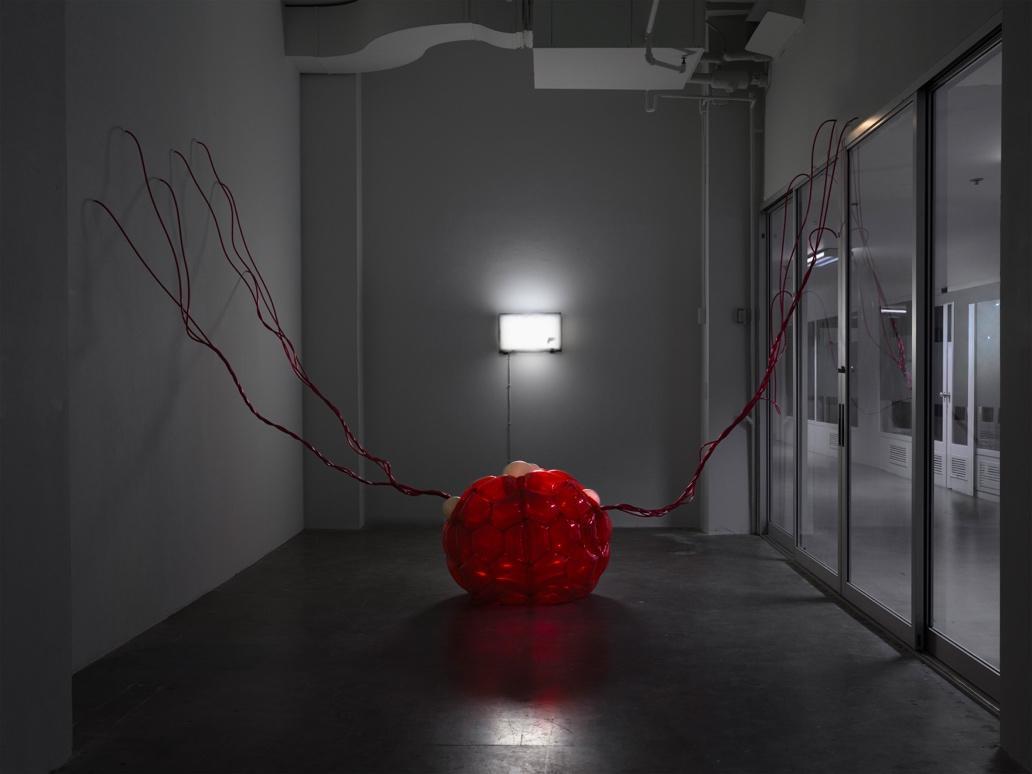
Chinning Liu’s latest solo exhibition “Mitosis” at The Reef. (Photograph: Zengyi Zhao)
In a courtyard surrounded by greenery, artist Chinning Liu, dressed in a white sterile suit, kneels before a bench to perform a “surgery.”
In the exhibition Invisibility as Method (Alt Projects), Chinning Liu begins with a surgical performance whose traces slowly unfurl into a month-long installation. This artist investigates the supply-demand dynamics between SCOBY (a symbiotic culture of bacteria and yeast) and sugar. The artist adheres the dehydrating cultures to the sugar shell cavity, creating a model of pseudo-symbiosis or parasitism. Through a ritualistic performance of cavity-invasive action and flesh reconstruction, she joins the SCOBY and the sugar as artistic collaborators. Over the following month, the artist shifts into the role of an observer, accepting her collaborators’ own rates of absorption and dehydration, allowing this internal dynamic equilibrium to complete the time-based work.
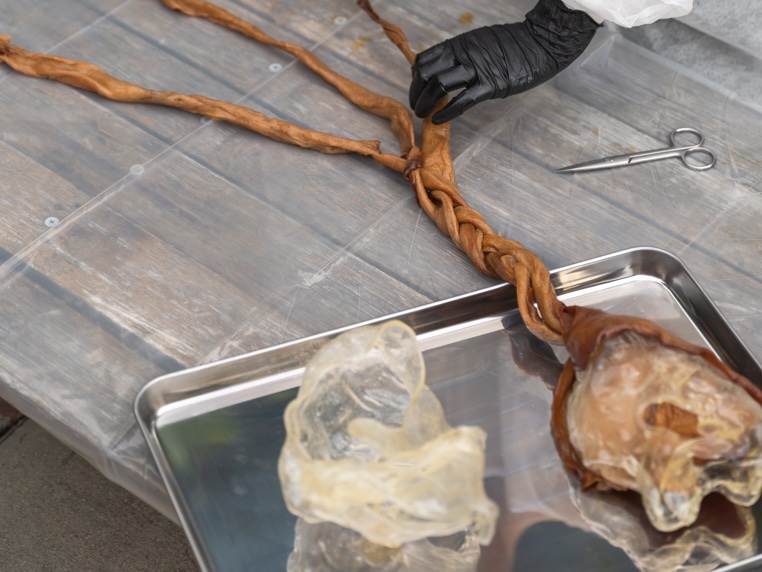
Chinning Liu, On-site performance in Invisibility as Method, Alt Projects (Photograph: Zengyi Zhao)
Liu harbors both a fascination with and a sense of contemplative witness toward her materials, assigning these media a new positioning. As Liu states: “I do not merely manipulate these materials as inanimate objects; I have long viewed biomaterials as my artistic collaborators. By directly integrating organisms and scientific concepts into her creative medium rather than merely depicting them, this co-creative dynamic between humanity and the natural world casts light on the deeply intertwined and unpredictable relationships between human and non-human entities within shared ecosystems. This same conceptual framework is embodied in her installation works, Sac (The Reef, Los Angeles) and Colon (Cevera Yoon Gallery, Los Angeles).
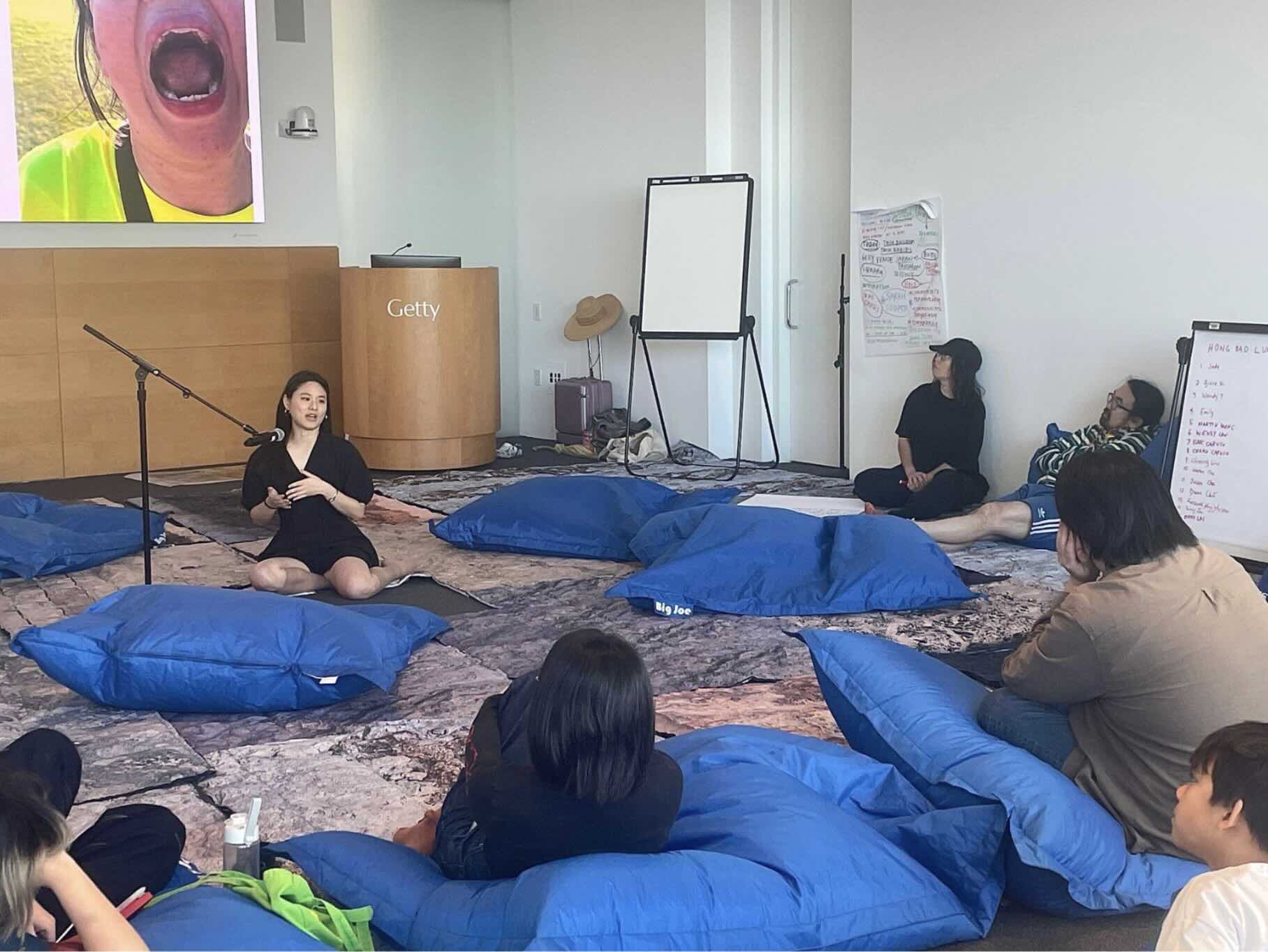
Chinning Liu, 24 HOUR CARE Open Mic Performance at the Getty Center, 2026.
(Courtesy of the artist and the Getty Center)
Liu’s background in science and psychology allows her to approach art through a unique artistic lens informed by observations of human behavior and perception. She often depicts the ideology through the performances. In the FXR 24 HOUR CARE Open Mic performance at Getty Center, Liu talked about how the environment unconsciously bonds personal attachments. Her visual language is saturated with hollows, strip-forms, and fleshy textures—elements that evoke extensions of the human body, biomimicry, and an intimacy to biological life. Rather than merely representing nature, she incorporates living organisms and scientific processes directly into the fabric of her practice. In her work, artistic creation is a process of negotiation between human and nonhuman actors, with agency distributed across bodies, systems, and forms of life. She dissolves conventional boundaries between artist, organism, and environment, thereby illuminating the profound entanglements that bind humans to the more-than-human world.
Liu’s background in science and psychology allows her to approach art through a unique artistic lens informed by observations of human behavior and perception. Her visual language is saturated with hollows, strip-forms, and fleshy textures—elements that evoke extensions of the human body, biomimicry, and an intimacy to biological life. Rather than merely representing nature, she incorporates living organisms and scientific processes directly into the fabric of her practice. In her work, artistic creation is a process of negotiation between human and nonhuman actors, with agency distributed across bodies, systems, and forms of life. She dissolves conventional boundaries between artist, organism, and environment, thereby illuminating the profound entanglements that bind humans to the more-than-human world.
These concerns with interdependence and co-creation find one of their clearest expressions in Mitosis, her recent solo exhibition at The Reef in Los Angeles. In the exhibition, Liu deepens her philosophical inquiry into the human body, biology, and the environment. She meditates on that ultimate ‘powerlessness’ we experience, whether as embedded participants or passive observers. By continuously shifting the vantage points between humanity, the environment, and biological forms, she spins their myriad, inextricable connections into a single thread, a braided rope, and ultimately, an eternal web with no fixed beginning or end. Drawing upon the filament-like structures that emerge during cellular division, Liu uses threads as both image and method. The threads recur throughout the exhibition, connecting bodies, materials, and spaces in an ongoing process of growth and transformation. In doing so, the exhibition imagines life not as a subject to be represented, but as a force actively circulating through bodies, materials, and environments.
Upon stepping into the exhibition space, the eye is instantly drawn to an irregular, vivid red sphere anchoring the center of the room. Its surface structures mimic the intricate morphology of cellular meiosis. The artwork is titled “Follicle”—a term encompassing the various sac-like pockets within the human anatomy, from hair follicles and the alveoli of the lungs to the very origin of life itself: the ovarian follicle. Liu reveals that before the exhibition, she invited a diverse group of individuals to breathe air into the sphere. Yet, their identities remained strictly anonymous, a secret kept only by the artist. Swelling with the unseen breath of strangers, this inflated form ultimately transforms into a depersonalized, collective entity. Throughout the gallery, red and translucent hoses branch across walls and ceilings like veins, roots, or circulatory systems. As these conduits weave through the architecture, the gallery gradually takes on the qualities of a living organism—expanding, breathing, and quietly absorbing the presence of its visitors.
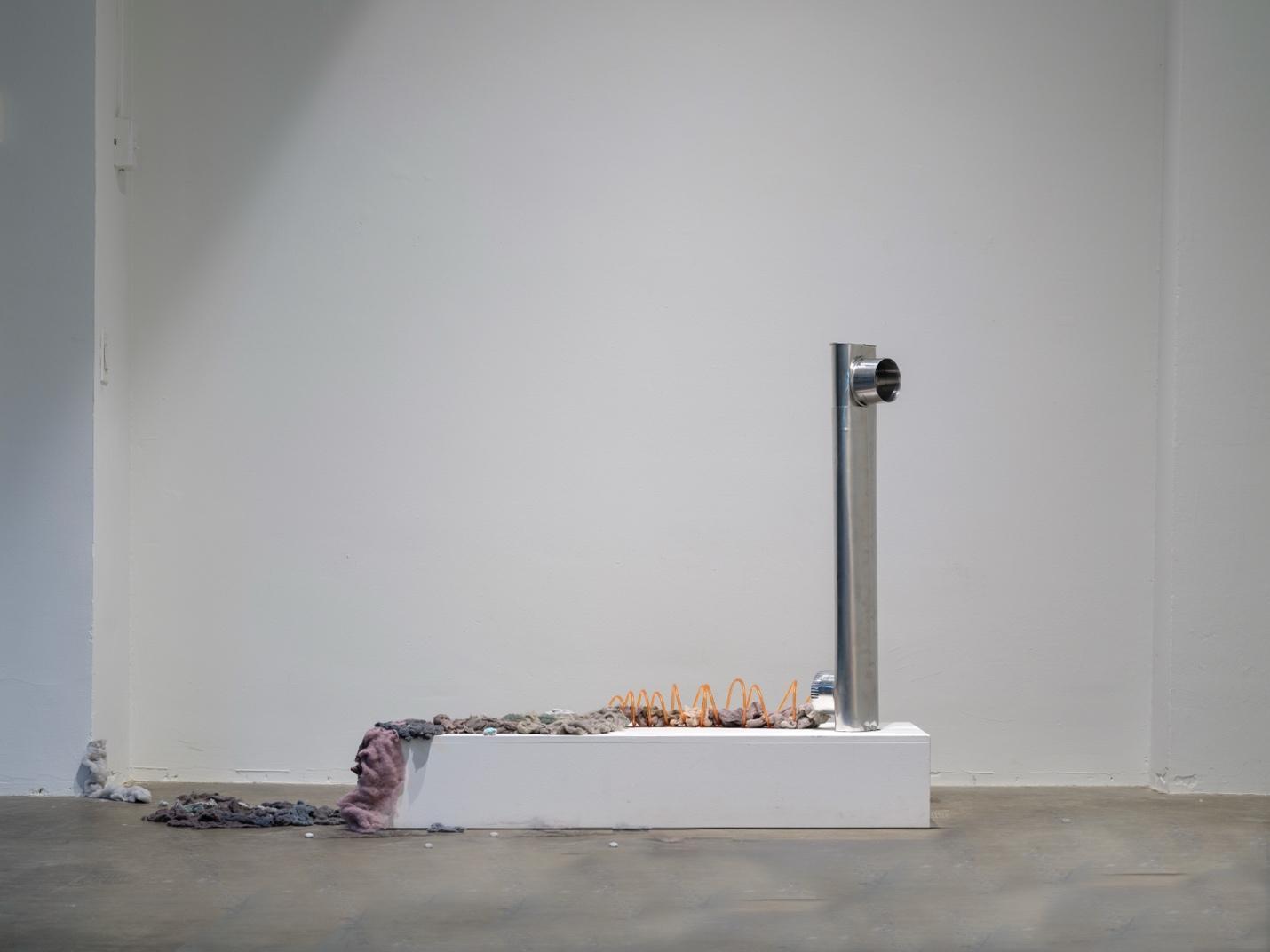
California Sunlight, 2026 (Photograph: Zengyi Zhao)
Yet for Liu, the logics of biological interdependence do not end at the boundaries of the organism. They extend into the observation of the social and historical ecologies of Los Angeles.
In the installation work” California Sunlight,” Liu collected dryer lint from various sources across the city. In the installation, the dryer duct spews out large, indistinguishable clumps of lint—a metaphor for how citizens are digested within a standardized industrial structure, reduced to residue like chyme, devoid of individual identity or unique appearance. Spewed out alongside the residue is a smooth, curled, bright orange PVC tube, which Liu jokingly refers to as a “Sunlight product.” Once a straight line that should have been hung under the real sunlight, it has now become a curled, reflective, counterfeit sunlight within the institutional structure. It sits there as if it perfectly belongs—absurdly fake and blatantly unreasonable, yet no one questions its existence.
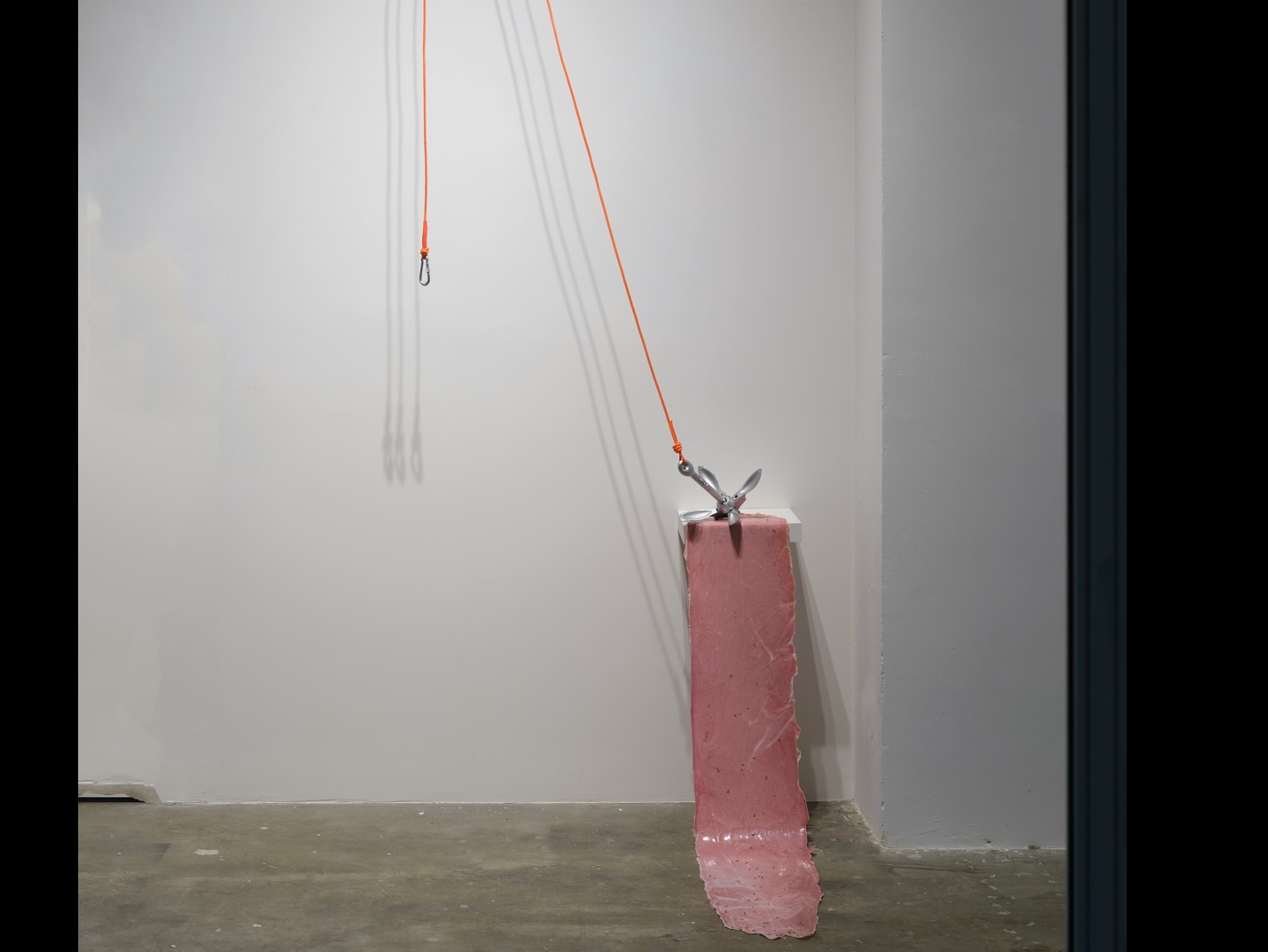
Before the Fruit, 2026 (Photograph: Zengyi Zhao)
Pushing this fabricated illusion even further, the artwork “Before the Fruit” operates as an absolute mirage—a delusion meticulously constructed by the artist from beginning to end. Liu said she got the inspiration from the fruit flies in a junkyard she passed by every day. Featuring hundreds of flies stuck to artificial, fruit-flavored hues, the piece juxtaposes a deceptive gravity with shadow-induced illusions to critique an endless, systemic delusion. Nothing is real, not even the shadows. Liu fused artificial coloring and fruit-scented gummy candy with rubber to create gigantic flypaper strips. Not a single one of the 120 fruit flies on it is real. The “fruit” that the fruit flies sacrifice their lives to approach is merely a metal anchor that looks like a flower. Even if they managed to crawl to the hook at the other end of the string, they would find absolutely nothing there. The number of the string shadow on the wall doesn’t match the number of the physical string. Even the pedestal is fake; it was just the shadow that created the pedestal-like shape in negative space. Liu also skillfully subverts all established causal relationships; the master-servant dynamic between every element and character in the installation is reversible. The flower that the fruit flies attempt to approach and feed from is fake; the fruit flies that the flower is waiting for to assist in pollination are fake; the leverage between that orange string and the anchor is fake—the anchor is not held by the rope, and there is no weight applied to the end of the string. The subjective succession is the comparison switching between the positions.
The meaning in existence is a relational concept that leads the audience as the threads in this space. Ultimately, it brings the viewer back to the initial spot; the exhibition comes full circle, “Phototaxis” assimilating the audience into phototactic moths driven to join this relentless, ever-churning biological cycle. The lightbox is isolated by the installation in the middle; therefore, the unreachability forces the viewer to turn into the witness; however, on the other hand, when people are eager to approach the lightbox and move through the space, they are gradually drawn into these cycles, much like phototactic organisms responding to an unseen source of light.
Across the exhibition, processes of growth, attraction, consumption, and decay continually echo one another. Liu turns the viewers into both contemplative witnesses and participating collaborators in the rhythms that animate the works themselves, where acts of connection, desire, and transformation are constantly unfolding.