
 Will Jones
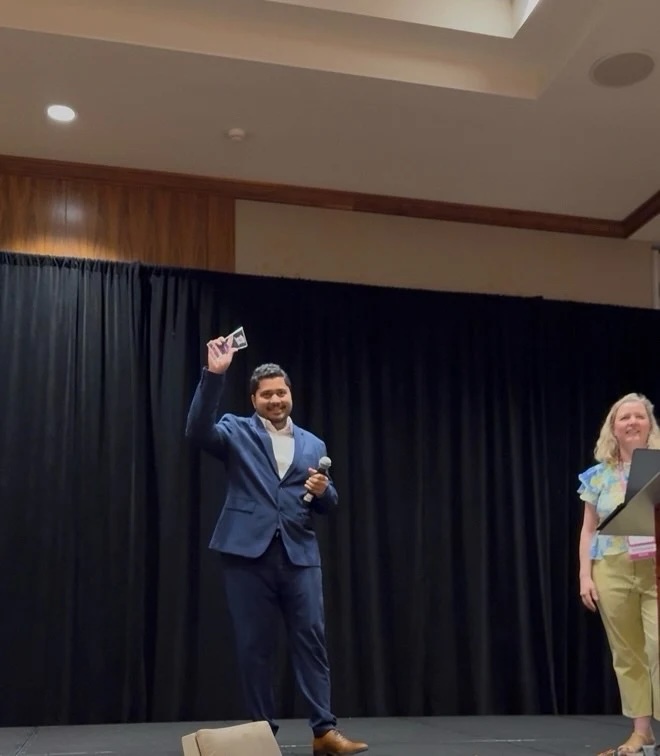
An automation program built for one of software’s most heavily regulated environments earned recognition for a result regulators rarely see: faster releases and stronger compliance evidence at the same time.
Rohit Singh Raja, Principal Software Product Quality Engineer at Clinical Ink, has received the Excellence in Automation award at the inaugural Innovate QA Awards. The recognition was presented during the Innovate QA 2026 Conference, held June 4–5, 2026, at the Westin Bellevue in Bellevue, Washington — a two-day event that, according to the event’s organizers and coverage by Software Testing Magazine, drew more than 250 attendees and 40 speakers across 35 sessions.
The awards program spanned eight categories, from Emerging QA Talent to AI and Innovation in the SDLC, and was evaluated by a panel of industry judges against published criteria. For Excellence in Automation, those criteria centered on innovation in automation frameworks, integration into SDLC and DevOps pipelines, measurable gains in speed, coverage and defect leakage, and the scalability and maintainability of automation across engineering teams — a set of standards that, in Raja’s case, was applied to one of software’s most heavily regulated categories: clinical trial technology, where a test result functions not only as an engineering signal but as regulatory evidence.
The award recognizes a body of work that runs against the industry’s default pattern for automation adoption. In many organizations, automation coverage expands by hiring specialized automation engineers, and the manual testers who understand a product’s real-world use are gradually routed around. Raja’s program instead converted existing manual testing teams into the people driving automation directly.
Why the regulated setting changes the problem
Raja has worked for over a decade in regulated healthcare software and decentralized clinical trials. According to his award submission, he leads a team of 11 highly skilled automation experts and guides 28 manual quality engineers at Clinical Ink. He has also led an entire quality organization of 68 concurrent quality engineering workstreams across teams in the United States, Europe and India, spanning manual testing, in-sprint automation, release management, validation compliance and audit readiness in the past.
In clinical trial software, a test is not only a check that something works. It is evidence. Validation coverage, requirement-to-test traceability, and the documentary record of what was verified are all subject to inspection by regulators and sponsors, which is why automation that produces fast results without a defensible evidence trail carries limited value in this setting.
Rather than replacing manual testers with dedicated automation specialists, Raja’s program converted existing manual testing teams into what his submission describes as AI-enabled quality engineers, using low-code and natural-language tooling built on generative AI so a tester could express a test case in plain language instead of code, while preserving the audit trail regulators require.
The numbers behind the award
The following figures are drawn from Raja’s award submission and reflect internal measurements at Clinical Ink rather than independently audited data, but they describe a pattern that runs counter to the usual assumption that speed and regulatory compliance trade off against each other.
- Enterprise regression execution fell from roughly two weeks to three days.
- Flaky tests — failures unrelated to the software itself — dropped by close to 75%, through self-healing scripts that adapt automatically when an interface changes instead of breaking.
- Release validation across multiple environments, regions and mobile devices compressed from about four weeks to five days.
- Production defect leakage fell by 99%, with a single low-severity issue reported in Q1 2026 and zero P1 or P2 incidents across critical releases.
- His team has contributed to the delivery and validation of more than 250 enterprise software releases and supported the launch of over 200 global clinical studies spanning therapeutic areas including oncology, diabetes, Parkinson’s and Alzheimer’s disease, IVF, and rare-disease research.
The flakiness figure is easy to skim past, but it deserves more attention than it usually gets. A test suite that fails unpredictably does not merely waste engineering time — it teaches engineers to disregard failures, which is the exact moment automated testing stops functioning as a control. Removing that noise is a governance improvement wearing the clothes of a maintenance fix.
Turning audit readiness from a fire drill into a standing practice
The second pillar of Raja’s program addresses the part of regulated delivery that consumes the most senior attention and produces the least visible output: audit readiness. Building an internal system using large language models and retrieval-augmented generation within the Clinical Ink’s team that reads across FDA regulations, ISO standards, validation documentation, SOPs and release evidence, and surfaces compliance gaps before an audit rather than during one.
Since adopting the approach, the organization has sustained a strong audit posture — a reported 100% audit success rate across 2025 and 2026, with zero major findings across recent regulatory and customer inspections. The design logic mirrors the automation work: the system does not certify compliance. It finds where the evidence does not yet support the claim, and puts that in front of a person while there is still time to act.
From five to seven days down to four hours
The third and most recent piece is also the most contested in the wider industry: an agentic test authoring framework, integrated via Model Context Protocol into the tools where product decisions already live — Jira, Figma and Confluence — generating test plans and reusable test cases while keeping human review and governance in the loop. Test planning and design cycles that previously ran five to seven business days now complete in about four hours.
Raja is precise about where the boundary sits, and it is the thesis of his entire program:
“AI should enhance human judgment in Quality Engineering, not replace it.”
In a regulated environment, that is not a philosophical preference. Someone has to be accountable for asserting that a release is fit for use in a clinical study, and that accountability cannot be delegated to the same system that generated the test cases it is now passing. Keeping a human in the review loop is what keeps the traceability chain defensible when an inspector follows it backward.
What connects all three systems is a consistent decision about where the machine stops. Generation, execution, maintenance and gap detection are automated. Judgment, approval and accountability are not. That line is drawn deliberately in each system, rather than emerging by accident from whatever the tooling happened to support.
Expanding who gets to do automation, not just how fast it runs
The organizational effect is the part Raja emphasizes most, and the part least captured by any cycle-time chart. Manual testers hold knowledge that automation engineers usually lack — what the product is actually for, which failures matter clinically, where real users behave unpredictably. Conventional automation strategies tend to route around that knowledge by replacing the people who hold it. Raja’s approach instead gives them a way to encode it directly, which is also why release velocity improved by roughly 75% without a corresponding drop in validation rigor.
A public case for responsible AI in regulated QA
Raja has spent the past year making this case publicly. He has delivered keynote sessions at IEEE, ACM, the World Forum on Cybersecurity, Machine Learning and Intelligent Systems, and the Advances in Engineering, Computing and Technology International Conference (AECTIC 2025), speaking on AI in quality engineering, responsible AI adoption in regulated systems, and empowering manual testers through AI-assisted automation. He served as Session Chair at ICAIC 2025 at the University of Houston, sits on the editorial board of ESP-IJACT, and has peer-reviewed more than 50 research papers across IEEE conferences, IJIRMPS, IJFMR and ESP-IJACT — alongside authoring 11 research papers of his own on quality engineering, AI, machine learning, cybersecurity and compliance-driven software systems.
He has also judged international hackathons including Code Olympics 2026, BlazinglyFast 2025 and Raptors Local Dawn Hack 2025, mentored capstone teams at Messiah University, and holds professional memberships with IEEE, ACM, the Project Management Institute, SOCRA, the British Computer Society and the Quality Engineering Foundation. The Excellence in Automation award adds to a recognition history that includes a Titan Award (Silver, Leadership and Quality Strategy), a Noble Award (Platinum, Emerging Quality Leadership in Clinical Research), a Globee Award (Silver, Leadership), and THREAD Research’s Golden Spot Award.
What the award recognizes
Many organizations have made software testing faster. What the Innovate QA judging panel recognized in Raja’s submission was narrower and, within regulated software, harder to demonstrate: a quality function inside one of the most heavily regulated categories of software expanded who is able to participate in automation, while the evidence that automation produces for regulators became more consistent rather than less.
Those two outcomes — broader participation and stronger evidence — are typically assumed to work against each other. Raja’s stated approach is that they do not have to, provided the boundary between automated execution and human accountability is defined in advance and enforced consistently across each system.