
 Will Jones
The former international sprinter mentored 30 athletes through the Track and Fits athlete program this year, building a route from elite sport into the industries around it.

Photo: Maya Bruney
Los Angeles will host the Olympic Games from July 14 to 30, 2028, with the Paralympic Games following in August. For two and a half weeks, the city will watch athletes at the peak of their careers. Maya Bruney, a former international sprinter and founder of the nonprofit Track+Fits, is focused on what happens to those athletes after the competition ends, and she has built a program to address it.
This year, the Track+Fits athlete program, an annual 12-week course in athlete transition and development, took a cohort of 30 athletes through weekly seminars with industry leaders, with Bruney mentoring them throughout. They graduated with updated résumés, interview practice, and digital portfolios, and participants have since gained work experience with sports brands including Sky Sports and Nike.
From Grosseto to Oran
Bruney made that transition herself. Representing Great Britain at the 2017 European Under-20 Championships in Grosseto, Italy, she won the 200 meters in 23.04 seconds after running a personal best in each round, then added bronze medals in the 4×100 and 4×400 meter relays. She came home a triple medalist at 19.
“When I lined up for the 200m final, I knew I was in the best shape I had ever been in, so all I had to do was relax,” she told Athletics Weekly the following January.
She grew up in South London, came through Blackheath and Bromley Harriers, and won English Schools titles at 100 and 200 meters as a junior. Her mother is Italian, and in 2021 Bruney transferred to the Italian team. She trained in Atlanta alongside Olympians, and her last international race was at the 2022 Mediterranean Games in Oran, Algeria, where she ran for Italy.
The Designer in the Tunnel
Design ran alongside sprinting from the start. Bruney studied at the BRIT School in Croydon, a performing arts school, and left with its Excellence in Design award before studying graphic design at the University of East London. In the summer of Grosseto she signed with Puma and went on to work on campaigns for the brand while still competing.
She launched Track+Fits as an Instagram account and blog pairing athletes with the clothes they chose to wear, a project World Athletics later described as bringing runway fashion to track and field. In 2023 World Athletics picked her as one of seven creators, chosen from thousands of applicants, for the Content Creator Programme it ran around that year’s World Championships in Budapest, making content for the federation’s TikTok, YouTube, and Instagram channels. That same year her work drew a mention in The New York Times’ coverage of track and field fashion, and Runner’s World also recognized it.
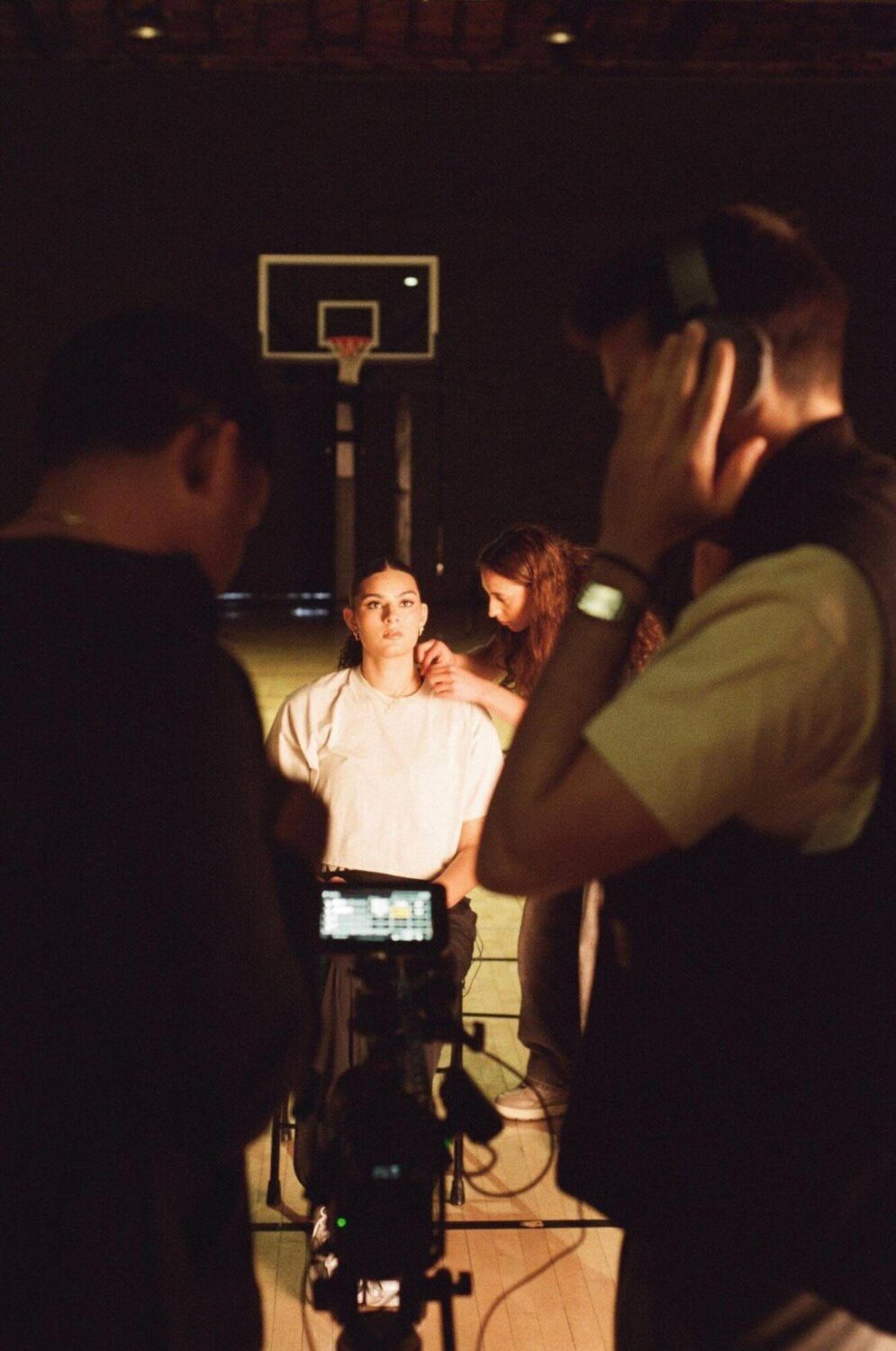
Photo: Salvador Johnson
Track+Fits also publishes the T+F Zine, an archive organized by city with Bruney on every byline. In the summer of 2023 she filed issues from Florence with JuVaughn Harrison, from Paris with Noah Lyles, from New York with Vashti Cunningham, Jelena Rowe, and Grace Cunningham, and from London with Alex Haydock-Wilson.
Her best-known work is with Lyles, on the tunnel walks he makes into the stadium before races. “Just as he is on the track, with fashion he’s a rule breaker, he’s very confident,” she told The Telegraph in 2024, adding that his walk-ins had doubled his following. She has also served as Head of Brand at I Am Athlete, the athlete-led media brand founded by former NFL receiver Brandon Marshall, and has worked with Red Bull, Under Armour, and On. “Track+Fits came out of my own move from elite athletics into design,” she says. “I wanted athletes to be seen, supported, and valued beyond the stadium.”
Inside the Track and Fits Athlete Program
The program runs once a year for 12 weeks. Athletes train in podcast production, sports photography and videography, social media marketing, and sports journalism, alongside mentorship and mental health support. Each week includes a seminar with professionals working in the industries the athletes want to enter, and Bruney mentors the cohort herself. Track+Fits also produces The Call Room, a podcast of short, unfiltered conversations led by Bruney and Vivien Olatunji.
The 2026 cohort of 30 finished with everything a hiring manager asks for: an updated resume, a digital portfolio, and interview practice. Track+Fits has also partnered with Google and Anthropic, the company behind the AI assistant Claude, to give athletes free access to professional certificate programs so they can build skills and test career options beyond sport.
“I want to create opportunities, build pathways, and support athletes beyond their competitive careers,” Bruney says.
Why the Transition Needs a Structure
Elite athletes tend to have a hard time when they stop competing. A 2024 meta-analysis in BMJ Open Sport and Exercise Medicine pooled 37 studies covering 24,732 former elite athletes and found depression at about 2.6 times the rate in the general population and anxiety at about twice the rate. Only 2% of the athletes in those studies were women, too few for the researchers to analyze them separately.
A separate 2024 study at Flinders University in South Australia surveyed 173 recently retired athletes, half of them women, and found women about 2.3 times more likely than men to report anxiety. Its authors argued that support in retirement deserves at least the attention given to health education during a career. A program that ends in a portfolio and a work placement is one practical form that support can take.
A Model Built for LA28
Bruney describes the program in terms broader than her own story. “I want to build a model for athlete development, workforce access, and entrepreneurship that has relevance well beyond my own sporting career,” she says.
Los Angeles will spend the summer of 2028 celebrating athletes at their peak. The Track and Fits athlete program is designed for the years that follow, and its graduates’ placements at Sky Sports and Nike show that the route from the track into the wider sports industry can lead somewhere concrete.